
Same-day urgent care
Emergency Dentist Bulimba
Dental pain cannot always wait. Under our Urgent Care Promise, we will do everything possible to arrange same-day care for urgent dental problems while the clinic is open.

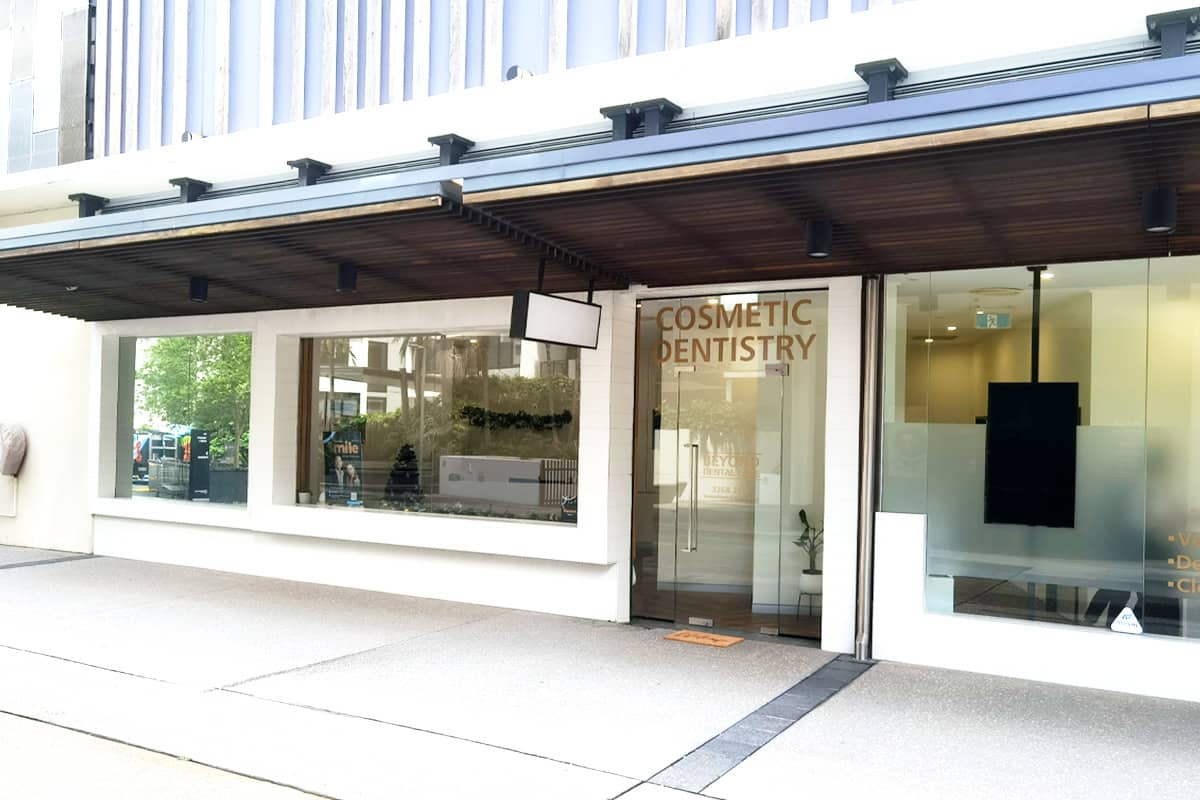
Beyond Dental Care welcomes patients from Bulimba at our Hamilton clinic in Portside Wharf. General, cosmetic and emergency dentistry from a team that takes time to explain the options before anything is decided.
View the clinic’s current public Google profile for rating and review details.
Dental pain cannot always wait. Under our Urgent Care Promise, we will do everything possible to arrange same-day care for urgent dental problems while the clinic is open.
Clear access, practical support and a clinic team prepared to explain the next step before treatment begins.
Four dentists currently welcoming new patients. No referral required.
Eligible private health fund claims can be processed through HICAPS at the clinic. Any remaining gap is payable on the day.
Free 2-hour parking is available in the Portside Wharf underground car park, about a 2-minute walk from the clinic, plus Dock A Car Park at 92 MacArthur Avenue, about a 5-minute walk away.
Our Urgent Care Promise prioritises urgent dental problems and aims to arrange same-day care while the clinic is open.
Choose a treatment and a time that suits you — it takes about a minute. Our Hamilton front desk confirms every booking personally.
A $50 deposit secures your booking — fully credited to your treatment on the day. No payment is taken online; we will call to confirm. How it works
To reserve dedicated time for every patient, online bookings are secured with a $50 deposit, fully credited toward your treatment when you attend.
Questions? Call (07) 3268 2116, or download the full policy (PDF).
Metro North voucher appointments cannot be booked online — call (07) 3268 2116 and we will hold one of the day's allocated spots for you.
Bulimba is one of Brisbane's best-known riverside suburbs — Oxford Street, the heritage ferry terminal, restored Queenslanders and a strong local community. And while it is great having almost everything right on your doorstep, finding the right dental team is worth a quick trip across the river. Our clinic is on the opposite bank, in Portside Wharf. It is a short, pleasant trip on the ferry, and if you prefer to drive, there is free underground parking a minute's walk from the door.
Whether you need a simple check-up or a longer treatment plan, the hardest step is often just making the appointment. We welcome families and individuals, offering a safe, zero-pressure space for anyone returning to dental care after a long break.
We start by listening to what brought you in. You'll be shown what the dentist can see, what needs attention now, what can wait, and which options may suit your goals, budget and timeline. We only move forward once your questions are answered and we agree on a plan that works best for you.
Our Hamilton dental practice is located at 14/39 Hercules Street at Portside Wharf — just a short trip across the Brisbane River.
Board the F1 CityCat at the Bulimba ferry terminal toward Northshore Hamilton and leave at Bretts Wharf, then continue to Portside Wharf and Hercules Street. Check the current Translink timetable before travelling, as services can change.
Drive from Bulimba toward Hamilton via your preferred route, then continue to Hercules Street and Portside Wharf. Free 2-hour parking is available in the Portside Wharf underground car park, about a 2-minute walk from the clinic, with additional free 2-hour parking at Dock A Car Park, 92 MacArthur Avenue, about a 5-minute walk away. Travel time varies with traffic, so check your preferred mapping service before leaving.
Beyond Dental Care Hamilton
14/39 Hercules Street, Hamilton QLD 4007
Phone: (07) 3268 2116
Nervous patients welcome
Dental anxiety can follow a previous painful experience, feeling rushed, uncertainty about what will happen or concern about not being able to pause. Treatment does not begin until the plan has been explained and you are ready to proceed. Before treatment, we discuss what is planned, the expected fees and the pause signal you would like to use. If you use that signal, we pause immediately, check in and continue only when you are ready.
Beyond Dental Care is a family-owned dental practice. The clinic is at 14/39 Hercules Street, Hamilton, an easy drive from Bulimba, with free parking a minute’s walk away and dentists registered with the Dental Board of Australia. We care for nervous adults and children, manage dental emergencies, and plan restorative and cosmetic treatment. Where more than one reasonable option exists, the dentist explains the trade-offs. If monitoring or a more conservative option is suitable, we explain that too.
Also standard here
A look inside our Hercules Street clinic, the team you may meet and the equipment used for examination and treatment planning.
Photographs show our Hamilton clinic, team, equipment, community activity and patient experience. They are not presented as treatment-result images and do not imply or guarantee a clinical outcome.
Your first visit
Your first appointment is an opportunity to discuss what has brought you in, understand your current oral health and decide what happens next without feeling rushed into treatment.
We discuss your medical and dental history, current concerns, previous experiences and any goals for comfort, function or appearance.
Your dentist assesses the teeth, gums, bite and oral soft tissues, with attention to the concerns you have raised.
Digital X-rays, photographs or scans are taken only when clinically indicated and useful for diagnosis or planning.
Findings, priorities, suitable treatment choices, likely stages and written costs are explained before you decide how to proceed.
56-second educational explainer
See how a first visit may move from a discussion of your concerns and goals to an examination, diagnostic records where indicated, a clear review of findings and suitable treatment options.
At your appointment, dentists explain the options clearly, work at your pace with an agreed pause signal, and offer complimentary comfort items if they help. You will know what the plan is and what it costs before treatment begins.
Not sure which treatment to choose? Call reception on (07) 3268 2116 and describe the problem or change you're considering.
Severe toothache, facial or gum swelling, a suspected dental abscess, a chipped, cracked or broken tooth, a knocked-out tooth, wisdom tooth pain or another sudden dental problem may require urgent assessment. Contact our emergency dental clinic while it is open and the team will do everything possible to arrange a same-day emergency appointment for patients travelling from Bulimba, whether or not you have visited Beyond Dental Care before. Our emergency dental clinic is just across the river from Bulimba and accepts urgent calls during opening hours.
55-second educational explainer
See how urgent dental care may progress from assessment and dental X-rays to pain relief, stabilisation and a clear plan for any further treatment.
If dental pain is stopping you from eating, drinking or sleeping, call while the clinic is open. Under our Urgent Care Promise, we will do everything possible to arrange same-day care for urgent dental problems. This applies whether or not you have visited Beyond Dental Care before. If your symptoms are severe or worsening, tell reception when you call.
The team will fit urgent care into the day's schedule wherever there is a suitable gap.
Where staffing and clinical circumstances allow, the team may extend the day to accommodate urgent care.
If our dental clinic cannot accommodate you, we will help arrange care with another Beyond Dental Care clinic or an appropriate local provider.
This promise applies to existing patients and anyone in the community with urgent dental problems or distress. It is never conditional on continuing treatment with Beyond Dental Care.
Call (07) 3268 2116Read the Urgent Care Promise (PDF)For difficulty breathing or swallowing, rapidly spreading facial or neck swelling, uncontrolled bleeding or major facial trauma, call 000 or attend a hospital emergency department.
Arrange urgent dental assessment for severe or persistent toothache, facial or gum swelling, a suspected dental abscess or tooth infection, a chipped, cracked or broken tooth, a knocked-out tooth, wisdom tooth pain, or a lost filling or crown that leaves the tooth painful, sharp or exposed. If you need an emergency dentist, contact our emergency dental clinic directly during opening hours. Urgent appointments are triaged according to the symptoms and urgency described.

After an emergency examination and dental X-rays where needed, treatment focuses on relieving pain, controlling infection and protecting the tooth or surrounding tissues. Depending on the diagnosis, care may include:
A focused examination identifies the likely source of pain, swelling or damage. Digital dental X-rays may be taken to assess decay, roots, bone, infection or a suspected fracture.
Treatment may include a temporary or permanent filling, smoothing a sharp edge, composite repair, re-cementing or replacing a crown where clinically appropriate, or a same-day CEREC crown in suitable cases.
Root canal treatment may preserve an infected tooth. Other urgent care may include drainage of a localised dental abscess where appropriate or placement of a temporary dental dressing to stabilise the area. Antibiotics are prescribed only when clinically indicated.
Emergency tooth extraction may be required when a tooth cannot be predictably restored or infection cannot be controlled by preserving it. The dentist will first assess whether repair, root canal treatment or another option is better suited.
Select the situation that best matches what happened. These steps are general first aid only and do not replace dental assessment. For current Australian guidance on knocked-out and broken teeth, see Healthdirect dental injury advice.
Do not reinsert a knocked-out baby tooth. Seek urgent dental advice.
Reception asks what happened, how long symptoms have lasted and whether swelling, trauma, bleeding or medical warning signs are involved.
The dentist assesses the painful or damaged area and surrounding tissues. Digital X-rays may be taken to check roots, bone, decay, infection or fracture.
The immediate priority is to manage pain, assess the cause and stabilise the tooth or surrounding tissues where possible.
The dentist explains what can be treated immediately, what may need another visit and the likely fees before additional treatment begins.
You leave with clear instructions and a plan for definitive treatment, review or ongoing care.
The total depends on the examination, imaging and treatment needed — a broken tooth needing a filling differs from an infected tooth needing root canal, extraction or a crown, so options and fees are explained after assessment.
Children may need urgent care after a fall, sports injury, tooth fracture, displaced tooth, toothache or swelling. The response differs for a baby tooth versus a permanent tooth, so call before trying to reposition it. We focus on keeping the child calm and explaining the next step to the parent or carer.
Eligible children may access up to $1,158 over two consecutive calendar years when 2026 is the first year of the benefit period. A period that began in 2025 remains subject to the $1,132 cap. Eligibility, balance, item restrictions and billing are confirmed before treatment.
Dental pain is always worse at night, and it is hard to judge whether something can wait until morning. If we are open, call and describe what is happening. Under our Urgent Care Promise we will do everything possible to arrange same-day care for urgent dental problems, whether or not you have visited Beyond Dental Care before.
If we are closed and the problem is not life-threatening, request an appointment online or leave a message — the team responds to these as a first priority when the clinic reopens. The dental first-aid steps above cover what helps most in the meantime.
For difficulty breathing or swallowing, rapidly increasing swelling, major trauma or uncontrolled bleeding, call 000 or attend hospital.
Our emergency dentists assess dental pain, swelling, broken teeth, dental injuries and failed restorations, then determine the immediate treatment, follow-up care or referral that fits the findings.
Call for severe or worsening toothache, facial or gum swelling, a suspected dental abscess, dental trauma, a knocked-out tooth, wisdom tooth pain, or a chipped, cracked or broken tooth. Our emergency dental team will help determine whether you need same-day emergency dental care, routine treatment or hospital assessment.
Urgent & surgical care · Bulimba
Where a tooth can reasonably be restored, we discuss those options before recommending extraction. The dentist first establishes whether the tooth can be repaired and, if removal is required, whether a simple or surgical extraction is needed.
Beyond Dental Care first assesses whether a painful, infected or damaged tooth can be retained. When repair is no longer predictable, tooth extraction may remove the source of infection or discomfort and protect the surrounding teeth and tissues. The dental team also assesses wisdom teeth that are painful, impacted, partly erupted, difficult to clean or affecting neighbouring teeth.
A visible tooth may be suitable for a simple extraction. A broken, impacted or partly buried tooth may require surgical removal. Wisdom teeth are assessed individually, and healthy third molars do not need to be removed simply because they are present.
Tooth extraction fees range from $190 to $400 per tooth, depending on difficulty. Wisdom tooth removal, surgical treatment, imaging and specialist referral are quoted after examination because tooth position, root shape and nearby anatomical structures can substantially change the procedure.
1-minute 2-second educational explainer
See how routine and surgical extractions may differ, from examination and dental X-rays to local anaesthetic, tooth removal, socket care and healing.
A repair is worthwhile only when enough healthy tooth and supporting tissue remain for the expected function and maintenance.
The fee depends on the condition and position of the tooth, access, root shape and whether removal is simple or surgical.
The booking includes assessment, consent, anaesthetic, bleeding control and aftercare — not just removal time.
Medical history, clinical examination and dental X-rays. OPG or CBCT imaging only when it answers a clinical question.
Nitrous oxide may be considered for suitable anxious patients after individual assessment.
Suitable simple and surgical extractions may be completed in the dental chair.
Tooth position, root anatomy, medical factors or surgical risk may make treatment by an appropriately qualified clinician, specialist service or hospital the safer pathway. The dentist will explain why a referral is recommended and what records or imaging should accompany it.
Advice covers bleeding, food, cleaning and activity, with next-day follow-up where applicable.
A missing non-wisdom tooth may later be replaced with a dental implant or bridge after assessment and healing. Replacement is not always immediate.
Extraction is considered after the dentist has assessed whether the tooth can be restored. Pain alone does not mean a tooth must be removed.

When decay extends too deeply or leaves insufficient structure, a filling or crown cannot be expected to provide a reliable restoration. This is the most common reason a tooth is recommended for removal.
A tooth fractured below the gum line, or with a root fracture, cannot be restored.
When infection cannot be resolved reliably with root canal treatment and restoration.
Severe loss of bone support or mobility means the tooth can no longer be held in function, even with periodontal treatment.
Repeatedly infected or retreated teeth where a further attempt is unlikely to succeed.
A fragment left in the bone that is causing symptoms or interfering with treatment.
Repeated pericoronitis, untreatable decay, damage behind the second molar, cystic change or resorption. Impaction alone does not mean removal is required.
An orthodontic tooth extraction may be planned to create space within a wider teeth-straightening plan. Removal may also form part of restorative care when a tooth cannot be retained or when the site must be prepared for a future replacement. The decision is made within the complete treatment plan rather than on the tooth alone.
The words simple and surgical describe the access required to remove the tooth. They do not indicate whether the problem matters, or whether you should expect a particular recovery. The dentist determines the approach after examination and imaging.
| Feature | Simple extraction | Surgical extraction |
|---|---|---|
| Tooth position | The tooth is visible and accessible above the gum line. | The tooth is broken, impacted, partly erupted or below gum or bone. |
| Access | The tooth is loosened and removed using elevators and forceps. | A small gum opening may be required, and bone or the tooth may be divided when clinically necessary. |
| Anaesthetic | Local anaesthetic is normally used. | Local anaesthetic is normally used; additional comfort planning may be discussed. |
| Appointment | Often shorter once the tooth is numb and accessible. | Usually longer because of access, sectioning and wound closure. |
| Recovery | Tenderness and light bleeding are expected initially. | Swelling, jaw stiffness and a longer settling period are more common. |
| Examples | Loose, decayed or damaged visible teeth. | Impacted wisdom teeth, roots below the gum, fractured teeth. |
Wisdom teeth are the third molars at the back of the mouth. They commonly emerge in the late teenage years or early adulthood, although some people develop fewer than four or none at all. A wisdom tooth can remain healthy and functional when it erupts into a useful position and can be cleaned properly.
Removal may be recommended when there is active disease or a clear risk to the wisdom tooth, surrounding gum, neighbouring molar or jaw. Monitoring may be reasonable when the tooth is healthy and the expected risk of surgery is greater than the benefit of preventive removal.
An impacted wisdom tooth has not erupted fully into a functional position. It may be covered by gum tissue, partly surrounded by bone, completely buried in bone or angled against the neighbouring tooth. Impaction alone does not automatically mean removal is required.
A partially erupted wisdom tooth can be difficult to clean because food and bacteria may collect beneath the surrounding gum flap. This can contribute to repeated pain, swelling or infection around the tooth, known as pericoronitis. A fully buried wisdom tooth may remain symptom-free but can still require periodic clinical and radiographic monitoring.
The assessment establishes whether removal is necessary, whether the tooth can be managed in the dental chair and what risks apply to the individual patient.
Imaging should answer a clinical question. It is not automatically included or required for every extraction.
No. Wisdom teeth may be retained when they are healthy, fully erupted, positioned usefully, not damaging adjacent structures and can be cleaned. Periodic clinical and radiographic review may be recommended.
Removal is more likely for repeated pericoronitis, untreatable decay, periodontal damage, cystic change, resorption, non-restorable fracture or another diagnosed problem. Preventive removal should be based on individual risk and informed consent rather than age alone.

Six stages, in order.
The dentist explains why removal is recommended, the alternatives, material risks, likely recovery and expected fees.
Local anaesthetic is administered and tested before the extraction begins. Nitrous oxide may be considered for suitable anxious patients.
The dentist loosens the tooth carefully. For surgical extractions, a small gum opening, limited bone removal or sectioning may be required.
The tooth or fragments are removed, and the socket is inspected and cleaned where indicated.
Gauze pressure is used, and stitches may be placed after a surgical extraction.
You receive instructions on bleeding, medication, eating, cleaning, smoking, activity and when to contact the clinic.

A stable blood clot forms in the socket.
No vigorous rinsing, spitting, smoking, straws or strenuous activity.
Swelling and jaw stiffness may be most noticeable after surgical removal.
Soft foods, prescribed advice, and contact the clinic if symptoms escalate.
Many patients feel substantially improved, although surgical sites may remain tender.
Return to activities according to comfort and instructions.
Initial gum healing is commonly well advanced.
Attend review or stitch removal when scheduled.
Recovery differs according to the tooth, procedure, number of sites, medical history and smoking status. Instructions from your treating dentist take priority.
Oozing, numbness and early swelling may occur.
Maintain gauze pressure as instructed, rest and avoid disturbing the socket.
A stable blood clot forms in the socket.
No vigorous rinsing, spitting, smoking, straws or strenuous activity.
Swelling and jaw stiffness may be most noticeable after surgical removal.
Soft foods, prescribed advice, and contact the clinic if symptoms escalate.
Many patients feel substantially improved, although surgical sites may remain tender.
Return to activities according to comfort and instructions.
Initial gum healing is commonly well advanced.
Attend review or stitch removal when scheduled.
Aftercare varies when stitches, sedation, blood-thinning medication, infection or medical conditions are involved. Do not stop prescribed medicine unless the treating doctor or dentist instructs you to.
During the first few days, choose foods that require little chewing and are unlikely to lodge in the socket, such as yoghurt, eggs, mashed vegetables, soft pasta, cooled soup and smooth foods eaten with a spoon rather than through a straw.
Avoid very hot, hard, crunchy, sharp or sticky foods until the area is comfortable. Seeds, nuts and small food particles can collect around healing sites.
Full list: what to eat after wisdom teeth removal.
Dry socket occurs when the protective blood clot is lost or breaks down before the socket is adequately covered. The typical warning is pain that becomes stronger several days after treatment rather than steadily improving, sometimes with an unpleasant taste or smell.
Contact the clinic for assessment and local care rather than placing home remedies or objects into the socket.
Every extraction carries potential risks. Their likelihood depends on the tooth, root anatomy, medical history, infection, smoking, medication and surgical difficulty.
The dentist explains the material risks relevant to the individual tooth before consent. General information cannot replace that case-specific discussion.
Wisdom teeth are not normally replaced. When another functional tooth is removed, replacement may be considered if the gap affects chewing, appearance, tooth stability or the wider treatment plan.
Options may include a dental implant or dental bridge after the site has healed and suitability has been assessed. Infection control, bone volume, gum health, neighbouring teeth and the intended timing of treatment influence which option may be suitable.
When future implant treatment is being considered, the dentist may also discuss socket preservation or bone grafting in selected cases. These procedures aim to support the shape and volume of the healing ridge but are not required after every extraction and do not guarantee that implant treatment will be suitable.
Act now
Contact Beyond Dental Care promptly if any of the following happens. Pain that becomes markedly worse after initially improving is the typical warning sign of dry socket.
Call the clinic first for post-extraction concerns. Our team can assess symptoms over the phone and arrange the earliest suitable appointment.
Confirm the full written quote, included imaging and any separate surgical, sedation or referral costs before treatment.
Wisdom teeth, imaging, sedation and specialist care are quoted individually after examination.
Private health insurance may contribute to eligible extraction and oral-surgery item numbers, subject to the policy, waiting periods, annual limits and remaining benefit. Beyond Dental Care accepts private health funds and can process eligible claims through HICAPS.
Payment options may be available to eligible patients through third-party providers. Approval, fees and terms are set by the provider. Ask for an itemised treatment plan before choosing a payment arrangement.
Services Australia lists tooth extractions among the basic dental services that may be covered under the Child Dental Benefits Schedule for eligible children, subject to item rules and the available balance. Orthodontic treatment and hospital dental services are not covered by CDBS.
Children's extraction decisions require age-appropriate assessment because a baby tooth can affect space for the developing permanent tooth.
The treating dentists assess whether a tooth can be preserved, whether removal is simple or surgical, and whether additional imaging or referral is needed. Treatment allocation is based on the individual tooth, medical history and clinical risk.
Wisdom teeth removal does not have one fixed Brisbane price because a fully erupted tooth can be very different to an impacted tooth buried beneath gum or bone. At Beyond Dental Care, the general tooth extraction guide is $190 to $400 per tooth, depending on difficulty. Wisdom tooth removal is assessed and quoted individually when the procedure is likely to involve surgical access or additional planning.
Beyond Dental Care provides an itemised treatment plan after examination so the actual procedure can be priced according to the tooth rather than applying a generic wisdom-teeth package to every patient.
At Beyond Dental Care, a tooth extraction generally ranges from $190 to $400 per tooth. The position within that range depends on how difficult the tooth is to remove rather than simply whether it is a front tooth, molar or wisdom tooth.
The $190–$400 range is therefore a Beyond Dental Care extraction guide, not a promise that every wisdom tooth or surgical extraction will fall within the same total treatment cost.
We do not use one fixed price for removing all four wisdom teeth because four teeth in the same patient can have very different levels of difficulty. The general extraction guide is $190–$400 per tooth, but wisdom teeth and surgical treatment are quoted after examination.
The first question is therefore not “What is the four-tooth package?” but whether each wisdom tooth has a clinical reason to be removed and what procedure each one requires.
No. Beyond Dental Care does not recommend removing a wisdom tooth merely because it exists. A healthy wisdom tooth may remain in place when it has erupted into a useful position, is not damaging another structure and can be kept clean.
Impaction by itself does not prove that a wisdom tooth needs to come out. The expected benefit of removal has to be considered against the risks of surgery for that particular tooth.
Because extraction is surgery and should have a clinical reason. A symptom-free wisdom tooth that is healthy, functional and maintainable may be better monitored than removed preventively when the expected benefit of surgery is low.
Beyond Dental Care's approach is therefore to diagnose first and remove when disease, damage, symptoms or individual risk justify it rather than recommending routine removal based on age alone.
There is no single age at which everyone should have wisdom teeth removed. Age is only one part of the assessment, and Beyond Dental Care does not recommend extraction simply because someone has reached a particular birthday.
A younger patient does not automatically need preventive surgery, and an older patient is not automatically too old for treatment. The decision is based on the individual tooth and clinical risk.
No fixed age makes wisdom tooth removal impossible. A person in their twenties, thirties or later can still have a wisdom tooth removed when there is a clinical indication and the procedure suits their health and anatomy.
The relevant question is therefore whether removal offers more benefit than monitoring for that patient, not whether the patient has passed an arbitrary age limit.
The terms describe how much access is required to remove the tooth. A simple extraction usually involves a tooth that is visible and accessible above the gum line, while a surgical extraction may be required for a broken, impacted or partly buried tooth.
“Surgical” does not automatically mean hospital treatment. Suitable surgical extractions may be performed in the dental chair, while more complex cases can be referred when that is the safer pathway.
An impacted wisdom tooth has not erupted fully into a normal functional position. It may remain partly under gum, partly surrounded by bone, completely buried in bone or angled towards another tooth.
Some impacted wisdom teeth remain symptom-free and can be monitored. Impaction is therefore a description of tooth position, not an automatic diagnosis for extraction.
Wisdom tooth symptoms should be assessed when they persist, recur or suggest infection or damage around the back molar. Pain alone does not prove that the tooth must be removed, but it does justify finding the cause.
Pain combined with swelling, fever or restricted mouth opening may require urgent dental assessment.
A badly decayed tooth may need extraction when too little healthy tooth structure remains for predictable repair. At Beyond Dental Care, removal is considered after assessing whether the tooth can still be restored.
The appearance of a severely damaged tooth does not establish the treatment on its own. The dentist needs to assess the remaining tooth, root and supporting tissues first.
When a natural tooth can reasonably be retained, Beyond Dental Care assesses that option before recommending extraction. Root canal treatment treats infection inside a tooth while keeping the root in the jaw; extraction removes the entire tooth.
The choice should be based on prognosis, not simply which procedure seems quicker. If a non-wisdom tooth is removed, the future gap and possible replacement also need to be considered.
An extraction can have a lower immediate fee than more extensive treatment to save a badly damaged tooth, but the extraction price is not always the complete financial comparison. At Beyond Dental Care, extraction is generally $190–$400 per tooth, while the long-term plan depends on whether the missing tooth will later need replacement.
For that reason, Beyond Dental Care treats removal as the last option rather than assuming the lowest initial procedure fee represents the lowest overall treatment cost.
Local anaesthetic is normally used so the treatment area is numb before an extraction begins. Patients can still feel pressure, pushing or movement because anaesthetic blocks pain rather than every physical sensation.
If sharp pain is felt, the dentist can stop, reassess the anaesthetic and address the problem before continuing. A numerical pain score cannot predict one patient's experience because simple and surgical extractions differ substantially.
Wisdom tooth removal is performed with anaesthesia appropriate to the planned procedure, with local anaesthetic normally used for in-chair treatment. During removal, pressure and movement are expected; sharp pain should be reported immediately.
Pain that becomes markedly worse after initially improving is different from ordinary post-operative soreness and should be assessed for complications such as dry socket or infection.
There is no single tooth that is always the hardest to remove. Impacted lower wisdom teeth are often more technically demanding than a fully erupted visible tooth, but actual difficulty depends on anatomy rather than the tooth's name alone.
Beyond Dental Care assesses complexity before treatment and recommends further imaging or referral when the anatomy or surgical risk makes that the safer choice.
Lower wisdom teeth can be more surgically complex, particularly when they are deeply impacted or close to important nerves, but this is not true for every patient. An upper wisdom tooth with difficult roots or a close relationship with the sinus can also require careful planning.
The dentist uses examination and appropriate imaging to assess the particular tooth instead of predicting difficulty from “top versus bottom” alone.
Not automatically. At Beyond Dental Care, local anaesthetic is normally used for suitable in-chair wisdom tooth extractions so the treatment area is numb. Nitrous oxide may be considered for suitable anxious patients after individual assessment.
The anaesthetic plan depends on surgical complexity, medical history, anxiety and the treatment setting rather than simply the number of wisdom teeth being removed.
Beyond Dental Care recommends allowing at least 40 minutes for an extraction appointment, but that is not a fixed surgery time for every wisdom tooth. The booking includes assessment, consent, anaesthetic, bleeding control and aftercare as well as the removal itself.
The planned appointment length is confirmed after the dentist knows what each tooth actually requires.
A surgical extraction provides controlled access when a wisdom tooth cannot be removed straightforwardly from above the gum line. The exact sequence varies according to tooth position and anatomy.
Surgical extraction does not mean every patient undergoes every step. The dentist uses only the access needed for the individual tooth.
Wisdom teeth removal is a common dental procedure, but every extraction has potential complications. The relevant risks depend on tooth position, root anatomy, infection, medical history, medicines, smoking and surgical difficulty.
The dentist explains the material risks relevant to the individual tooth before consent. A generic list cannot establish how likely a particular complication is for one patient.
Lower wisdom teeth can sometimes sit close to nerves that supply sensation to areas of the lip, chin or tongue. For that reason, nerve relationship is one of the anatomical factors considered before lower wisdom tooth surgery.
The risk is not the same for every lower wisdom tooth. If imaging suggests a close relationship with a nerve, the dentist can explain the specific risk and whether additional imaging or referral is needed.
The roots of some upper back teeth can lie close to the maxillary sinus. In selected extractions, removal can create a communication between the tooth socket and the sinus, which is why the relationship is considered during planning.
This complication applies to particular upper back-tooth anatomies rather than every upper wisdom tooth extraction.
Recovery varies with the number of teeth, whether removal was simple or surgical, the patient's health and individual healing. Many patients feel substantially better within about a week, while the extraction sites continue healing beyond that point.
Your treating dentist's written instructions take priority because recovery recommendations can change when stitches, sedation, infection or medication are involved.
For some patients, the second to fourth days can feel more uncomfortable than the first day because swelling and jaw stiffness may become more noticeable after surgical removal. Beyond Dental Care therefore describes days 2 to 4 as an important early recovery period rather than promising that one particular day will always be the worst.
If you are uncertain whether day-three symptoms are normal, call Beyond Dental Care rather than relying on a generic recovery timeline.
Some tenderness can still be present several days after a surgical wisdom tooth extraction. What matters is whether the overall recovery is improving or whether pain has become markedly stronger after initially settling.
A calendar day cannot diagnose the problem. A change in the direction of recovery is more useful clinically than assuming all pain on day five is either normal or abnormal.
Rest is important during early healing, particularly after surgical or multiple wisdom tooth extractions. Beyond Dental Care advises avoiding strenuous activity during the first 24 hours and then returning to normal activity according to comfort and the instructions given for the procedure.
Many patients are substantially improved by about one week, but the correct return-to-work or exercise timing should follow the individual post-operative instructions.
A simple extraction may require only a short period away from normal activities, while surgical wisdom tooth removal may justify several days of recovery. There is no fixed amount of leave that suits every extraction.
The dentist can give a more useful estimate once the number and complexity of the planned extractions are known.
The main aim during the first 24 hours is to allow a stable blood clot to form and protect the extraction socket. Disturbing that clot can increase bleeding and interfere with healing.
Gentle cleaning and salt-water rinses may be introduced after the first day when recommended in your written instructions.
During the first few days, choose foods that require little chewing and are unlikely to disturb or lodge in the healing socket. Food should generally be cool or lukewarm rather than very hot.
Return towards a normal diet according to comfort and the specific aftercare advice supplied for your extraction.
Day three is usually still within the early healing period. Beyond Dental Care's recovery guidance recommends soft foods during days 2 to 4, particularly after surgical removal, rather than using a particular food as a fixed milestone.
Progress the diet according to comfort and your written post-operative instructions rather than assuming day three automatically means normal chewing is safe.
There is no universal day on which every patient should return immediately to a completely normal diet. Eating can be advanced gradually as bleeding settles, numbness resolves and the extraction site becomes comfortable.
Many people feel substantially improved by around one week, although a surgical socket is still healing and should continue to be treated carefully.
Dry socket occurs when the protective blood clot in an extraction socket is lost or breaks down before the area has been adequately covered by healing tissue.
Dry socket is treated by assessing and caring for the extraction site; it should not be diagnosed solely from how the socket looks at home.
Dry socket usually declares itself during the early healing period rather than immediately after the tooth is removed. The important warning is pain that becomes markedly worse several days after treatment instead of continuing to improve.
Rather than treating a particular calendar day as “safe,” follow the post-operative instructions until the socket has progressed through early healing.
You cannot eliminate every risk of dry socket, but protecting the blood clot and avoiding behaviours that disrupt early healing can reduce preventable risk.
If pain starts becoming markedly worse after it had been improving, contact Beyond Dental Care rather than attempting to treat the socket yourself.
No. A salt-water rinse is not a substitute for dental assessment or treatment of a suspected dry socket. Beyond Dental Care may recommend gentle salt-water rinsing after the first day as part of routine post-extraction hygiene, but this is different from treating an established complication.
Do not pack the socket with home remedies, medication or other materials. Contact the clinic for appropriate local care.
Not routinely. Antibiotics are prescribed when there is a clinical indication rather than automatically after every simple or surgical extraction.
Take antibiotics only when prescribed for you and follow the prescribed course. New or worsening swelling, fever or other signs of infection should be reported to the clinic.
Some bleeding, tenderness and swelling are expected during early healing, particularly after surgical removal. Certain changes, however, should prompt contact with Beyond Dental Care.
Call 000 or attend the nearest emergency department for difficulty breathing or swallowing, rapidly spreading facial or neck swelling, uncontrolled bleeding, collapse or serious facial trauma.
Swelling can become more noticeable during days 2 to 4 after surgical removal, so some increase during that early period can be part of normal recovery. The concern is swelling that continues escalating, spreads or occurs with signs of infection or airway involvement.
If you are uncertain about the direction of recovery, contact the clinic rather than waiting for a particular number of days to pass.
Not every wisdom tooth requires an OPG. The dentist chooses imaging to answer a clinical question rather than ordering the same scan automatically for every extraction.
A CBCT scan is reserved for cases where additional three-dimensional information is clinically justified, such as a suspected close relationship between roots and a nerve or sinus.
Socket preservation is a bone-grafting procedure that may be considered after removal of a non-wisdom tooth when maintaining the dimensions of the healing ridge could help a future restorative plan, particularly when dental implant treatment is being considered.
The condition of the socket, infection, available bone, gum health and future replacement plan determine whether grafting is worth considering.
Not every extracted tooth needs an implant. Wisdom teeth are normally not replaced. For another functional tooth, replacement is considered according to the position of the gap and its effect on chewing, appearance, tooth stability and the wider treatment plan.
Where an implant is likely, discussing the replacement plan before extraction can be useful because socket preservation or staged grafting may be considered in selected cases.
Sometimes. An orthodontic extraction may form part of a planned teeth-straightening pathway when creating space supports the overall orthodontic treatment objective.
The tooth removal should be coordinated with the clinician responsible for the orthodontic treatment so the correct tooth and timing are clearly established.
Tooth extraction is among the basic dental services that may be covered under the Child Dental Benefits Schedule for eligible children, subject to the scheme's item rules and the child's available balance.
Beyond Dental Care can confirm the proposed treatment and the relevant claiming pathway before the extraction proceeds.
Private health insurance may contribute towards eligible extraction and oral-surgery item numbers, but the rebate depends on the individual policy rather than on Beyond Dental Care setting one universal covered amount.
Your health fund determines the actual rebate, so the most useful comparison is based on the proposed item numbers and written treatment plan.
If cost is stopping you from addressing a painful or infected wisdom tooth, begin by finding out what treatment is actually required rather than assuming you need the most expensive surgical pathway. Beyond Dental Care can provide an itemised plan after assessment.
Do not postpone assessment of significant pain, swelling or infection solely because you are assuming the eventual treatment cost. Establish the diagnosis and written fee first.
Beyond Dental Care is a private dental practice and does not describe wisdom tooth removal as a universally free service. Eligible Queensland residents may have separate public dental pathways, but public-service eligibility, urgency criteria, available treatment and waiting times are determined by the relevant public oral-health service.
For severe pain, swelling or infection, the immediate priority is obtaining appropriate assessment rather than assuming either private or public treatment will follow one standard pathway.
Patients travelling from Bulimba are assessed by the dental team at Beyond Dental Care. The dentist determines whether the tooth can be preserved, whether extraction is simple or surgical and whether additional imaging or referral is needed.
Dr PA Zaw's profile specifically lists wisdom teeth surgery and surgical extractions. Complex cases may be referred to an appropriately qualified clinician, specialist service or hospital when that is the safer treatment pathway.
Call Beyond Dental Care promptly when recovery is moving in the wrong direction rather than gradually settling. The clinic can assess the symptoms and arrange the earliest suitable review when required.
Routine post-operative soreness and swelling can occur, but severe or escalating symptoms should not be managed by waiting for the next scheduled review.
Book promptly for persistent toothache, facial or gum swelling, wisdom tooth pain or infection, a broken non-restorable tooth or pain at the back of the jaw. The dentist will first assess whether the tooth can be repaired, monitored or removed and whether dental X-rays or additional imaging are required.
Cosmetic dentistry · Bulimba
Cosmetic dentistry begins with the change you want — and the tooth structure you already have. Beyond Dental Care provides veneers, composite bonding, teeth whitening and clear aligner treatment for Bulimba, Hawthorne, Balmoral, Morningside and surrounding Brisbane suburbs.
Each option changes the appearance of teeth in a different way, at a different cost and with a different effect on natural tooth structure. The chapters below compare the materials, limits, planning and fees so treatment can be selected on evidence rather than assumption.
Cosmetic & restorative planning · Bulimba
Beyond Dental Care provides porcelain, composite and hybrid veneer treatment for patients from Bulimba considering changes to the colour, shape, length, proportion or appearance of visible teeth.
Composite veneers start from $700 per tooth, Élevé porcelain veneers start from $1,500 per tooth, and hybrid packages usually range from $4,500 to $8,000 for 4-6 teeth.
The right plan is not determined by tooth count alone. The dentist also assesses enamel, existing fillings and crowns, gum health, bite forces, adjacent tooth colour and whether whitening, orthodontics or restorative treatment should happen first.
1-minute educational explainer
See how planning, possible preparation, digital records, temporary protection, final bonding and the separate direct composite process may differ.
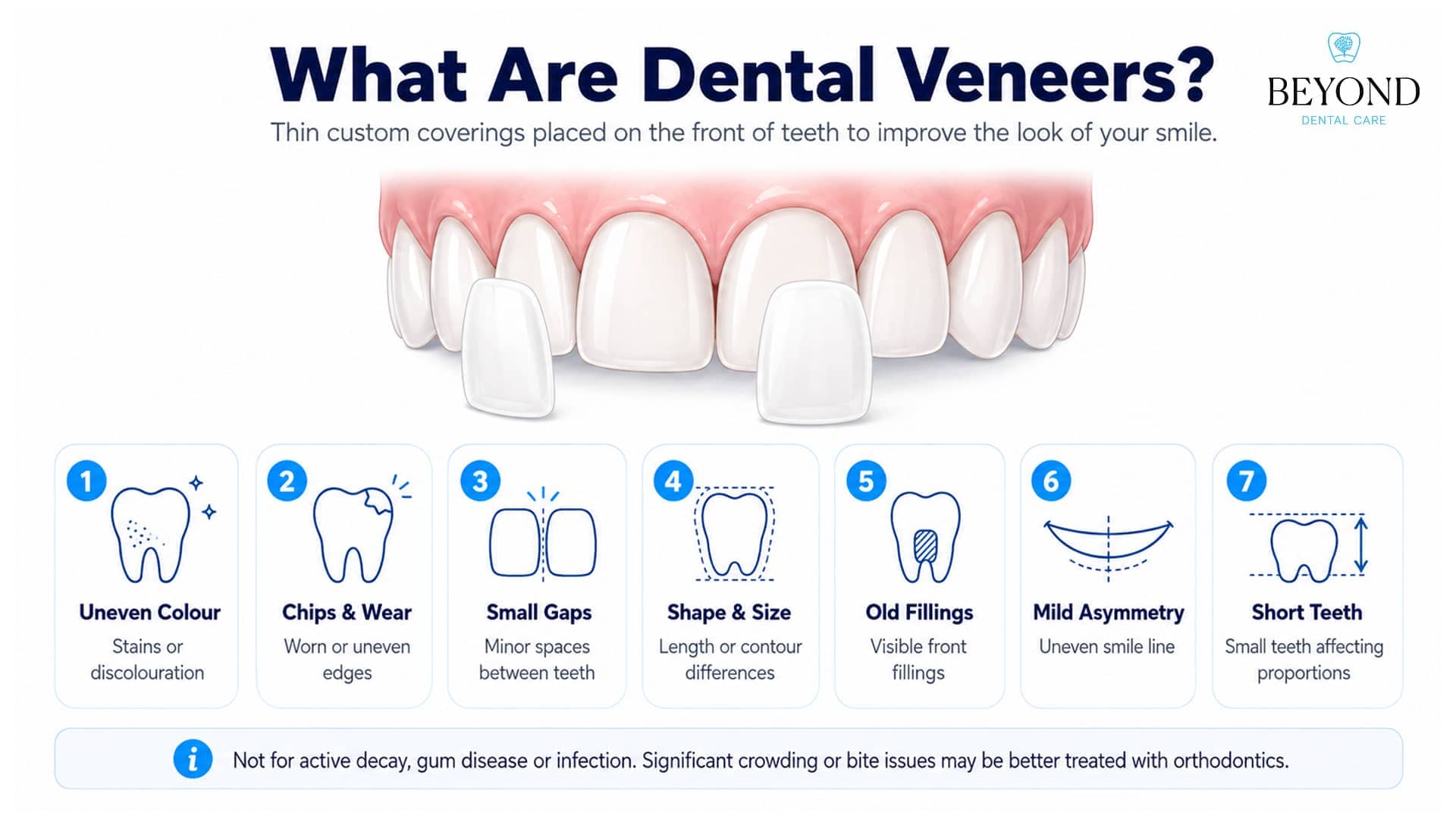
A dental veneer is a thin restoration attached to the front surface of a tooth. It can change the visible colour, shape, length or contour while preserving more natural tooth structure than a full crown in suitable cases.
Porcelain veneers are custom ceramic restorations made outside the mouth and bonded to prepared or minimally prepared enamel. Composite veneers are shaped from tooth-coloured resin, usually directly on the teeth. Hybrid treatment combines porcelain and composite on different teeth according to visibility, function, existing tooth structure and budget.

When we describe a veneer result as natural, we do not mean making every tooth identical or creating an overly uniform smile. The aim is to improve balance, symmetry, brightness and visible tooth proportions while keeping the result appropriate for your face, lips, gum line, bite and the features that still make the smile look like you.
Planning may combine photographs, digital scans, smile and facial measurements, shade discussion and a digital or laboratory-designed wax-up. Where appropriate, that proposed design can then be transferred temporarily onto the teeth as a physical mock-up or trial smile, allowing the patient and dentist to review length, contour, symmetry, speech and the way the smile appears at rest and in motion before the final porcelain veneers are made.
Brief 25-second chairside clip
This short clip shows the mock-up being revealed and checked in the mouth. It demonstrates the preview stage rather than the complete porcelain veneer procedure.
A temporary material is shaped or transferred over the teeth to preview the proposed design. It is a communication and evaluation stage rather than the finished veneer. The dentist and patient can discuss shape, visible length, symmetry, speech and overall character before irreversible treatment proceeds.
For a laboratory-made porcelain veneer case, provisional veneers may protect prepared teeth while the final ceramic restorations are produced. They also provide another opportunity to assess comfort, speech, bite and appearance. A trial mock-up and provisional veneers are related planning stages, but they are not the same thing.
Digital previews, mock-ups and provisional veneers are planning and communication tools. Not every patient requires every stage, and the final clinical result may differ because of tooth anatomy, gum response, bite, material properties and the treatment that can be performed safely.

Veneers may be considered when selected front teeth have differences in colour, contour, length, width or proportion. Planning begins with the health and position of each tooth, the surrounding gums and the bite — not with a pre-selected material or number of veneers.
A single veneer may be considered for a localised chip, discolouration, uneven contour, undersized tooth or limited gap. Matching one restored tooth to the colour, translucency and shape of the neighbouring natural teeth can require especially careful shade and surface planning.
Multiple veneers may be considered when colour, wear, spacing, asymmetric tooth shapes or differences in length affect several visible upper front teeth. Digital smile design coordinates the teeth as a group while accounting for gum display, speech, bite and untreated neighbouring teeth.
A peg-shaped or undersized lateral incisor can create an obvious difference in width, length or symmetry beside the central teeth. Composite or porcelain may be considered to alter the visible proportion, provided the tooth position, available space, gum line and bite support the planned shape.
Existing veneers are examined before removal. Depending on the material, damage and condition of the underlying tooth, the dentist may discuss monitoring, polishing, composite repair, recementation, veneer replacement or a crown where fuller structural coverage is required.
Élevé is Beyond Dental Care's name for its digitally planned porcelain veneer pathway; it is not a separate dental material category. The pathway combines premium ceramic materials, digital scanning, smile planning and condensed appointment scheduling where clinically appropriate.
Composite veneers use nanohybrid tooth-coloured resin sculpted directly onto the teeth. They may suit minor cosmetic changes, repairs or a one-day pathway where clinically appropriate.
Composite usually requires less preparation than porcelain and is often easier to repair, but it may stain, lose polish or need refreshing sooner.
A hybrid plan uses different materials on different teeth. Porcelain may be selected for central teeth where translucency and long-term colour stability are priorities, while composite may be used on adjacent supporting teeth.
Hybrid packages usually range from $4,500 to $8,000 for 4–6 teeth, with the final allocation confirmed after assessment.

| Feature | Élevé porcelain | Composite | Hybrid plan |
|---|---|---|---|
| Material | Custom dental ceramic | Nanohybrid composite resin | Porcelain and composite assigned to different teeth |
| Starting investment | $1,500-$1,850 per tooth | $700-$950 per tooth | Usually $4,500-$8,000 for 4-6 teeth |
| Appointment pattern | Planning, preparation and placement visits | Often completed in one visit for suitable cases | Coordinated porcelain and composite stages |
| Stain resistance | Generally more stain-resistant | More likely to stain or lose polish over time | Varies according to material used on each tooth |
| Repair | A fractured restoration may need replacement | Can often be repaired or added to | Managed according to the affected material |
| Typical maintenance horizon | Often around 10-15 years with individual variation | Often around 5-8 years with individual variation | Different components may need maintenance at different times |
Natural teeth can lighten but veneers cannot, so professional whitening may be completed before final shade selection.
A heavily restored, cracked or structurally weakened tooth may need fuller coverage than a veneer provides.
Moving significantly rotated or crowded teeth can reduce the preparation needed for the final design.
Healthy gums and stable teeth are required before cosmetic restorations are planned or bonded.
Build an indicative smile-planning scenario for the visible upper teeth. The calculator allows for adjacent teeth, mixed materials, whitening and a possible crown allowance. It does not determine which teeth need treatment and does not replace a clinical assessment.
Timing guide: Élevé porcelain treatment may be condensed into 2-3 visits over about 7-14 days where clinically appropriate. Individual timing varies.
This calculator is an indicative planning tool, not a quote. Final fees depend on the teeth treated, material, preparation, laboratory work, existing restorations, bite, gum health and any diagnostic or pre-treatment requirements. Hybrid package pricing applies to suitable 4-6 tooth plans. Finance and health-fund benefits are subject to separate terms.

Patients considering Élevé porcelain veneers, composite veneers, replacement veneers or a hybrid smile plan can explore a TLC dental payment plan after receiving an itemised treatment quote. TLC is an external credit provider, so approval, the available amount, interest rate, fees, repayment term and total repaid depend on its assessment and current terms.
Payment plans are provided by Total Lifestyle Credit Pty Ltd under its own lending criteria and terms. Beyond Dental Care does not provide credit advice, approve applications or guarantee a particular rate, term or repayment amount.
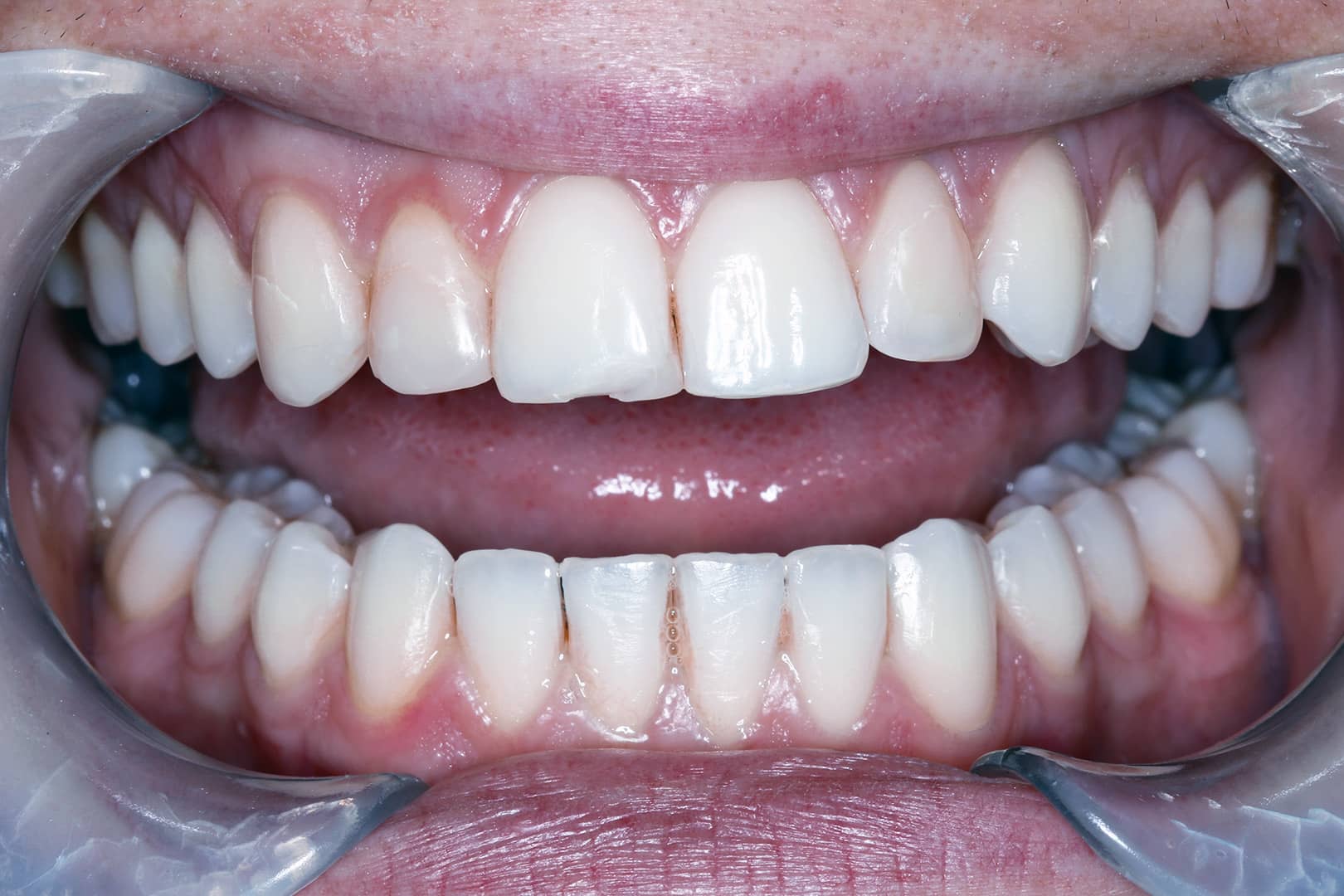
A veneers assessment considers more than the front view of the smile. The dentist examines enamel available for bonding, existing restorations, tooth strength, gum health, bite forces and any clenching or grinding.
No-prep and minimal-prep veneers may suit teeth that already have an appropriate position, size and shape, where the desired change can be achieved without making the teeth look bulky.
They are not suitable for every case. A tooth that projects forward, is significantly crowded, has large fillings or needs a major colour and shape change may require controlled preparation or a different restoration.
This is a typical laboratory-made porcelain veneer pathway. The order and number of appointments vary, and some cases do not require a physical mock-up, tooth preparation or provisional veneers.
Discuss what you would like to change and what should remain recognisably yours, then compare veneers with whitening, bonding, aligners, crowns or monitoring.
Examine teeth and gums, assess the bite and collect photographs, digital scans, dental X-rays or other records where indicated.
Plan the proposed length, contour, symmetry and shade and translate the design into a digital or laboratory wax-up.
Where appropriate, preview the proposed shape in the mouth before preparation and refine the design using patient feedback and clinical checks.
Confirm the teeth involved, material, preparation, provisional stage, laboratory process, fees, risks, maintenance and realistic treatment goals.
Use no preparation, minimal enamel preparation or conventional preparation according to the approved design, then record the prepared teeth and bite.
Where required, temporary veneers protect prepared teeth and allow appearance, speech, bite and comfort to be reviewed before the final ceramic restorations.
Check fit, shade, contour and bite before bonding the porcelain veneers, then review comfort, gum response, cleaning and maintenance.
Direct composite pathway
Unlike porcelain veneers made by a dental laboratory, direct composite veneers are built and shaped on the teeth during the appointment.
The intended proportions, contours and colour are assessed before resin is placed.
The tooth surface is conditioned and a bonding agent is applied to support adhesion.
Tooth-coloured composite is added in controlled layers and sculpted to the planned contour.
A curing light hardens the material before the edges, bite and surface are refined and polished.
The recommended approach depends on the teeth, bite, amount of change required and treatment goals. Composite veneers and smaller composite-bonding repairs are planned differently.
For suitable Élevé porcelain cases, consultation, digital scanning and tooth preparation may be coordinated into an extended first appointment, with placement possible around 7-14 days later depending on laboratory, clinical and scheduling requirements.
Composite treatment may be completed in one visit for suitable cases. Condensed scheduling does not remove clinical steps or guarantee a particular timeline.
Veneer replacement differs from first-time treatment because the existing restoration must be assessed together with the tooth beneath it. An older, stained or chipped veneer does not automatically require complete replacement. Depending on the material and clinical findings, monitoring, polishing, localised repair, recementation, veneer replacement or conversion to a crown may be considered.
| Replacement option | Starting fee | Planning consideration |
|---|---|---|
| Porcelain veneer replacement | $1,500-$1,850 per tooth | Existing veneer removal, underlying tooth assessment and colour coordination |
| Composite veneer replacement | $700-$950 per tooth | Repair may sometimes be considered before full replacement |
| Crown replacement | From $1,680 per tooth | May be relevant where the tooth requires fuller structural coverage |
A porcelain veneer with a small chip may have different repair options from a composite veneer with surface staining or edge wear. Where the underlying tooth has become heavily restored, fractured or structurally weakened, another veneer may no longer provide sufficient coverage.
Longevity varies according to material, tooth structure, bite, oral hygiene, gum health, grinding habits, diet and maintenance. Porcelain is generally more stain-resistant and designed for longer service, while composite is often easier to repair or refresh.
Veneer maintenance may involve professional polishing, review of stained margins, repair of selected composite defects or replacement when the restoration can no longer be maintained successfully. Gum recession can also make a veneer margin more visible even when the veneer itself remains intact.
Mild sensitivity can occur after preparation or bonding. Your dentist will explain eating, cleaning and review instructions for the specific treatment.
Drag the comparison handle to view this patient’s smile before and after porcelain veneer treatment.
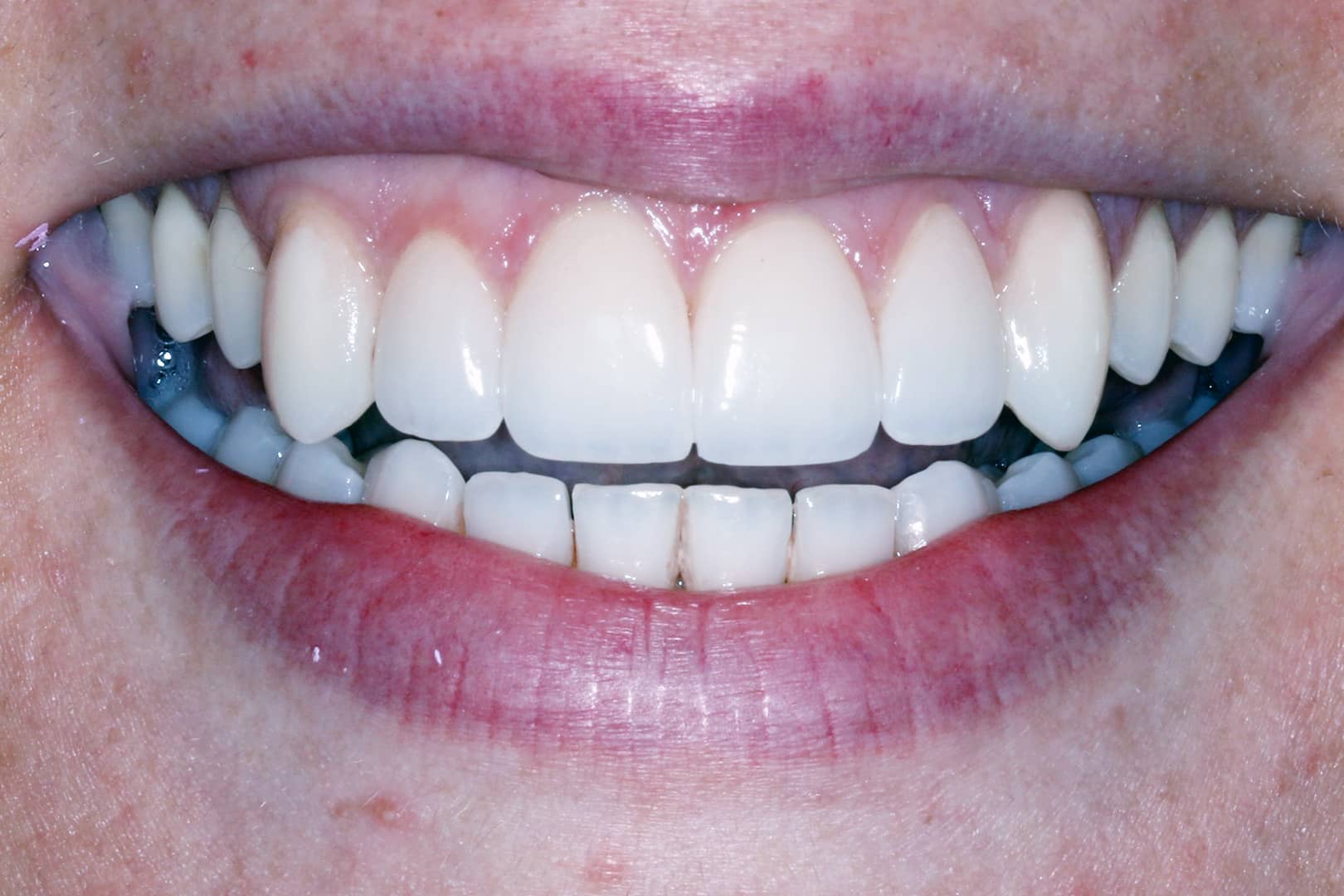
Treatment performed by Dr PA Zaw, Dentist(AHPRA registration DEN0001979187).
After photograph taken approximately 3 weeks after treatment. Individual results vary. Images show the outcome for this patient only and do not guarantee the same result.
Drag the comparison handle to view this patient’s smile before and after composite veneer treatment.
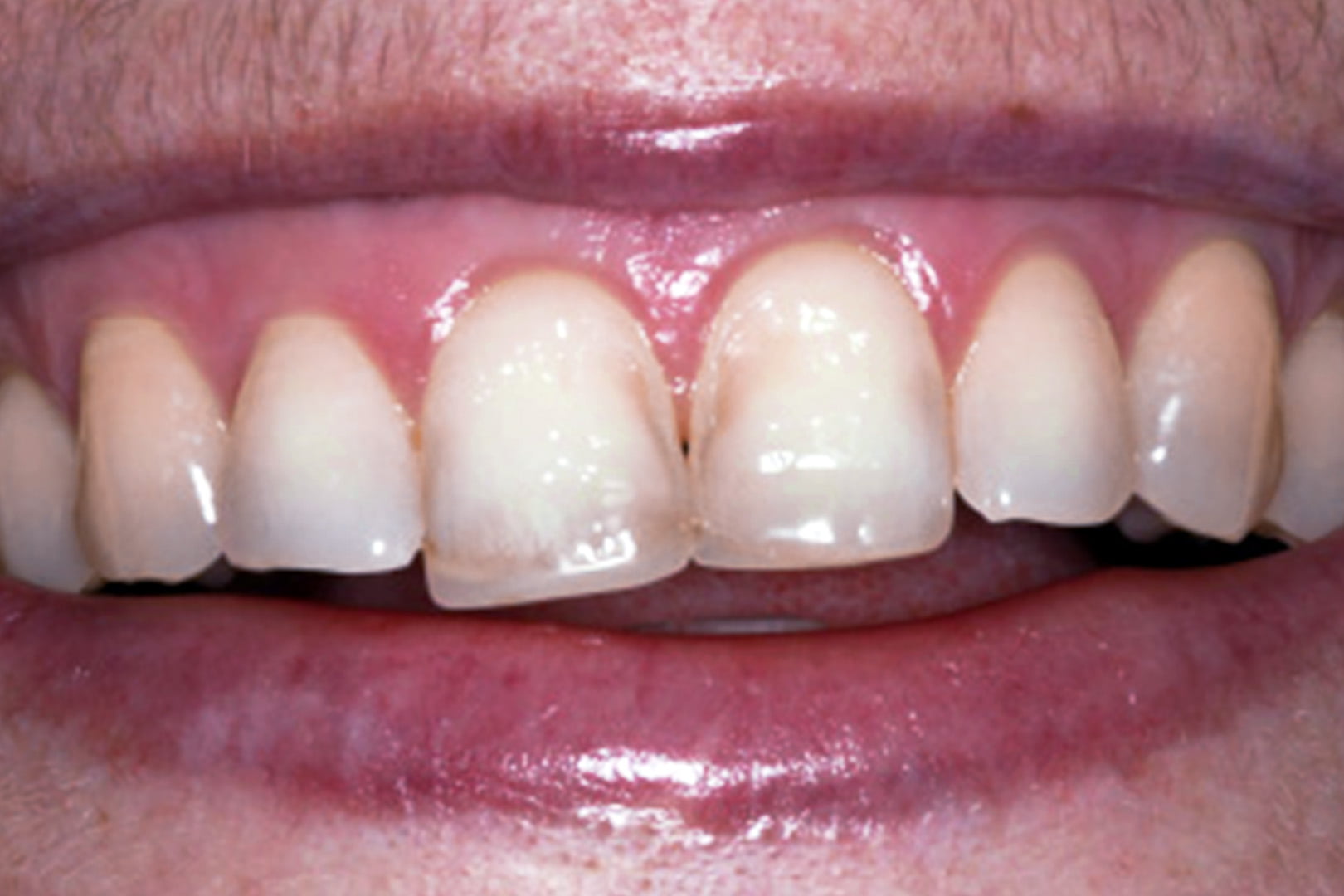
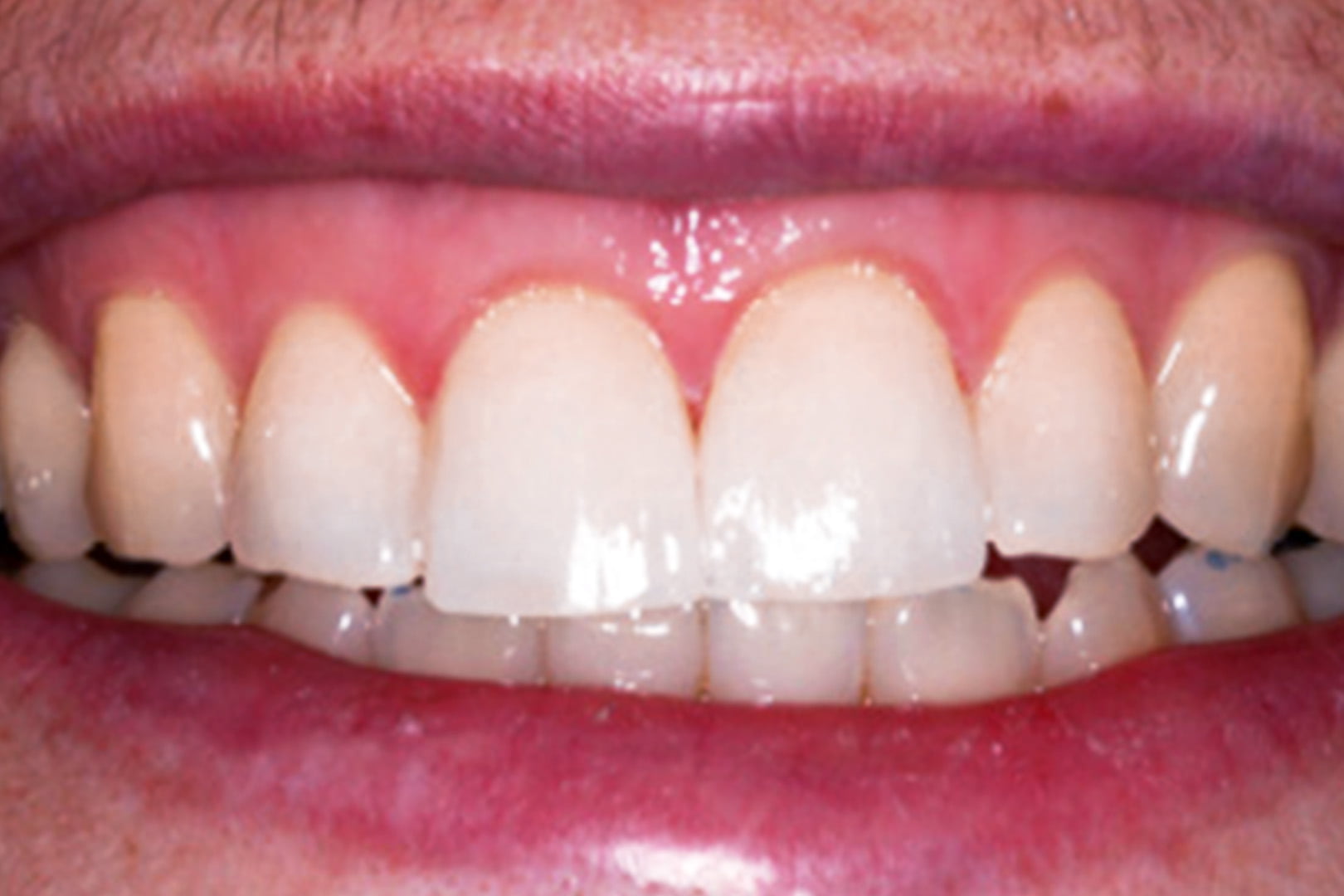
Treatment performed by Dr PA Zaw, Dentist(AHPRA registration DEN0001979187).
After photograph taken approximately 3 weeks after treatment. Individual results vary. Images show the outcome for this patient only and do not guarantee the same result.
Drag the comparison handle to view this patient’s smile before and after treatment with six composite veneers.
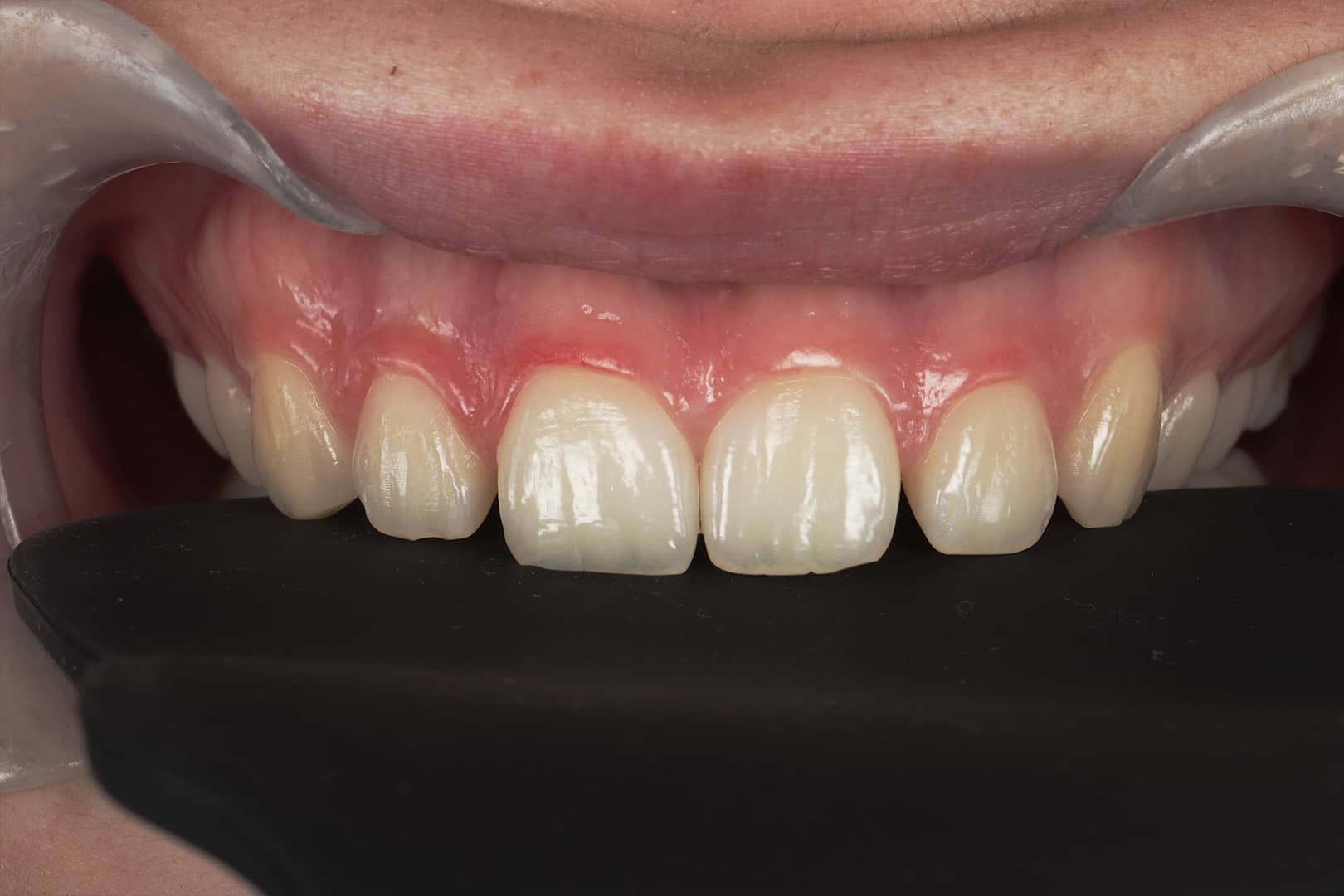
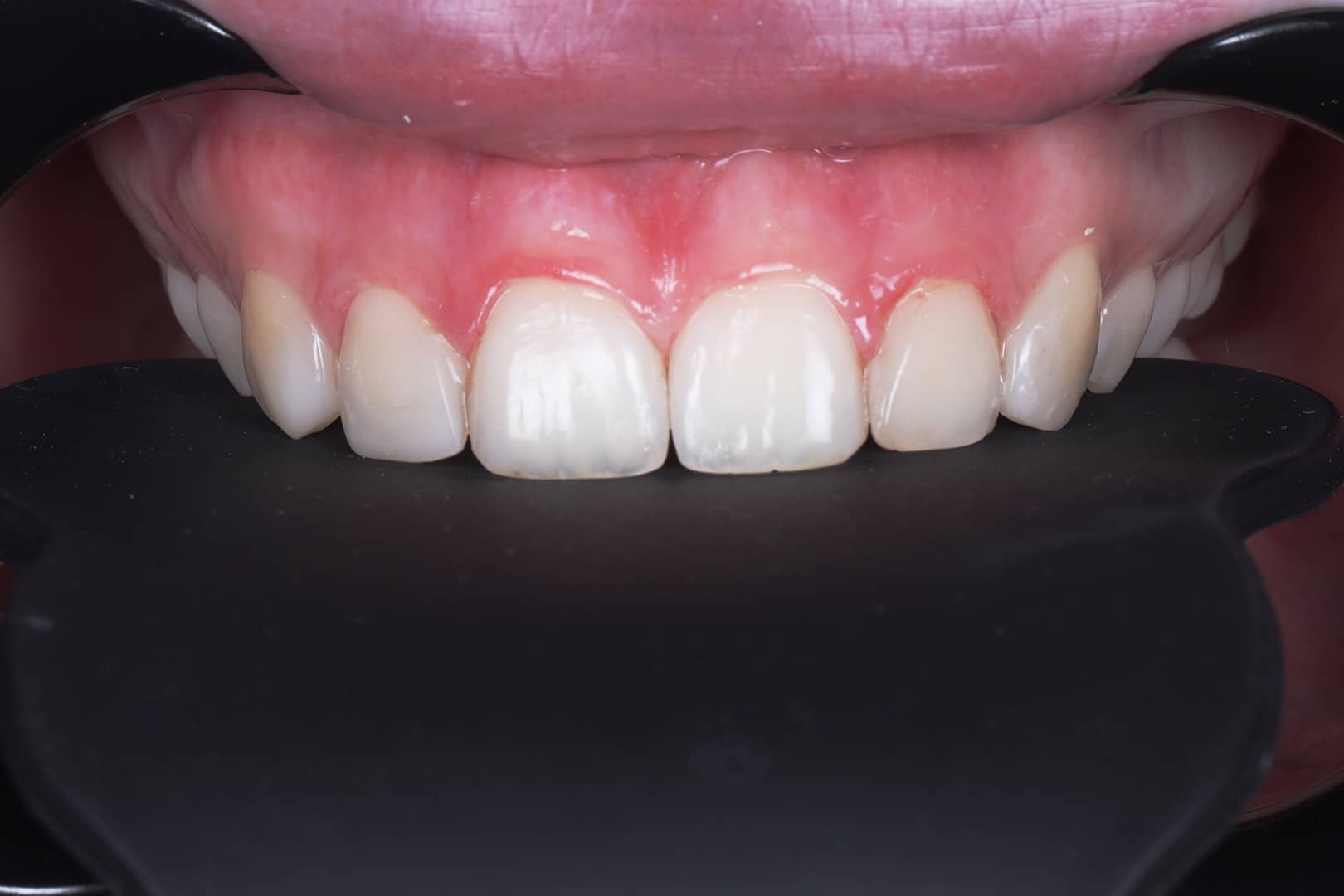
Treatment performed by Dr Jacky Shum, Dentist(AHPRA registration DEN0001659446).
After photograph taken approximately 2 weeks after treatment. Individual results vary. Images show the outcome for this patient only and do not guarantee the same result.
After veneer treatment
Temporary temperature sensitivity or tenderness around the gums may occur after preparation or bonding.
Brush and floss carefully around the veneer margins and avoid using the teeth to bite hard objects.
Arrange a review if the bite feels uneven, a veneer moves or chips, or discomfort does not settle.
When the main concern is natural tooth colour rather than shape or damage.
View teeth whiteningFor minor chips, uneven edges, small gaps or conservative shape changes.
View composite bondingWhen tooth position, crowding or bite is the main concern.
View clear alignersWhen a tooth has extensive damage or restorations needing fuller coverage.
View dental crownsWhen visible restorations are the main aesthetic concern.
View white fillingsWhen the concern is minor and monitoring or a non-invasive approach is preferred.
Our cosmetic dentists assess tooth health, enamel, existing restorations, bite forces and appearance goals before recommending porcelain or composite veneers where suitable.
Veneer cost depends on the material, number of teeth and complexity of the smile plan. At Beyond Dental Care, composite veneers are $700-$950 per tooth, Élevé porcelain veneers are $1,500-$1,850 per tooth, and suitable hybrid packages are usually $4,500-$8,000 for 4-6 teeth.
A complimentary veneer consultation is currently listed at $0, valued at up to $390 subject to offer terms. Finance and health-fund benefits are assessed separately from the clinical plan.
There is no correct veneer number that applies to every smile. Some localised concerns can involve only one tooth, while broader treatment may involve several visible upper front teeth. The dentist plans the number around what actually shows when you smile and speak.
The final number should not be selected from a package alone. Adjacent tooth colour, gum display, bite, facial proportions and the possibility of whitening, bonding or alignment first all affect the most conservative plan.
Élevé is Beyond Dental Care's name for its digitally planned porcelain veneer pathway. It is not a different biological type of tooth or a separate veneer material category; the restorations themselves are custom dental ceramic.
Élevé porcelain veneers are listed at $1,500-$1,850 per tooth. Suitability, preparation, appointment sequence and final fees are confirmed only after the dentist has assessed the teeth, gums and bite.
The main differences are material, how the veneers are made, the amount of preparation required, repair options, stain resistance, appointment pattern and cost. None of the three approaches is automatically best for every patient.
At the Bulimba service page, composite veneers are $700-$950 per tooth, Élevé porcelain is $1,500-$1,850 per tooth, and suitable 4-6 tooth hybrid packages are usually $4,500-$8,000.
Whitening may be useful before final veneer shade selection when some visible natural teeth will remain untreated. Natural tooth structure can become lighter with whitening, while porcelain, composite veneers, crowns and fillings do not bleach afterwards.
The sequence is planned individually. If whitening is appropriate, it is generally completed before the final veneer shade is chosen so the restoration can be matched to the resulting natural tooth colour rather than an earlier shade.
A veneer mainly covers the visible surface of a tooth, whereas a crown provides much broader coverage. A crown may be better suited when the remaining tooth needs structural protection, not primarily an appearance change.
The decision cannot be made from appearance alone. The dentist assesses existing restorations, enamel, tooth strength, bite forces and any previous treatment before recommending a veneer, crown or more conservative alternative.
Often, yes. Veneer planning may use photographs, digital scans, simulations, a laboratory wax-up or a physical mock-up to help communicate the proposed changes before final treatment proceeds.
The mock-up is a planning and communication tool; it is not the finished veneer. Feedback can be used to refine the design, but the final result still depends on tooth anatomy, gums, bite, material properties and what can be performed safely.
Laboratory-made porcelain veneers usually involve planning, preparation and final placement rather than one universal appointment sequence. For suitable Élevé cases, treatment may sometimes be condensed into 2-3 visits over about 7-14 days.
Condensed scheduling does not remove necessary clinical stages or guarantee a particular completion date. Composite veneers may follow a different pathway and can often be completed in one visit for suitable cases.
Veneers are not universally reversible. When enamel is removed to create space, shape the tooth or establish the planned veneer margins, that tooth has been permanently altered and will continue to require an appropriate restoration.
No-prep treatment is not suitable simply because a patient wants to avoid tooth preparation. The tooth must already have a suitable position, size and shape so that adding a veneer does not create excessive bulk or compromise the result. No-prep does not mean no risk or no future maintenance.
Yes, a single veneer can be planned to blend with neighbouring natural teeth, but matching one front tooth can be particularly demanding because there are natural teeth immediately beside it for comparison.
A perfectly invisible match cannot be guaranteed, particularly when neighbouring teeth have complex natural colour variation. Careful shade planning and appropriate material selection are therefore especially important in single-front-tooth veneer cases.
Veneers can sometimes reduce a small gap by changing the visible width and contour of the teeth beside the space. Whether that is appropriate depends on tooth proportions, the size of the gap, gum shape and the position of the teeth.
Clear aligners may therefore be more appropriate for some gaps. The dentist should assess whether changing tooth position or changing tooth shape provides the more balanced and conservative result.
Composite or porcelain veneers may be considered for an undersized or peg-shaped lateral incisor when additional width, length or contour would create better proportion within the smile.
The aim is to improve proportion, not only to make the small tooth larger. The final width and length need to fit the available space and surrounding teeth without creating an over-contoured restoration that affects cleaning, bite or overall smile proportion.
Veneers may mask selected minor differences in contour or alignment, but they do not actually move teeth. If crowding, rotation or the bite is the main problem, orthodontic movement may be a more appropriate first treatment.
The veneer page specifically notes that significant crowding, rotation or larger spaces may benefit from orthodontics first. Moving the teeth can sometimes reduce the amount of restorative treatment needed afterwards.
These are three different stages. A mock-up is mainly used to preview and discuss a proposed design, temporary or provisional veneers may protect prepared teeth while porcelain is being made, and the final veneer is the definitive restoration.
Not every porcelain veneer case requires every stage. The dentist determines whether a physical mock-up, preparation or provisional restorations are useful for the particular treatment plan.
Sometimes. A small porcelain chip may be suitable for smoothing or a localised composite repair, while a larger fracture can require replacement of the veneer. The correct option depends on why it chipped and what remains intact.
Do not keep testing a chipped veneer by biting on it. Until it has been assessed, avoid hard biting with the affected tooth and arrange a dental review to determine whether polishing, repair or replacement is appropriate.
Yes, some surface staining or loss of gloss on composite veneers can be improved with professional finishing and polishing. Composite generally requires more surface maintenance than porcelain and can stain or lose polish over time.
Composite cannot simply be made lighter with tooth-whitening gel. Depending on the cause, the dentist may recommend professional polishing, localised repair, resurfacing or replacement. Porcelain is generally more stain-resistant, although margins and surrounding natural teeth can still change appearance over time.
Sometimes. An existing filling does not automatically prevent veneer treatment, but its size, position and condition affect how much healthy tooth structure remains for bonding and whether a veneer provides appropriate coverage.
The final recommendation may therefore be a veneer, replacement filling, crown or another restorative option. Existing dental work needs to be assessed as part of the tooth rather than simply covered for cosmetic reasons.
A veneer margin can become more noticeable even when the restoration itself remains bonded. Changes in the gums, surrounding tooth colour, surface condition or restoration edge can alter how the transition between veneer and tooth appears.
A visible margin does not automatically mean the veneer has failed. It should, however, be examined if the appearance changes suddenly or is accompanied by sensitivity, gum inflammation, movement, roughness or another new symptom.
A veneer that feels loose, moves when touched or suddenly changes the way the teeth meet should be assessed rather than ignored. Continued biting on an unstable restoration can increase stress on the veneer and underlying tooth.
A high bite may place unnecessary force on the veneer or opposing teeth and can sometimes require adjustment. A loose veneer needs assessment of both the restoration and the natural tooth before recementation, repair or replacement is considered.
Veneers are intended to function as part of the normal bite, but they are not indestructible. Most everyday eating can continue once treatment is complete, while habits that place concentrated force on the front edges should be avoided.
For hard foods such as a whole apple, cutting the food into smaller pieces can reduce concentrated front-tooth forces. After veneer placement, follow the dentist's specific eating instructions because temporary restorations and newly bonded final veneers may have different considerations.
Stain behaviour depends strongly on the material. Porcelain is generally more stain-resistant, while composite veneers are more likely to develop surface staining or lose polish over time. The surrounding natural teeth and restoration margins can also change appearance.
Coffee does not affect every veneer in the same way, but frequent exposure can contribute to staining of composite and surrounding tooth surfaces. Regular cleaning and review help distinguish removable surface stain from material change or a margin that needs assessment.
Yes. A veneer covers part of a natural tooth; it does not make that tooth immune to dental decay. The tooth and veneer margins still need daily cleaning and regular examination, particularly where the restoration meets natural tooth structure.
The veneer suitability assessment therefore includes tooth health, enamel, existing restorations and gum condition. Untreated decay should be managed before a cosmetic restoration is placed.
Veneers do not have one universal effect on natural teeth. The important issue is how much preparation the individual tooth requires. Some cases can be managed conservatively, while conventional veneer preparation can permanently remove enamel.
The decision should therefore be based on whether the desired change can be achieved without excessive bulk or unnecessary weakening of the tooth. Whitening, bonding or orthodontics may provide a more conservative solution for some concerns.
There is no guaranteed lifespan for a veneer. The Beyond Dental Care page deliberately does not promise a fixed number of years because longevity depends on the material, natural tooth, bite, oral hygiene, gum health, grinding habits, diet and maintenance.
Porcelain is generally selected for greater long-term colour and surface stability, whereas composite is often easier to repair or refresh. Neither should be described as permanent or guaranteed for a particular timeframe.
The “4-8-10 rule” is an informal smile-design concept describing common numbers of upper teeth that may be considered for veneers according to how broad the visible smile is. It should not be treated as a clinical requirement or a package that every patient needs.
The appropriate number should therefore come from the clinical and aesthetic assessment, not from choosing four, eight or ten veneers before the teeth have been examined.
Veneers can change colour, contour, length and proportion, but they should be approached as a long-term restorative decision rather than only a cosmetic purchase. The condition of the natural teeth and what will happen to them over time are central to planning.
A written veneer plan should confirm the teeth involved, material, preparation, shade strategy, appointments, risks, maintenance and total fees before irreversible treatment begins.
Compare single-tooth veneers, front-teeth smile design, composite veneers from $700 per tooth, Élevé porcelain veneers from $1,500 per tooth and hybrid plans for selected multi-tooth cases. Your written plan confirms the teeth involved, material, preparation, shade planning, appointments and total fees.
Direct cosmetic dentistry · Bulimba
Tooth-coloured resin is applied and sculpted directly on the tooth to repair a chip, close a small gap or rebuild a worn edge. Suitable straightforward cases are often completed in one visit. Composite bonding in Bulimba may be used for selected chipped front teeth, worn edges, small gaps and localised shape changes. There is no laboratory stage, and straightforward cases may finish in one appointment.
· Portside Wharf
52-second educational explainer
See how tooth-coloured resin may be used to repair small chips, close narrow gaps and refine selected tooth edges through preparation, layered placement, curing, contouring and polishing.
Many straightforward cases can be completed in one appointment. Treatment is planned around the condition of the tooth, the amount of change required and the way the upper and lower teeth meet. Bonding is often conservative and repairable, but it is not the right solution for every crack, gap, colour concern or alignment problem.
Composite bonding is a direct dental treatment. Rather than sending a restoration to a laboratory, the dentist places tooth-coloured composite resin directly onto the tooth and builds the required shape in layers. Each layer is hardened with a specialised curing light before the final contour, bite and surface are refined.
A small chip may need resin only on one edge, while a composite veneer covers most or all of the visible front surface.
The material may be similar, but the purpose differs. A filling restores tooth structure lost to decay or damage. Cosmetic bonding primarily changes contour, proportion, colour or symmetry.
Composite bonding works best when a conservative change can be achieved by adding and shaping a controlled amount of tooth-coloured resin. It may be considered for selected chipped front teeth, worn incisal edges, small gaps, localised enamel defects or differences in tooth shape, provided the tooth is healthy and the proposed resin can tolerate the bite forces.
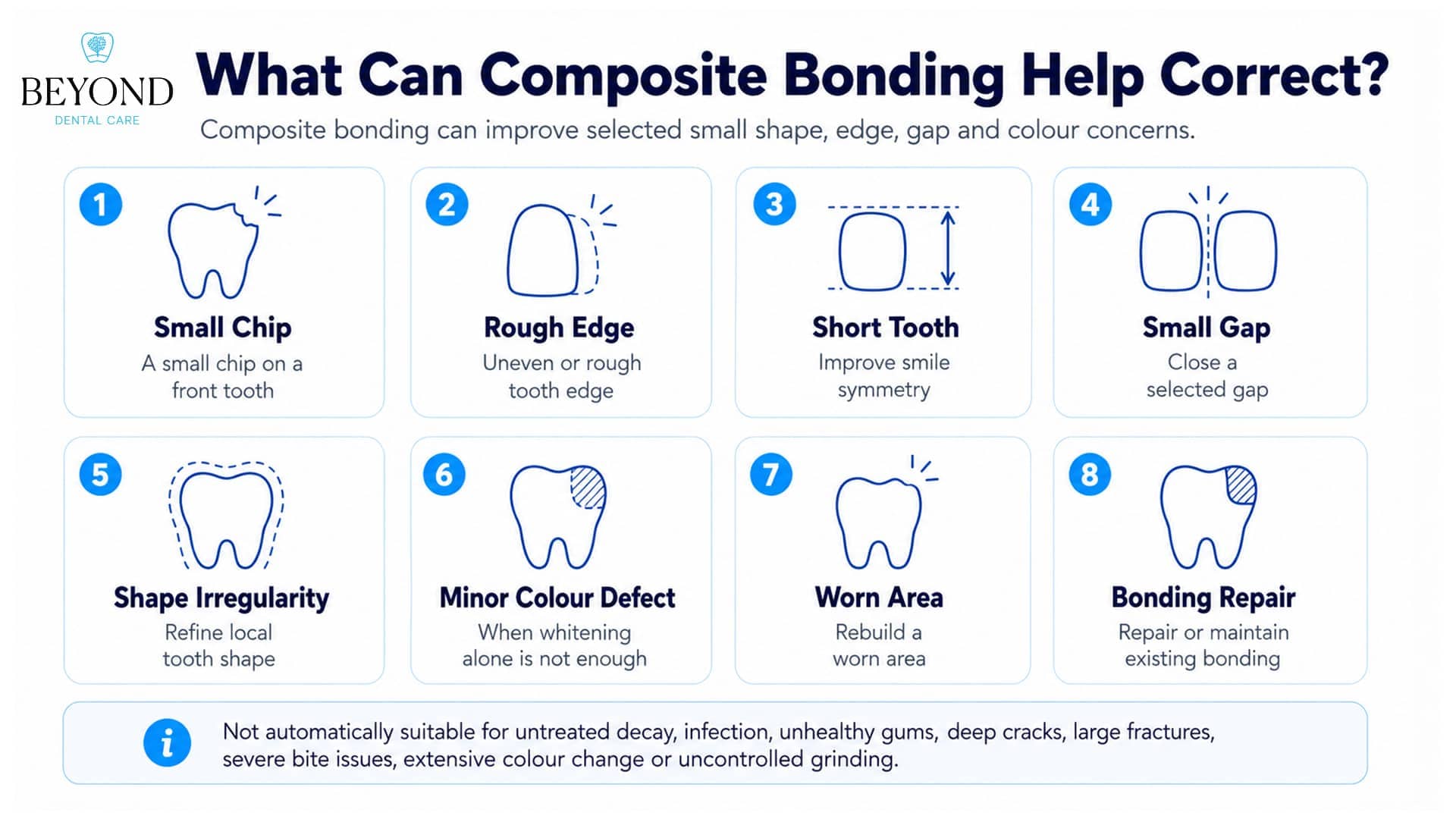
Composite resin may rebuild a small chip or missing section of the biting edge. The cause, depth of damage and tooth vitality must be assessed before the colour, translucency and final contour are reproduced.
Composite gap closure, also known as direct resin diastema closure, may reduce a selected space by adding material to the neighbouring teeth. The dentist checks that the final widths, contact points, gum access and bite will remain appropriate.
Bonding may add length, improve a localised shape irregularity or alter the proportion of an undersized or peg-shaped lateral incisor. The proposed shape must coordinate with the neighbouring teeth, gum line and available space.
Selected areas of discolouration, enamel hypoplasia or fluorosis may sometimes be masked with layered composite resin. The cause and depth of the colour change must first be diagnosed because bonding is not suitable for every dark or altered tooth.
Composite may restore a small superficial enamel defect or selected non-structural crack after assessment. Pain on biting, deep fracture lines, recurrent chipping or structural weakness require diagnosis before cosmetic masking is considered.
Incisal edge bonding may rebuild selected worn front-tooth edges after the cause of the wear has been assessed. Grinding, clenching, erosion and bite relationships may need to be managed to reduce repeated fracture or wear of the new resin.
The same direct-resin technique can be used for a focused repair, an edge adjustment, a gap closure or broader visible-surface coverage.
A focused repair may rebuild a chipped front tooth, restore a worn corner, close a narrow gap or refine one irregular edge without treating the surrounding teeth. This may include a chipped tooth repair, localised enamel defect repair or shade-matched resin restoration on one visible tooth. The dentist selects resin shades and opacity to blend with neighbouring enamel, and straightforward single-tooth treatment is often completed in one appointment.
Incisal edge bonding may restore length or repair an uneven biting edge on one tooth or several neighbouring teeth. The final contour is checked during speaking, chewing and guidance movements so the new resin is not placed under avoidable stress.
Diastema closure with composite uses bonded resin to alter the width and contact of selected neighbouring teeth. The dentist checks tooth proportions, gum shape and whether the new contact will remain cleanable. Clear aligners may be more appropriate when tooth movement would create a better result.
Several teeth can be treated to improve symmetry, edge position or proportion. Multiple-tooth cases need more planning than a small chip repair. Clinical photographs, scans, a trial shape or digital smile planning may be used to agree on the intended outcome before resin is applied. Broader treatment may also be described as direct resin smile reshaping when several teeth require coordinated edge, contour or proportion changes.
A composite veneer uses resin across most or all of the visible front surface of a tooth. This can change colour and contour more broadly than localised bonding. Composite veneers are placed directly by the dentist and can often be completed without laboratory fabrication, but they require more material, shaping and maintenance than a small bonded repair. For broader changes to the front surface of a tooth, compare the porcelain and composite options in Dental Veneers Bulimba.
When tooth structure has been lost through decay or fracture, composite resin may be used as a restorative filling rather than a purely cosmetic addition. The extent of damage determines whether a direct filling, bonded onlay or crown provides the most reliable protection. When decay or fracture requires restoration rather than cosmetic reshaping, see White Fillings Bulimba.
Answer a few simple questions about the tooth, the change you want and any warning signs. You will get a practical next step — not a diagnosis.
Suitability depends on the health of the tooth, the scale of the requested change and how the bonded area will function in your bite. A treatment that looks straightforward from the front may be exposed to heavy contact when you chew or move your jaw.
Bonding is often described as reversible because it may require little or no enamel removal. That description is not universal. Some teeth need surface preparation, contouring or removal of old material. The dentist should explain what will be changed and whether future removal or replacement could affect the tooth.
The exact sequence depends on whether treatment involves a small repair, gap closure, edge bonding or broader composite coverage. For suitable straightforward cases, same-day composite bonding in Bulimba may be completed in one appointment; multiple teeth or more detailed smile changes can require additional planning or visits.
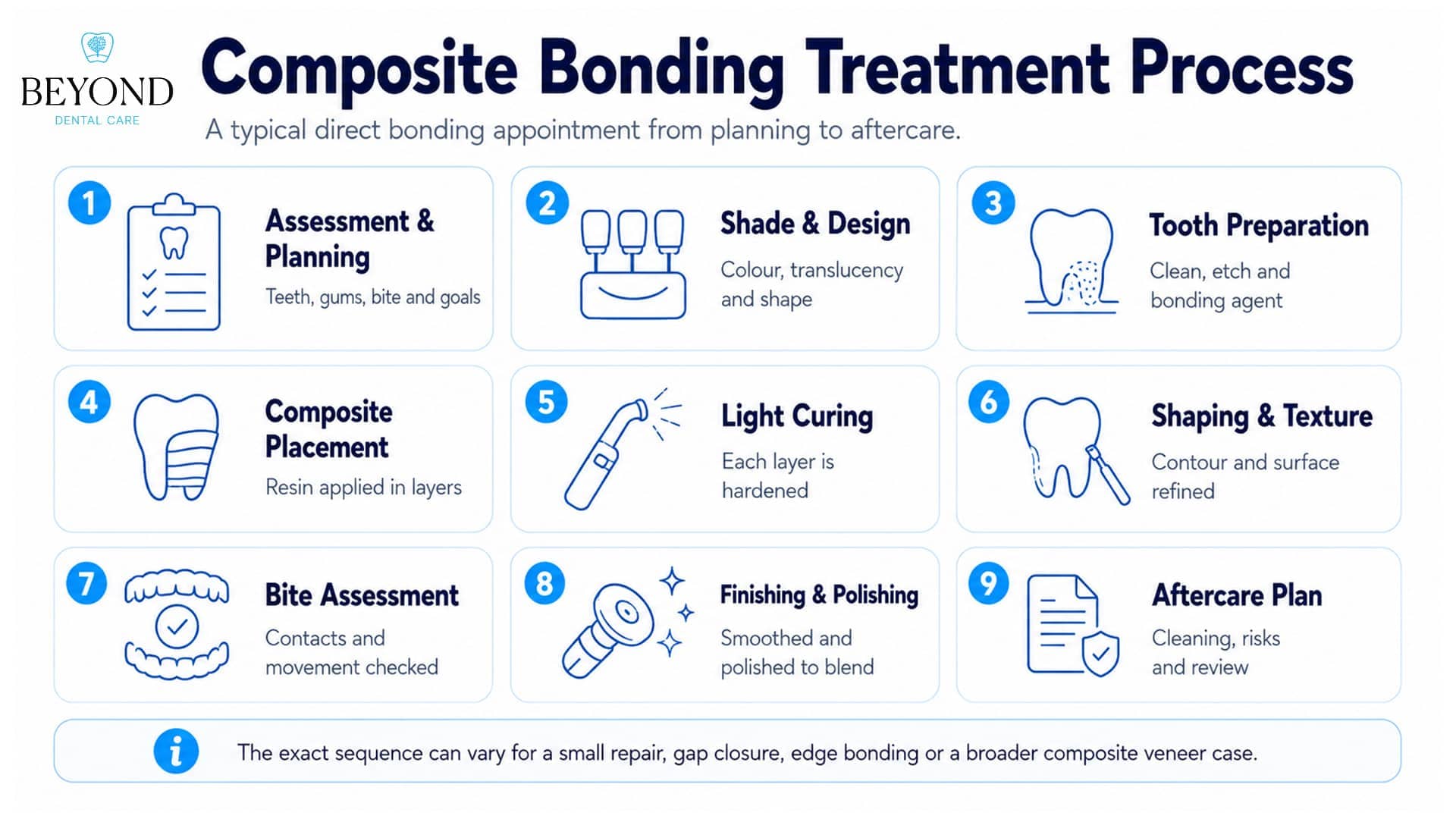
The dentist examines the tooth, gums, existing restorations and bite, then discusses the change you want to make.
The resin colour, translucency, shape and intended proportions are selected. Photographs, scans or a trial design may be used for more involved cases.
The surface is cleaned. Minimal roughening, etching and a bonding agent may be used to create a reliable connection between enamel and resin.
Resin is applied in controlled layers. Different shades and opacities may be combined to reproduce natural tooth colour and depth.
Each layer is hardened with a specialised curing light.
The dentist refines the edge, contour, line angles and surface texture.
The bonded tooth is checked during normal closure and functional movements. High contacts are adjusted.
The resin is smoothed and polished to reduce roughness and help it blend with the surrounding enamel.
The dentist explains cleaning, staining, chipping risks and when to return for review, maintenance or repair.
Many surface-only cosmetic bonding procedures require minimal preparation and no local anaesthetic. This is not a guarantee. Anaesthetic or additional preparation may be recommended when the tooth is sensitive, decay is present, old restorative material needs removal or the repair extends into deeper tooth structure.
Tell the dentist if you are worried about discomfort, have sensitive teeth or have had a difficult dental experience. The appointment can be paced around your needs, and Comfort Menu options are available during treatment.
A small single-tooth repair commonly takes around 30–60 minutes. Beyond Dental Care's current service information states that many bonding cases are completed in one 60-minute appointment. Treating several teeth, planning composite veneers or rebuilding worn teeth can take longer and may require more than one visit.
One appointment does not mean one standard design. Time is needed to select colour, layer the material, reproduce natural contour, check the bite and polish the surface. The dentist will confirm the expected appointment length after examining the teeth.
Composite bonding at Beyond Dental Care is priced from $300 per tooth. The final fee depends on what is being repaired or changed, how much resin and clinical time are required and whether treatment involves one localised area or broader coverage of the tooth.
Treating several teeth requires more planning, shade control, layering, shaping and polishing.
A small chip repair generally requires less material and time than a full composite veneer or multiple-tooth smile design.
Layered shade effects, edge translucency, texture and symmetry may require additional clinical time.
Decay, old bonding, failing fillings, cracks or worn edges may require restorative treatment before or during bonding.
Where the bonded area carries heavy contact, additional planning, bite adjustment or protective care may be required.
Future polishing, chip repair, reshaping or replacement is quoted according to the work required.
Composite bonding is one option. The most appropriate treatment depends on whether the main concern is colour, tooth position, a focused defect, broad surface change or structural weakness.
Both treatments use tooth-coloured composite resin. The difference is mainly the amount of the tooth being covered and the scale of the planned change.
Composite bonding and porcelain veneers can both change the visible shape and colour of teeth, but they differ in material, preparation, treatment process, stain resistance, repair and expected maintenance.
Teeth whitening. Whitening changes natural tooth colour without adding resin. Composite does not whiten after placement.
Clear aligners or Invisalign®. Moving teeth may improve alignment without making them look straight by adding material.
Composite bonding. Resin can be added directly to the selected area.
Composite veneers or porcelain veneers. Full-surface coverage provides greater control over the visible tooth face.
Onlay or dental crown. The tooth may need protection rather than a cosmetic surface addition.
Tooth-coloured filling or another restoration. The disease and damaged structure must be treated before cosmetic reshaping.
The concern may be better addressed with teeth whitening, clear aligners, a dental crown or a tooth-coloured filling, depending on whether the main issue is colour, position, strength or lost tooth structure.
Composite resin is selected to match the tooth colour at the time it is placed. Whitening gel changes natural tooth enamel but does not lighten existing composite bonding. If you want a lighter overall shade, whitening is usually planned before final resin shade selection.
The dentist will advise how long to wait after whitening before bonding so the shade can settle and the tooth surface is suitable for adhesive treatment. Existing composite may appear darker after the surrounding teeth whiten and may need polishing, repair or replacement.
Because composite resin will not lighten later, review Teeth Whitening Cosmetic Dentist Bulimba, QLD 4171 before the final bonding shade is selected.
This consented case shows composite bonding used after orthodontic treatment. Treatment scope, tooth shape, bite and colour are assessed individually.
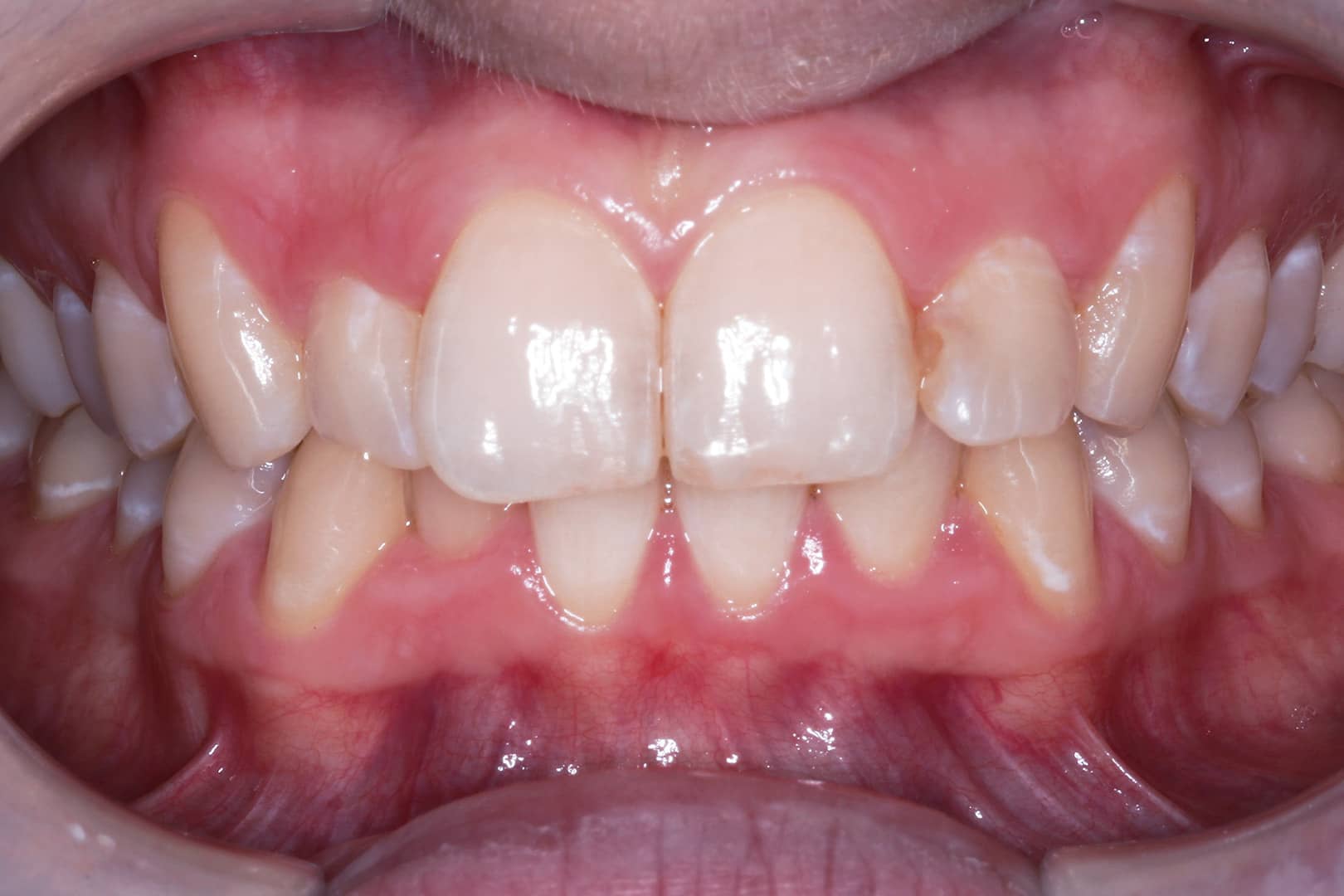

Treatment performed by Dr Mitesh Vasant, Dentist(AHPRA registration DEN0001791968).
After photograph taken approximately 6 months after treatment.
Individual results vary. Images show the outcome for these patients only and do not guarantee the same result.
Composite bonding is commonly used for conservative repairs and cosmetic changes, but the material and tooth remain exposed to normal oral forces. Understanding the limitations helps patients compare bonding with other options.
Composite bonding is not permanent. Bonded material may need a touch-up, repair or replacement over time. Its useful life varies with the size and location of the restoration, bite forces, habits, oral hygiene, staining and maintenance.
Repairable, but not permanent Useful life varies with the size and position of the bonding, bite forces, habits, diet and ongoing care.
Brush twice daily with fluoride toothpaste and clean between the teeth every day. Attend Check-up & Clean appointments so the dentist can examine the bonded margins, tooth and gums.
Avoid using bonded teeth to open packaging or bite hard non-food objects. Reduce nail biting, pen chewing and ice chewing that can chip thin resin edges. Tell the dentist about grinding or clenching so protective options can be discussed where appropriate.
Expect coffee, tea, red wine and tobacco to contribute to surface staining over time. Ask whether professional polishing can refresh a dull or stained surface before replacing the bonding.
Contact the clinic if the tooth feels high, rough, sharp, mobile or painful, or if a piece breaks away.
Many bonding procedures are conservative and completed without laboratory stages, but patients can still feel anxious about the appearance, comfort or permanence of the result. The dentist should explain the planned shape, preparation and maintenance before treatment begins.
The treatment plan will show the teeth involved and the total fee. Payment-plan options may be available through third-party providers and are subject to their approval criteria, terms and fees.
Private health-fund benefits depend on the clinical purpose, item number, level of extras cover, annual limits and waiting periods. Cosmetic bonding may not receive the same benefit as a restoration placed to treat damage or decay. Ask the clinic for treatment details and confirm your expected rebate directly with your fund.
Compassionate release of superannuation should not be presented as a routine pathway for elective cosmetic bonding. Eligibility is determined externally and depends on the purpose and circumstances of the proposed dental care.
When composite bonding involves several teeth, compare the available dental payment plans with the total treatment fee and maintenance requirements.
Clear starting price of $300 per tooth, with the final fee confirmed after assessment.
Treatment is completed directly by our dentists.
Shade selection, layering, shaping, bite assessment and polishing completed as part of the clinical procedure.
One-appointment treatment available for many straightforward cases.
Digital photographs, scans, smile planning or trial designs available where clinically useful.
Access to teeth whitening, clear aligners, veneers, fillings and crowns when bonding is not the most suitable option.
Repair and maintenance can often be completed directly in the clinic.
Comfort Menu options for patients who feel anxious or want additional support during treatment.
Our cosmetic dental team assesses chipped front teeth, uneven edges, small gaps and composite veneer planning. Suitability depends on tooth health, enamel, existing restorations, bite forces and the change you want to make.
Book an assessment to discuss chipped front-tooth repair, incisal edge bonding, composite gap closure, peg-lateral reshaping, a localised enamel defect or broader direct resin treatment. The dentist can compare bonding with whitening, aligners, composite veneers, porcelain veneers, fillings or crowns according to the tooth, bite and intended change.
Cosmetic dentistry · Bulimba
Choose a faster in-chair appointment, a gradual take-home course, or combine both for continued whitening and future maintenance.
Professional teeth whitening, also known as dental bleaching, lightens discolouration within natural tooth structure. It may improve yellowing and stains associated with coffee, tea, red wine, tobacco and normal ageing, but it does not change the colour of crowns, veneers or tooth-coloured fillings. Zoom in-chair whitening costs $799, Pola take-home whitening costs $399, and the combined Pola & Zoom package costs $975.
57-second educational explainer
See how in-chair whitening may include suitability assessment, protection of the lips and gums, controlled gel cycles, shade review and optional take-home trays.
Choose your treatment pace
The most appropriate method depends on the type of tooth discolouration, the condition of the teeth and gums, existing restorations, sensitivity, preferred treatment pace and how future whitening touch-ups will be managed.
Clear treatment pricing
Compare the current treatment fee and what is included before you book.
Custom trays, Pola whitening gel and instructions for home use.
Professional in-chair whitening performed by a dentist in approximately 90 minutes.
Zoom in-chair whitening plus custom Pola trays and gel. Saves more than $200 compared with booking separately.
Why colour changes
Tooth discolouration may develop on the outer surface or within the tooth itself. Identifying whether the change is mainly extrinsic staining, intrinsic discolouration or a problem affecting one individual tooth helps determine whether professional whitening is likely to provide an appropriate result.
Coffee, tea, red wine, tobacco and strongly coloured foods can contribute to staining on the outer surface of the teeth. A professional clean may remove plaque, tartar and some external stain before whitening begins. Whitening gel then lightens natural tooth structure rather than simply polishing the surface.
Colour can also change within enamel or dentine because of ageing, developmental changes, previous trauma or other internal factors. Intrinsic discolouration can respond differently from surface staining, and some cases require a different cosmetic or restorative approach.
A single dark or grey tooth should be examined before whitening, particularly when the colour changed after trauma or previous root canal treatment. Internal tooth discolouration may require a different approach from standard external bleaching.
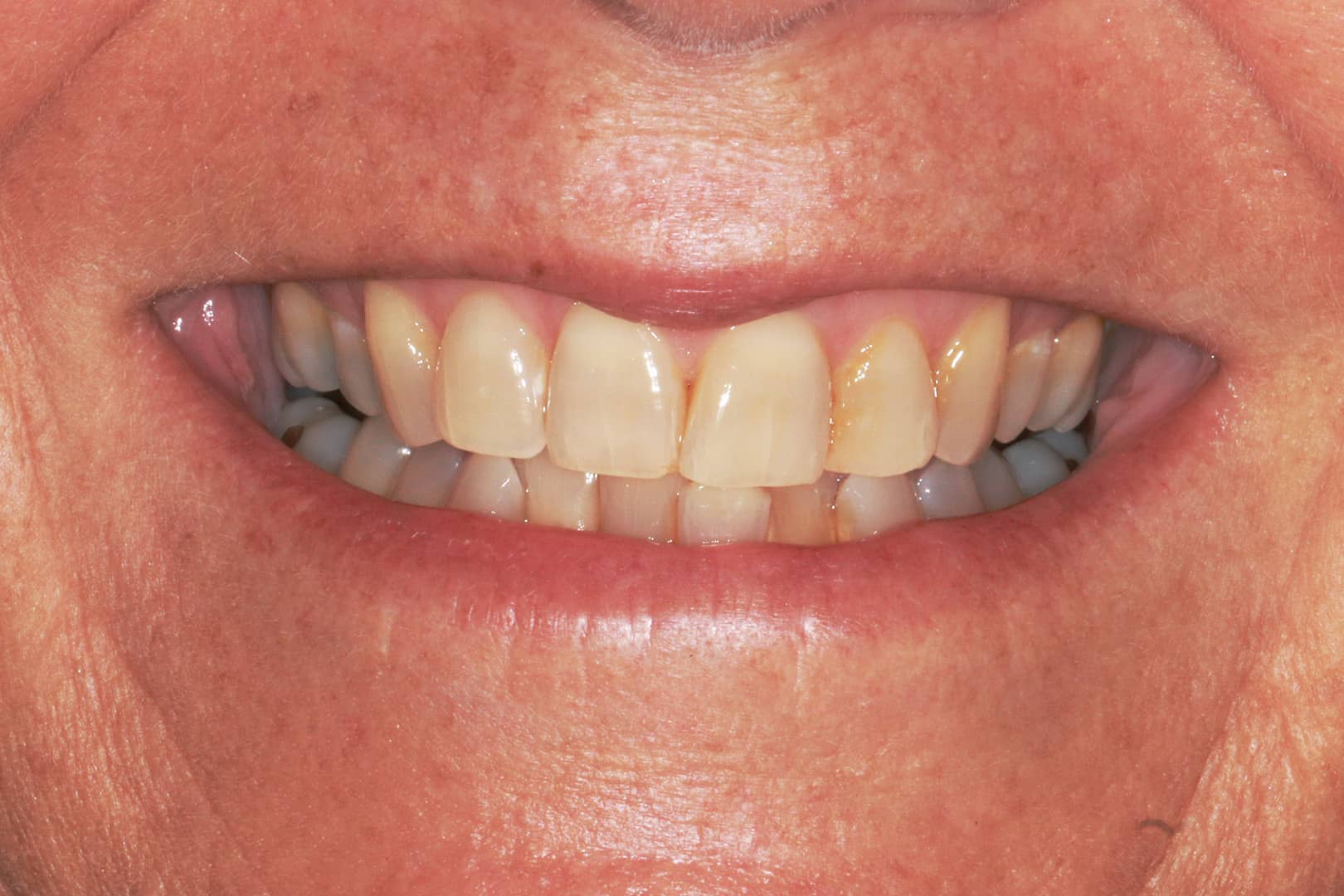
Plan around oral health
Professional whitening is planned around the health of your teeth and gums, not only the shade you would like to reach.
Temporary sensitivity is one of the most common side effects. It may feel like short, sharp sensitivity to cold air, cold drinks or brushing during treatment or shortly afterwards.
Existing sensitivity, gum recession, exposed roots, cracks and worn enamel can affect comfort. The dentist may adjust the method or home schedule.
Where appropriate, the dentist may modify the concentration, application time or take-home schedule and recommend a desensitising product or toothpaste for sensitive teeth. Whitening should be paused and reviewed if sensitivity becomes intense, prolonged or difficult to manage.
Whitening changes the shade of natural tooth structure but does not bleach porcelain, ceramic or composite restorations. Existing crowns, veneers and tooth-coloured fillings may therefore appear darker or different in colour after the surrounding natural teeth become lighter.
Where visible dental work is planned, whitening is often completed first so the new restoration can be matched to the settled tooth shade.
What happens next
One professionally supervised visit.
A custom home pathway with clinical instructions.
Includes preparation, protection, whitening applications and aftercare instructions.
The schedule may be slowed if sensitivity develops or another concern needs attention first.
The starting colour, type of staining, enamel condition and individual response determine the actual result.
Drag the comparison handle to view this patient’s tooth colour before and immediately after professional teeth whitening.
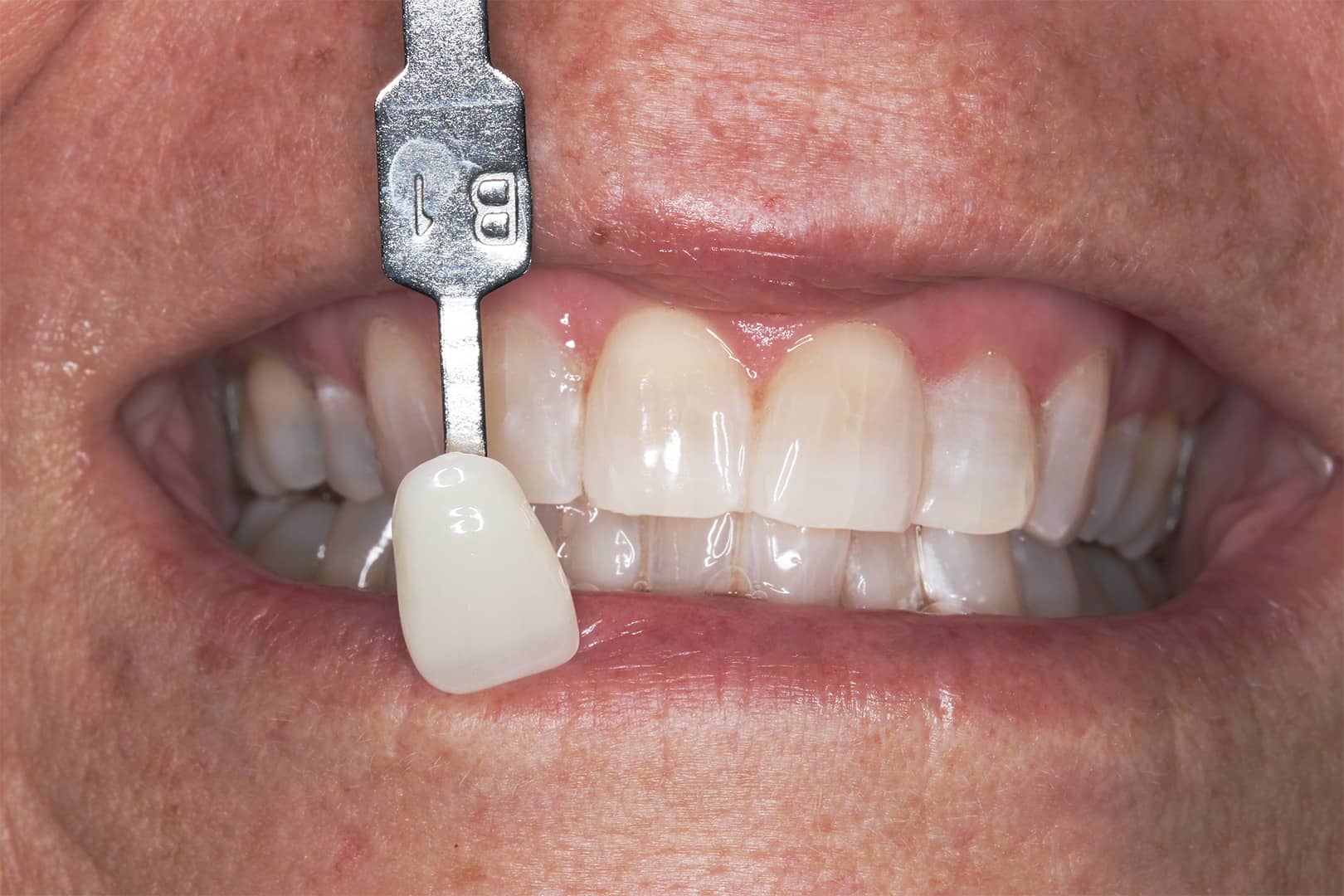
Treatment performed by Dr Sein Le Way, BDS, Dentist(AHPRA registration DEN0002665284).
After photograph taken immediately after treatment. Tooth shade can change as the teeth rehydrate after whitening.
Individual results vary. Images show the outcome for these patients only and do not guarantee the same result.
Whitening is not permanent. Results change gradually with coffee, tea, red wine, tobacco, strongly coloured foods and normal ageing.
How long the change remains noticeable depends on the starting shade, oral hygiene, diet, smoking, maintenance and treatment type. Custom Pola trays can be retained for future touch-ups when new gel is supplied and approved for use.
Regular cleaning helps control plaque, tartar and extrinsic staining, while dietary habits, tobacco use and oral hygiene influence how quickly colour returns. A professional Check-up & Clean can remove plaque, tartar and some surface staining before whitening. Custom take-home bleaching trays may be retained for future whitening touch-ups when the dentist confirms that the teeth and gums remain suitable and supplies the appropriate gel.
Professional whitening is generally low-risk when planned and supervised by a dental professional, but it is not suitable for every mouth and side effects can occur.
A brief response to cold air, cold drinks or brushing can occur during treatment or shortly afterwards. Intensity and duration vary.
Gel can irritate gums or soft tissue. In-chair protection, custom trays and correct gel placement reduce unnecessary contact.
Natural teeth may not respond at the same rate. Restorations do not change colour, so visible dental work can create an uneven result.
Treatment planning
Retail whitening products vary in active ingredients, concentration, fit and intended use. Dentist-supervised whitening begins with an assessment of the teeth, gums, sensitivity, visible restorations and the cause of discolouration, followed by a treatment method and schedule selected for the individual mouth.
Choose by what you want to change
Whitening only changes the colour of natural teeth. It does not reshape teeth, close gaps, repair chips or alter the colour of existing restorations.
Pola take-home whitening costs $399, Zoom in-chair whitening costs $799, and the Pola & Zoom Complete Package costs $975.
Ask reception about current payment choices before treatment. Where third-party finance is used, approval, fees, interest and repayment terms are set by that provider.
Our cosmetic dentists assess oral health, sensitivity, tooth shade, visible restorations and the cause of discolouration before recommending Zoom in-chair whitening, Pola take-home whitening or the combined package.
Professional teeth whitening at Beyond Dental Care has two main treatment pathways: Pola take-home whitening for $399 and Zoom in-chair whitening for $799. There is also a combined Pola & Zoom package for $975 when both the in-clinic treatment and custom home system are wanted.
The published fees describe the whitening treatment itself. Any dental problem that needs to be treated before cosmetic whitening is planned separately after examination.
The $399 Pola take-home treatment includes custom trays made for your teeth, Pola whitening gel and instructions explaining how to use the system at home. It is a dentist-prescribed take-home whitening option, not a generic retail kit.
The initial course is commonly completed over about 14 days, although the schedule can be adjusted according to sensitivity and individual response.
The $799 Zoom option is professional in-chair whitening performed by a dentist. It is intended for patients who prefer a faster visible change in one clinic appointment rather than completing the initial whitening course gradually at home.
The complete appointment is approximately 90 minutes. Temporary sensitivity can occur, so previous sensitivity should be discussed before treatment begins.
The $975 Pola & Zoom Complete Package combines Zoom in-chair whitening with custom Pola take-home trays and whitening gel. It provides the faster clinic-based treatment together with a home system that can support continued whitening and later maintenance.
The package saves more than $200 compared with booking Zoom and Pola separately. Suitability for both stages is assessed before the combined option is recommended.
Neither option is automatically better. Zoom and Pola whiten natural teeth at different paces, so the more appropriate choice depends on your starting colour, sensitivity, existing dental work and whether you prefer treatment in the clinic or gradual whitening at home.
The combined package is another option when both approaches are useful. The dentist should first establish what is causing the discolouration because changing the treatment method does not make every type of dark tooth respond reliably.
Teeth whitening is generally treated as cosmetic dental care, so a private health fund benefit cannot be assumed. Whether any contribution is available depends on the individual policy and should be confirmed directly with the health fund.
Where third-party finance is used, approval, interest, fees and repayment terms are determined by that provider. The whitening option should be selected clinically before payment options are considered.
Zoom in-chair whitening takes approximately 90 minutes at Beyond Dental Care. That time covers more than simply having whitening gel on the teeth because assessment, protection, applications and aftercare are part of the appointment.
The 90-minute figure is an approximate appointment length and does not represent guaranteed active whitening time. Individual treatment can vary according to sensitivity and clinical findings.
The prescribed Pola take-home course is commonly completed over about 14 days. Many patients begin to notice a colour change within the first few days, but whitening response varies and there is no reason to exceed the supplied schedule in an attempt to accelerate it.
The aim is controlled whitening; speed is secondary to comfort and individual response. The final shade change varies.
Professional whitening may lighten natural teeth by up to eight shades, but that is a possible change rather than a promised result. Starting colour, enamel condition, the cause of discolouration and individual response all influence how much change actually occurs.
The aim is a realistic result that works with your natural tooth colour and visible dental work. A specific shade or eight-shade improvement cannot be guaranteed before treatment.
Yellow natural teeth can often become lighter with professional whitening, but the degree of change depends on why they look yellow. Whitening is designed to lighten natural tooth structure rather than simply remove deposits from its surface.
A professional clean may first remove plaque, tartar and some external staining. The dentist can then judge whether whitening is likely to address the remaining colour or whether another cosmetic or restorative approach makes more sense.
Teeth can remain more yellow than expected when their natural starting colour, internal discolouration or visible restorations limit the change that whitening can produce. Professional whitening can lighten natural tooth structure, but it does not turn every tooth into the same predetermined white shade.
If the result is unexpectedly uneven, more whitening is not automatically the answer. The dentist should identify which parts of the smile are natural tooth structure and whether another cause of discolouration needs to be assessed.
Professional whitening changes the colour of natural tooth structure, but it does not bleach artificial restorative materials. Some natural teeth with deeper or unusual discolouration can also respond differently and may need separate assessment rather than repeated routine whitening.
This distinction matters when restorations sit within the visible smile. Whitening the surrounding natural teeth can make existing dental work appear darker, so shade planning should happen before replacing visible restorations.
Crowns, veneers, fillings, bridges and composite bonding do not change colour with standard teeth whitening. The natural teeth around them may become lighter, which can make an existing restoration appear darker or more noticeable afterwards.
Whitening therefore needs more planning when the front teeth contain dental work. Repeatedly whitening a crown or veneer will not make that restoration lighter.
A single dark tooth should be examined before applying the same whitening approach used for general yellowing across the smile. A colour difference isolated to one tooth can have a different cause from ordinary surface staining.
One dark or grey tooth is therefore not a reason to keep applying more whitening gel. The dentist should first determine why that tooth has changed colour.
Whitening may need to be postponed when there is an untreated dental or gum problem that could affect comfort, safety or the eventual result. Cosmetic colour change should not take priority over diagnosing active disease or damaged tooth structure.
The dentist can treat or investigate the underlying issue first and then reconsider whitening. Being unsuitable today does not necessarily mean whitening can never be considered.
Professional whitening is generally low-risk when suitability is assessed and treatment is planned and supervised by a dental professional, but side effects can still occur. It is not appropriate to describe whitening as completely risk-free or suitable for every mouth.
Whitening should be paused and reviewed when discomfort becomes intense, prolonged or difficult to manage. Continuing only to reach a lighter shade is not advised.
Professional whitening is designed to change the colour of natural teeth without reshaping them or removing enamel as part of the cosmetic procedure. That does not mean every whitening product or every pattern of repeated use should be treated as equivalent.
If a tooth is already worn, cracked, sensitive or affected by another dental problem, that issue should be assessed first. Whitening should not be used to mask damaged or unhealthy teeth.
The main side effects described for professional whitening are temporary tooth sensitivity and gum irritation. Colour can also become uneven because different natural teeth may respond at different rates and existing dental restorations do not whiten.
With Pola take-home whitening, the dentist may adjust the schedule when sensitivity develops. Adding extra gel or wearing the trays for longer than instructed is not the way to manage a slower whitening response.
Sensitive teeth do not automatically rule out whitening, but the cause and severity of sensitivity should be assessed first. Recession, exposed roots, cracks and worn enamel can all change how comfortable whitening is likely to be.
The goal is not to tolerate severe discomfort for a cosmetic result. Significant or unexplained sensitivity may need its own diagnosis before whitening begins.
Whitening gel can irritate the gums or other soft tissues if it contacts them, so temporary gum irritation is a recognised side effect. Professional in-chair protection and properly fitted home trays are intended to reduce unnecessary exposure.
Persistent or substantial gum discomfort should not simply be accepted as part of whitening. The application method and the condition of the gum tissue should be reviewed.
The teeth and gums should be assessed before professional whitening so active dental problems, sensitivity and visible restorations are considered before bleaching begins. A cosmetic shade change does not treat decay, gum disease or damaged teeth.
The assessment is therefore not merely a formality before cosmetic treatment. It determines whether whitening is appropriate and what result can realistically be expected.
A professional clean can be useful before whitening when plaque, tartar or external staining is present, but cleaning and whitening do different jobs. Cleaning removes deposits from the tooth surface; whitening lightens the colour of natural tooth structure.
The dentist can determine whether cleaning should happen first after examining the teeth. Whitening should not be used as a substitute for routine oral-health care or as a way of bleaching over plaque, calculus or active gum problems.
A Check-up & Clean can make teeth look cleaner and brighter by removing plaque, calculus and some surface staining, but it does not bleach the natural colour of the tooth. Professional whitening is a separate cosmetic treatment.
A clean can therefore be an important preparation step without being a whitening treatment itself. If the teeth remain darker than desired once surface deposits have been removed, the dentist can assess whether Zoom, Pola or no additional cosmetic treatment is appropriate.
If whitening is already part of the cosmetic plan, it is often completed before new visible veneers, bonding, crowns or tooth-coloured fillings are shade matched. Whitening changes natural teeth but does not lighten the restorative material placed afterwards.
The sequence should be planned before restorative work begins. Existing restorations may appear darker once surrounding natural teeth whiten, and some may need separate aesthetic review rather than further bleaching.
Teeth whitening is not permanent, and the landing page does not promise a fixed number of months or years. The colour changes gradually over time according to diet, tobacco exposure, oral hygiene, natural ageing and the way whitening is maintained.
Patients with custom Pola trays can retain them for later touch-ups, provided the dentist confirms that the teeth and gums remain suitable before additional gel is used.
Teeth can gradually darken again after whitening because the treatment does not permanently freeze the natural tooth colour. Everyday staining and normal ageing continue after the initial treatment has finished.
A gradual overall shade change is different from one tooth suddenly becoming darker than its neighbours. An isolated colour change should be assessed because it may have a different cause from ordinary whitening relapse.
Follow the eating and drinking instructions provided after your specific whitening treatment. Beyond Dental Care's landing page does not set one universal number of hours before coffee, so a fixed waiting period should not be applied to every patient.
The same principle applies to strongly coloured foods. Whitening results gradually change with normal habits, so maintenance depends on the overall pattern of exposure and oral care.
Do not whiten every day indefinitely or extend treatment beyond the schedule supplied for your whitening system. Pola take-home whitening follows a prescribed course, and repeated or excessive whitening can increase sensitivity and soft-tissue irritation.
More frequent whitening does not guarantee a better shade. Treatment should stop at a realistic result rather than continuing simply because a lighter colour might theoretically be possible.
A dentist-supervised whitening pathway starts with assessment of the teeth and gums and then selects the treatment method around the patient's sensitivity, restorations and type of discolouration. Beyond Dental Care offers both professionally performed Zoom whitening and custom Pola take-home treatment.
Retail products vary in formulation, fit and instructions and are generally chosen without the same individual dental assessment. Existing disease or an unexplained dark tooth should be diagnosed before cosmetic whitening.
Professional whitening offers a different level of assessment and treatment control from retail whitening strips. That does not mean every retail product is identical or automatically inappropriate, but the professional pathway is planned around the individual mouth rather than selected from a shelf.
The important distinction is not simply “dentist versus strip.” It is whether the discolouration and dental health have been assessed before treatment and whether the chosen method can be used predictably.
Age alone does not determine whether professional whitening will work. Age-related darkening is one of the types of colour change considered during whitening assessment, although older teeth may not respond in exactly the same way as younger or more uniformly yellow teeth.
The relevant question is the condition and colour of the teeth, not a numerical age limit. Suitability is confirmed after examination.
Natural teeth are not all the same shade, and a slightly yellow or off-white colour does not automatically indicate poor hygiene. Tooth colour reflects natural tooth structure as well as age, staining, previous treatment and individual dental history.
A professional clean can remove some external staining, while whitening changes natural tooth shade. Neither should be used to ignore an unexplained colour change isolated to one tooth.
No. Whitening can improve many forms of yellowing and staining in natural teeth, but colour changes have different causes and do not all respond in the same way. Surface deposits, general natural darkening and internal discolouration should not be treated as one problem.
The cause is more important than simply how dark the tooth looks. If standard whitening is unlikely to address the concern, the dentist can discuss whether another cosmetic or restorative treatment is more appropriate.
Yes. For an upcoming event, the main decision is whether an in-chair Zoom appointment or a take-home Pola course better suits the available time and your sensitivity. Leaving some flexibility is useful because whitening response cannot be guaranteed in advance.
For Bulimba patients planning around a fixed date, the dentist can compare the available options after checking oral health, tooth colour and existing dental work.
Beyond Dental Care provides professional teeth whitening for Bulimba patients, with Zoom in-chair whitening and Pola custom take-home whitening available after dental assessment. The two pathways can also be combined in the Pola & Zoom Complete Package.
For questions about suitability or appointment availability, call (07) 3268 2116. The whitening method is selected after assessment rather than solely according to how quickly the patient wants the teeth to change colour.
Book a whitening assessment to compare Zoom in-chair whitening, Pola take-home bleaching and the combined package. The dentist will review the type of staining, tooth sensitivity, gum health and visible restorations before recommending a treatment and maintenance plan.
Am I suitable, what can aligners treat, how will daily life change, how long will it take, and what will it cost? This chapter answers each question in turn, then gives you a planner for the treatment scope and payment options.
months, depending on the movements required
hours each day, according to your dentist's instructions
per arch · explore the payment planner
58-second educational explainer
See how prescribed aligner treatment progresses from examination and a digital scan to planned tooth movement, attachments or space creation where needed, reviews, refinements and retainers.

Clear aligners are removable orthodontic appliances made as a planned sequence of custom trays. They are sometimes called clear braces or invisible braces, although technically they are trays rather than fixed braces. Each aligner applies controlled pressure to selected teeth and is replaced according to the prescribed schedule as treatment progresses.
The clear material makes them less noticeable than metal brackets and wires, although tooth-coloured attachments may still be visible on some teeth. Successful treatment depends on careful planning, consistent wear and regular reviews with the dentist supervising the case.
Invisalign® Australia describes Invisalign® products as custom-made orthodontic devices prescribed and supplied by dental professionals rather than products purchased directly by the public. The same clinical principle applies to any dentist-supervised aligner plan: the trays are only one part of treatment, alongside examination, diagnosis, planning, monitoring and retention.
Clear aligners describe the broader category of removable orthodontic treatment. Invisalign® is one prescribed clear aligner system with its own materials, digital planning software and attachment features. Other professionally prescribed systems use their own tray materials, treatment-planning platforms and movement protocols.
| Clear aligners | Invisalign® |
|---|---|
| The general category of removable trays used to move teeth. | A specific clear aligner brand and treatment system. |
| May be produced by different aligner companies or dental laboratories. | Uses Invisalign® aligners and brand-specific digital treatment planning. |
| The available system depends on the clinic and the clinical requirements of the case. | May be selected when its treatment system suits the planned movements and treatment scope. |
| Quality depends on diagnosis, planning, manufacturing, supervision and patient wear. | The brand does not replace the dentist's responsibility for diagnosis, planning and monitoring. |
Beyond Dental Care does not present Invisalign® as the only possible clear aligner option. Your dentist will explain which system is proposed, why it has been selected and what is included in the treatment plan.
The following features are specific to the Invisalign® system. Other clear aligner brands use their own materials, planning software and movement features.
For an Invisalign® case, the dentist uses ClinCheck® software to customise the proposed sequence of tooth movements from the first aligner to the planned result. The software supports treatment design, but the dentist remains responsible for diagnosis, approving the plan, monitoring progress and making clinical adjustments.
Invisalign® aligners are made from SmartTrack™ material. Invisalign® Australia states that the material is engineered to apply gentle, constant force, fit closely around the teeth and improve control of planned tooth movement. These are Invisalign®-specific product claims and should not be applied automatically to another aligner system.
SmartForce™ attachments are small tooth-coloured shapes bonded to selected teeth before or during Invisalign® treatment. They provide additional surfaces for the aligners to act against when a planned movement requires more control. Not every Invisalign® case requires attachments.
Invisalign® aligners are designed to move teeth through active treatment. Retainers are used after treatment to help hold the teeth in their new positions. Vivera™ is Align Technology's branded retainer option, but Beyond Dental Care will confirm which retainer system is included or recommended for your case.
Clear aligners are not suitable for every orthodontic problem. Our Invisalign® vs braces comparison explains the general differences between removable aligners and fixed braces, including when referral to a registered specialist orthodontist may be appropriate.
Clear aligner treatment may be considered for a range of tooth-position and bite concerns. The amount and type of movement that can be achieved depend on the individual case.
Crowding occurs when there is not enough room for the teeth to sit in a well-aligned position. Teeth may overlap, rotate or sit forward or behind the dental arch. Clear aligners may create and redistribute space through planned tooth movement, and selected cases may also require interproximal reduction.
Aligners may close selected spaces or redistribute space more evenly. The dentist will assess why the gap exists, the size and shape of the teeth, gum health and whether the space is linked to a missing tooth or another structural issue.
An overbite or deep bite describes excessive vertical or horizontal overlap between the upper and lower front teeth. Some cases can be treated with clear aligners, while more complex bite correction may require fixed braces or another orthodontic approach.
Selected underbite, crossbite and open-bite cases may respond to clear aligner treatment. Suitability depends on whether the concern is mainly related to tooth position, jaw growth, skeletal relationships or a combination of factors.
Teeth can move after previous braces or aligner treatment, particularly when retainers are no longer worn. Clear aligners may be used to correct selected relapse before a new long-term retention plan is provided.
Small tooth movements may improve spacing or alignment before veneers, composite bonding, crowns or implant restoration. Aligning the teeth first can sometimes reduce how much restorative treatment is required and support a more conservative final plan.
Alignment may also be planned before veneers, crowns or dental implants so the final restorations can be designed around a more suitable tooth position.


Suitability depends on more than whether the teeth look crooked. The dentist needs to assess the health of the teeth and gums, the bite, the movements required and whether aligners can achieve the planned movements with adequate control.
Clear aligners are not suitable for every orthodontic problem. Where the required movement cannot be managed predictably with removable trays, the dentist may recommend referral to an orthodontic provider for fixed braces or further assessment. Beyond Dental Care does not provide fixed metal braces.
Clear aligners are commonly considered in adult orthodontics and teenage orthodontic care when a removable and less noticeable approach is appropriate. Age alone does not determine suitability. Treatment depends on oral health, the required movements, growth and development where relevant, and whether the prescribed daily wear can be maintained.
Adults may have additional considerations, including gum recession, worn teeth, missing teeth, implants or extensive restorative work. These factors do not automatically rule out aligners, but they must be included in the treatment plan.
The consultation assesses whether clear aligners, Invisalign® treatment, fixed braces or another approach is appropriate. The dentist examines the teeth, gums, supporting bone and full bite before determining which records, photographs, dental X-rays and digital scans are required.
Any untreated decay, gum disease or urgent dental problem may need to be managed before aligner treatment begins. A current Check-up & Clean can establish the health of the teeth and gums and identify anything that could interfere with orthodontic movement.
A Check-up & Clean can identify decay, gum inflammation or other concerns that should be treated before aligner records are completed.
The digital simulation prepared from your scan is a planning tool, not a guaranteed preview. The dentist must review the proposed movements, attachment positions, bite relationships and biological limits before approving the plan, and treatment may be adjusted as the teeth respond.
An intraoral scanner creates a three-dimensional digital record of your teeth and bite. Treatment-planning software is then used to map the proposed sequence of movements and design the aligners required for each stage. For Invisalign® treatment, this planning is completed through the ClinCheck® platform. Other aligner systems use different software and manufacturing workflows.
The digital simulation is a planning tool, not a guaranteed preview. The dentist must review the proposed movements, attachment positions, bite relationships and biological limits before approving the plan. Treatment may be adjusted as the teeth respond.

The dentist examines your teeth, gums, bite and treatment goals.
Photographs, scans and X-rays are collected where required for diagnosis and planning.
The dentist plans the sequence of movements and explains the proposed aligner system, duration and fee.
Decay, gum inflammation, failing restorations or another active concern is managed before movement begins.
The first trays are checked for fit, and tooth-coloured attachments may be placed where required.
Aligners are changed according to your prescribed schedule and worn for the required daily time.
The dentist checks tracking, fit, oral health and whether the planned movements are occurring.
Additional scans and aligners may be required to fine-tune the result.
Retainers are provided or arranged to help hold the teeth after active movement is complete.
Clear aligner treatment is not always limited to wearing plain trays. Small additional procedures may be required to achieve particular movements.
Attachments are small shapes of tooth-coloured composite bonded to selected teeth. They give the aligner a surface to grip and can help with rotation, tipping, extrusion or other planned movements. They are removed after treatment, although the teeth may feel slightly different while they are in place.
Interproximal reduction, often shortened to IPR, involves removing a very small, controlled amount of enamel between selected teeth to create space or improve contact shape. It is not required for every patient and should only be performed where the treatment plan indicates that it is appropriate.
Some cases may use small elastics, precision cuts or other features to assist bite correction. The dentist will show you how to use them and explain how they affect daily wear.
Treatment duration is based on the amount and complexity of movement required. Beyond Dental Care currently describes clear aligner and Invisalign® treatment as generally taking approximately 3 to 24 months. A smaller relapse or limited alignment case may require less time than a comprehensive plan involving both arches and bite correction.
The estimated timeframe can change if aligners are not worn as prescribed, appointments are missed, trays stop tracking or additional refinement aligners are required. Your dentist will provide a case-specific estimate after treatment planning.
Clear aligners are generally worn for approximately 20 to 22 hours each day according to the dentist’s instructions. Consistent wear helps each tray remain seated and keeps the teeth progressing towards the planned position. Extended time without the aligners can affect tracking, delay treatment or make the next tray difficult to fit.
Leaving aligners out for extended periods can allow the teeth to move away from the planned position. This can make the next tray difficult to fit, delay treatment or require the plan to be revised.
The change schedule is prescribed for the individual case. Many aligner systems use a sequence changed every one to two weeks, but the exact interval depends on the planned movement, aligner fit, biological response and the dentist's instructions. Do not move to the next tray early unless your dentist has advised you to do so.
Clear aligners should not be described as painless. Pressure or tenderness is common when a new tray is fitted because the aligner is applying force to move the teeth. The sensation often reduces as the teeth adjust to that stage.
Contact the clinic if an aligner causes significant pain, does not fit, creates a persistent ulcer or if a tooth feels unusually mobile or symptomatic.
Complimentary weighted blankets, noise-cancelling headphones and lavender eye pillows may be requested for scan, attachment and review appointments. Availability can vary, so mention any sensory or anxiety needs when booking.
Remove clear aligners before eating. Plain water can generally be consumed while the trays are in place, but hot drinks can distort some aligner materials and coloured or sugary drinks can become trapped against the teeth. Follow the instructions provided for your specific aligner system.
Clean the aligners every day using the method recommended by the dentist and aligner manufacturer. Lukewarm water and a soft brush may be suitable for routine cleaning, while brand-specific cleaning products may also be recommended. Avoid abrasive toothpaste, boiling water and household chemicals that could scratch, distort or damage the trays.
Good brushing and interdental cleaning remain essential because aligners can hold plaque, food acids and sugars against the teeth if they are reinserted without cleaning.
Contact the clinic if an aligner is lost, cracked, distorted or no longer fits closely around the teeth. Do not automatically skip ahead to the next tray or continue wearing a damaged aligner without advice. The dentist may recommend temporarily returning to the previous tray, moving forward, arranging a replacement aligner or reviewing the tooth movement in person.
Clear aligners and metal braces can both move teeth, but they work differently and place different responsibilities on the patient. Neither option is automatically better for every case.
| Clear aligners and Invisalign® | Metal braces |
|---|---|
| Removable trays that are less noticeable during daily wear. | Fixed brackets and wires remain on the teeth throughout treatment. |
| Removed for eating, brushing and cleaning between the teeth. | Require cleaning around brackets and wires and some food restrictions. |
| Depend heavily on consistent daily wear. | Do not rely on the patient remembering to reinsert an appliance. |
| May suit mild, moderate and selected complex movements. | May provide greater control for some complex movements and bite corrections. |
| Attachments, IPR, elastics and refinements may still be needed. | Wire changes, elastics and bracket adjustments may be needed. |
| A lost or poorly fitting tray can interrupt progress. | Broken brackets or wires may require an additional appointment. |
The dentist will explain whether clear aligners or fixed braces provide the more predictable and practical option for your treatment goals. For a deeper comparison of daily wear, cleaning and treatment scope, read our Invisalign® vs braces guide.
Beyond Dental Care provides clear aligner treatment and does not place fixed metal braces. Where braces are the more suitable option, the dentist can arrange referral to an orthodontic provider.
Clear aligners move natural teeth. Veneers and composite bonding change the visible shape, proportion or colour of teeth without correcting the underlying tooth position in the same way.
When the main concern is tooth shape, colour or a localised chip rather than tooth position, compare dental veneers and composite bonding.
Whitening is often planned after active aligner treatment and after tooth-coloured attachments have been removed. This allows the full visible tooth surfaces to be assessed and helps the final whitening result align with any later bonding, veneers or crown shade selection.
Whitening during aligner treatment should only be undertaken when the dentist has confirmed that the product, timing and tray use are appropriate. Do not place whitening gel into orthodontic aligners unless specifically instructed.
When whitening is part of the plan, review Teeth Whitening Bulimba before replacement attachments, bonding or visible restorations are shade-matched.
Existing dental work needs to be included in the aligner plan. How a tooth is restored changes how a tray grips it, which movements are available and whether the restoration will still suit the final tooth position.
Existing crowns, dental implants and fillings should be assessed before movement is planned because restorations and natural teeth respond differently.
These three consented cases show different orthodontic treatment scopes and finishing stages. The amount of movement, treatment duration, refinements and any restorative finishing are specific to each patient.

Treatment performed by Dr Mitesh Vasant, Dentist(AHPRA registration DEN0001791968).
After photograph taken approximately 6 months after treatment.
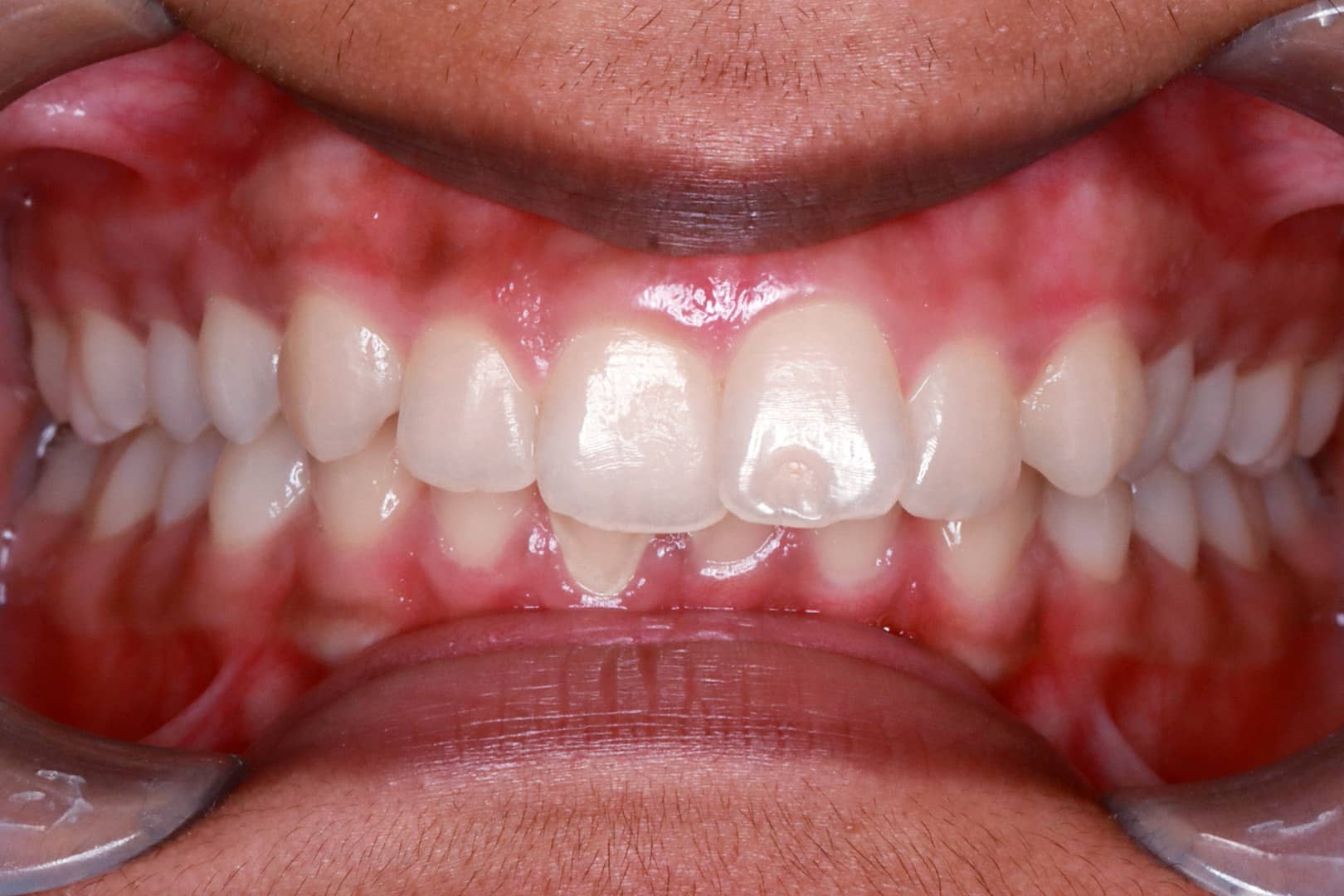
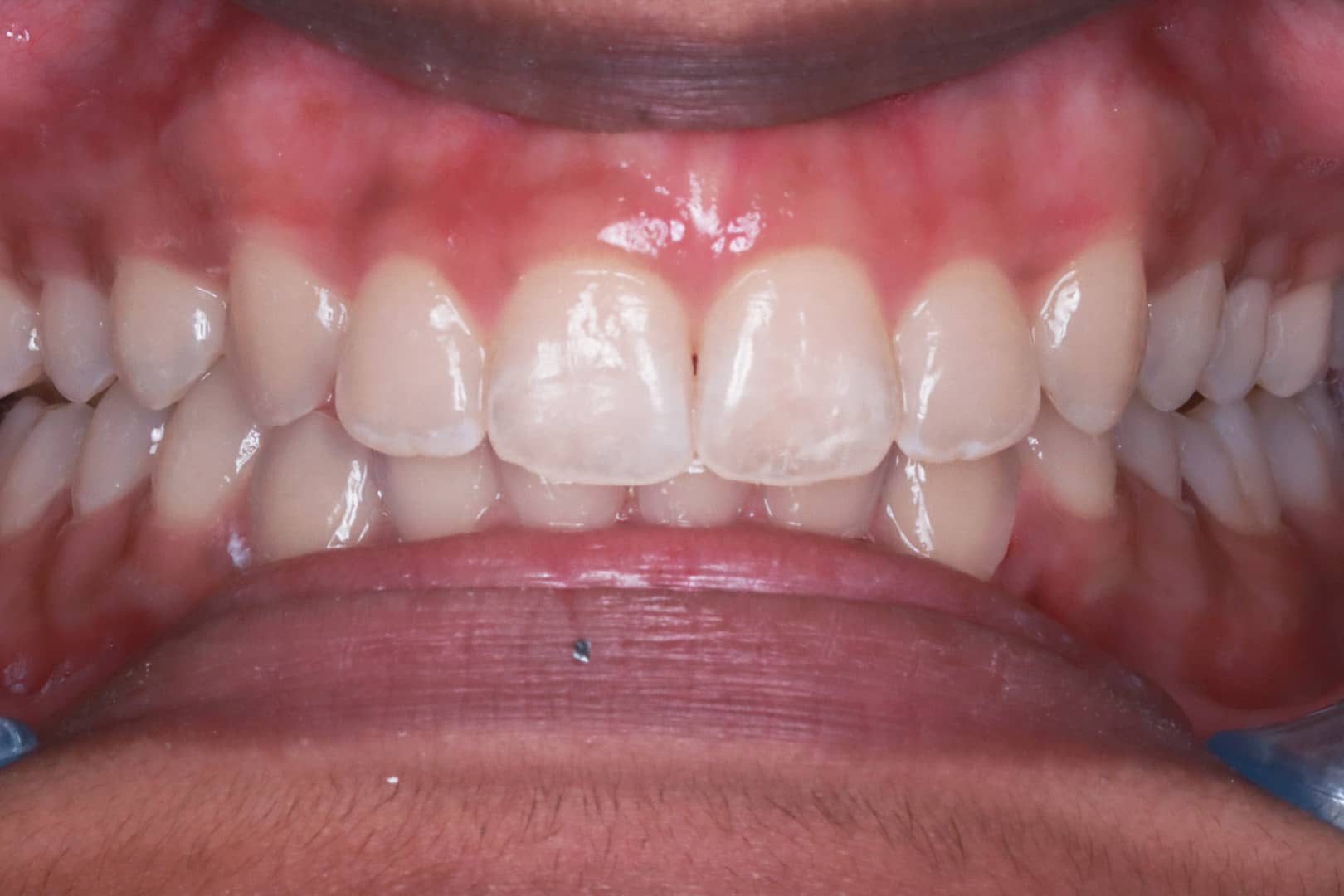
Treatment performed by Dr Mitesh Vasant, Dentist(AHPRA registration DEN0001791968).
After photograph taken approximately 7 months after treatment.

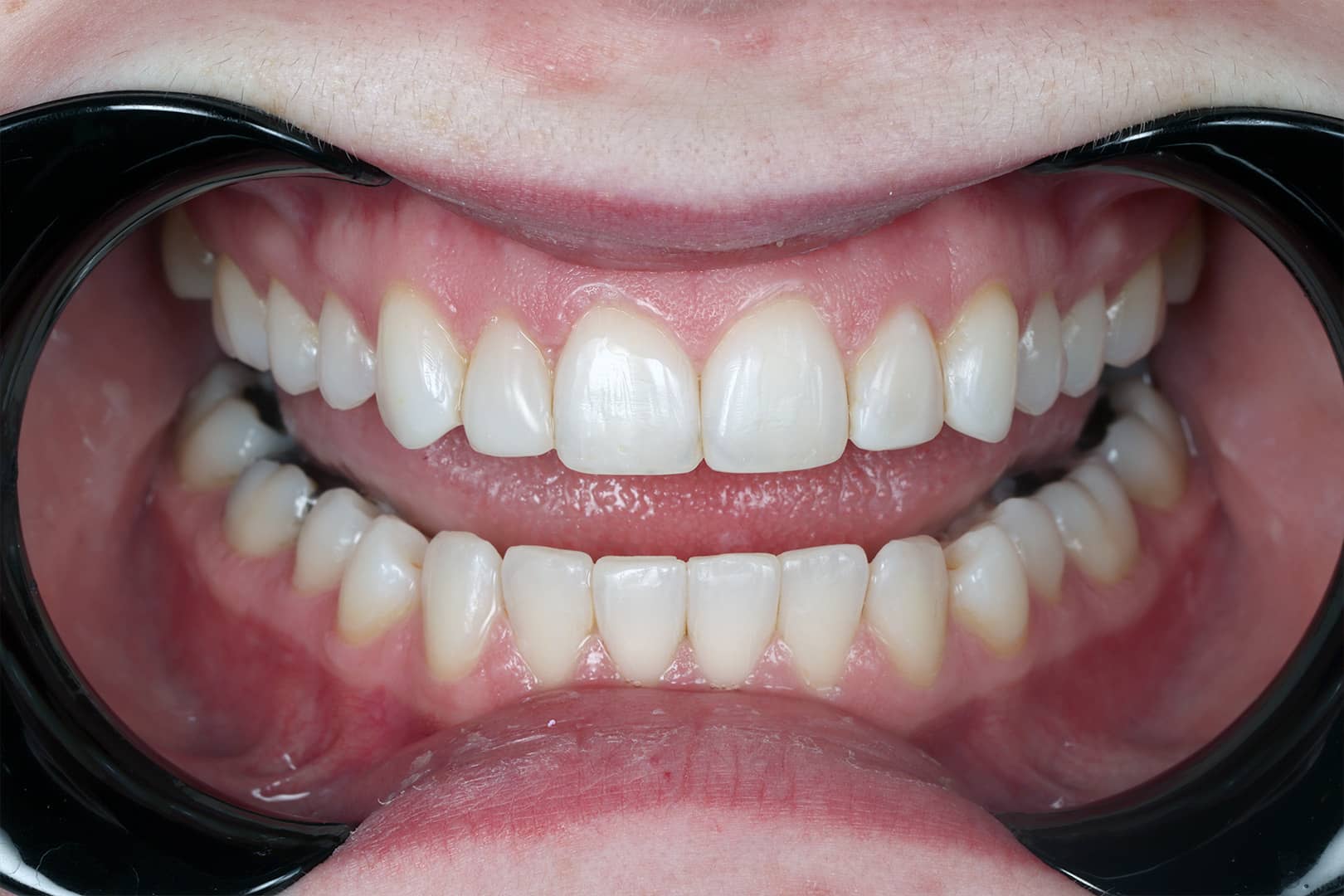
Treatment performed by Dr Jacky Shum, Dentist(AHPRA registration DEN0001659446).
After photograph taken approximately 3 weeks after treatment.
Individual results vary. Images show the outcome for these patients only and do not guarantee the same result.
Clear aligner treatment can be spread over a TLC payment plan, which brings a two-arch course to around $24 per week over the longest term. Your dentist will assess your teeth, gums, bite and treatment goals, then provide a written plan showing the recommended aligner system, expected treatment time, total fee, reviews and retainers.
See indicative aligner pricing (from $3,400 per arch), the typical 3-24 month treatment time, how a TLC payment plan can spread the fee, and information about using superannuation for eligible orthodontic treatment through SuperCare.
Treatment time varies by case — roughly 3–6 months for mild alignment, 6–12 months for moderate crowding or spacing, and 12–24 months for more complex movement. Your dentist confirms the timing after assessment. All figures are indicative “from” prices; your written plan confirms the fee, the aligner system and what’s included.
Indicative “from” prices only, not a treatment quote. Aligners are quoted per arch from $3,400 each — about $6,800 for both arches, with individual plans commonly around $7,000. Retainers at the end of treatment are recommended and quoted separately. The missing-tooth option uses a single dental implant with custom crown from $5,000, and the damaged-tooth option one dental crown at $1,800. Final fees depend on clinical suitability, the aligner system, teeth being moved, one or both arches, records, attachments, refinements and any dental care required before or after alignment.
Bulimba patients considering clear aligners or Invisalign® can explore a TLC dental payment plan after receiving an itemised treatment quote. TLC is an external credit provider, so approval, the available amount, interest rate, fees, repayment term and total repaid depend on its assessment and current terms.
Payment plans are provided by Total Lifestyle Credit Pty Ltd under its own lending criteria and terms. Beyond Dental Care does not provide credit advice, approve applications or guarantee a particular rate, term or repayment amount.
Your written treatment plan should confirm the aligner system, records and imaging, planned aligners, attachments, reviews, refinements, replacement aligners and retainers, including any items charged separately.
Private health insurance may contribute where your policy includes orthodontic or major dental benefits. Waiting periods, annual or lifetime limits and rebates vary, so confirm your proposed item numbers and treatment provider with your health fund before relying on a benefit.
Dentist-supervised clear aligner treatment begins with an in-person assessment of the teeth, gums, bite and supporting tissues. This matters because decay, gum disease, reduced bone support, damaged teeth or an unsuitable movement plan may not be apparent from a self-impression or remote photograph alone. Patients who started through SmileDirectClub or another remote aligner service should arrange an assessment if treatment stopped, the trays no longer fit or the bite does not feel right.
Bring any current and previous aligners, treatment records, scans, photographs and correspondence that you still have. The dentist will assess your current tooth positions and oral health, then explain whether treatment can continue, requires new records or needs to be replaced with a different plan. An existing remote-treatment plan cannot always be transferred directly to a new clinic.

Clear aligner treatment involves biological tooth movement and is not risk-free. The dentist will discuss the risks that apply to your case before treatment begins.
Poor aligner tracking may occur when trays are not worn as prescribed, attachments are lost, tooth movement differs from the digital plan or biological limitations affect the intended movement.
Individual outcomes and treatment times vary. A digital simulation is an estimate of planned tooth movement and does not guarantee the final appearance or bite.
Teeth have a natural tendency to move after orthodontic treatment. Retainers help hold the result and remain important after both clear aligners and braces; retainer wear is usually long-term and often lifelong. Invisalign® Australia distinguishes active aligners, which move teeth, from retainers, which are made to resist unwanted movement after treatment. The retainer type and wear schedule are prescribed by your dentist.
Before accepting a quote, confirm whether retainers are included, how many sets are provided, what replacement retainers cost and how often the dentist recommends review.
Retainers can wear, crack, become loose or stop fitting correctly as the mouth and materials change. Contact the clinic if a retainer is uncomfortable or distorted instead of continuing to wear it. Replacement retainers usually involve a separate fee unless they are specifically included in the treatment plan.
Clear aligner assessment and treatment are available through all three treating dentists. Planning considers the health of the teeth and gums, existing dental work, the full bite and appearance goals.
Related preventive, restorative and cosmetic care can be coordinated within the same clinic, and payment options can be discussed once the treatment scope and total fee are known.
Our clear aligner dentists provide dentist-supervised assessment and treatment where suitable. Planning considers the teeth, gums, supporting bone, existing restorations, bite relationships, daily wear reliability and the movements required.
Book a dentist-supervised assessment to compare Invisalign® and other clear aligner systems, confirm one or both arches, discuss treatment time, retainers and receive an itemised written plan.
Invisalign® is a registered trademark of Align Technology, Inc. Clear aligner suitability, treatment time, results, refinements and retainers vary by patient. Your written treatment plan confirms the proposed system, inclusions and total fee.
Check-up & clean
$299 comprehensive dental examination, clean and fluoride
Beyond Dental Care allows a full hour for a comprehensive oral health check and professional teeth cleaning. The $299 appointment combines a detailed dental examination with plaque and calculus (tartar) removal, a scale and polish, fluoride treatment, dental X-rays when clinically required and an oral cancer check. The aim is to assess your teeth, gums, bite and oral tissues before discussing prevention, monitoring and any treatment priorities.
There is no judgement if your dental visit is overdue or it has been years since your last routine check-up. Tell the dentist what has kept you away, what you are concerned about and what would make the appointment easier. The one-hour format provides time to review your medical and dental history, complete the examination, perform the cleaning and explain the findings.
56-second educational explainer
See how a one-hour appointment may include discussion of concerns, examination, dental X-rays where indicated, gum measurements, plaque and tartar removal, polishing and a review of findings.
The appointment follows six clear stages. Diagnostic tests are selected according to individual need.
Medical conditions, medications, allergies, previous dental care and any recent pain, bleeding, sensitivity or changes are reviewed before the examination begins.
The dentist performs a tooth-by-tooth examination and assesses existing restorations, gum health, the bite, jaw joints and oral soft tissues.
Plaque, hardened tartar or calculus and selected surface stains are removed from accessible areas around the teeth and gumline. The tooth surfaces are then polished where appropriate.
Fluoride may be applied where suitable, followed by practical preventive advice based on decay risk, dry mouth, exposed roots, diet and home-care habits.
Dental X-rays are selected according to symptoms, history, previous images, age, decay risk and the findings of the clinical examination rather than taken automatically.
Findings are separated into what requires treatment, what can be monitored and what may be prevented through professional care or changes at home. Any recommended treatment and fees are explained before another appointment is arranged.
Included in the $299 one-hour Check-up & Clean: history review, tooth-by-tooth examination, gum assessment, bite and jaw review, soft-tissue screening, X-rays where clinically required, scale, clean and polish, fluoride, a personalised plan and recall advice.
A rushed appointment can produce a clean set of teeth without giving enough time to understand why problems are developing. The one-hour format combines prevention, diagnosis, cleaning and discussion in one visit.
The additional time is useful when you have several concerns, a complicated dental history, existing crowns or implants, jaw symptoms, gum problems, dental anxiety, or a long gap since your previous examination.
It also gives you time to ask questions. You should leave knowing what was checked, what the dentist found, which issues are urgent, which can be monitored and what the likely next steps may be.
Your mouth does not exist separately from the rest of your health. Before the examination, the dentist reviews information that may affect diagnosis, treatment planning, healing, dry mouth, gum health, bleeding or the choice of anaesthetic and medication.
The examination follows a consistent structure so visible problems, hidden risks and changes that need monitoring are considered together.
When pocketing, bleeding or bone changes indicate active disease, treatment may move beyond routine cleaning to Gum Care & Deep Cleaning Bulimba.
Where symptoms or the examination indicate a need, the dentist assesses how the upper and lower teeth meet, visible wear, crowding, jaw movement, clicking, tenderness and muscle tension. This can help explain fractured teeth, uneven wear, clenching or chewing discomfort.
Clinical photographs, cold testing, fracture assessment or other focused tests may be used when they help document a concern, compare changes over time or investigate a specific tooth. These are selected according to clinical need.
Included in the $299 one-hour appointment
The dentist examines the lips, cheeks, gums, tongue, floor and roof of the mouth and visible throat area, together with relevant areas of the face, jaw and neck.
Screening does not diagnose cancer. It identifies changes that may need closer assessment or referral.
A persistent mouth ulcer, unexplained lump, altered sensation or red or white patch should be assessed. Healthdirect provides further information about mouth cancer symptoms and when to seek medical advice.
Diagnostic imaging and preventive cleaning serve different purposes within the same one-hour appointment.
X-rays are taken when clinically required, not simply because you booked a Check-up & Clean. They help the dentist assess areas that cannot be seen directly during the examination.
Standard dental X-rays are included when clinically required. The dentist decides which image is justified from your history, age, symptoms, previous X-rays, decay risk and examination findings. Separate or advanced imaging is discussed before proceeding.
Professional cleaning removes plaque and calculus (hardened tartar), which cannot be fully removed with normal home cleaning. It also provides an opportunity to review brushing, interdental cleaning and areas where plaque repeatedly accumulates.
Plaque and calculus are assessed around the teeth and gumline.
An ultrasonic scaler and hand instruments may be used to remove hardened deposits from accessible areas.
The tooth surfaces may be polished to remove selected surface stains and leave them smooth.
Fluoride treatment is applied, followed by instructions appropriate to the product used.
The dentist explains where plaque is accumulating and which home-care tools may make those areas easier to clean.
A professional clean is not the same as teeth whitening. It can remove plaque, calculus and some external staining, but it does not bleach the natural colour of the tooth. If you want to change tooth shade, see Teeth Whitening Bulimba.
Preventive care and routine removal of plaque and calculus around accessible tooth surfaces and gum margins.
Separate treatment when gum disease requires cleaning below the gumline and around affected root surfaces.
If the dentist finds signs of gum disease, the findings and costs of any separate treatment are discussed before it is booked. A standard Check-up & Clean is not complete treatment for advanced gum disease.
The $299 fee covers the one-hour examination, clinically required standard X-rays, professional clean and fluoride described above.
One-hour comprehensive dental examination, history review, teeth and gum assessment, bite review, professional scale, clean and polish, fluoride treatment, oral cancer screening, clinically required standard dental X-rays and a personalised care plan.
Your private health fund may pay part or all of the appointment, depending on your extras policy, remaining annual limits, waiting periods and the item numbers claimed. The out-of-pocket amount is different for each patient. Bring your health-fund card or app so the available benefit can be checked through the clinic's normal claiming process.
Routine adult dental care is generally not covered by Medicare. Eligible children may be able to use the Child Dental Benefits Schedule for covered basic dental services, subject to eligibility, the remaining benefit balance and the services provided.
Many patients are reviewed approximately every six months, but the right interval is based on individual risk rather than a universal calendar rule.
Patients with stable oral health and a lower risk profile may be advised to return at a different interval. The dentist explains the recommendation after reviewing the examination findings.
Regular examinations are designed to identify changes before they become harder to manage. Preventive dentistry combines professional teeth cleaning, appropriate fluoride use and personalised home-care advice with ongoing review of teeth, gums and oral tissues.
Dental anxiety is common, especially after a difficult experience or a long time away from care. The purpose of the appointment is to understand the current situation, explain the findings and agree on a manageable next step.
Tell the dentist what has made previous appointments difficult and what would make this one easier. The visit can be paced around communication, sensitivity, sensory needs and the need for breaks.
The appointment begins with your current concerns, health history and what you would like help with.
The dentist reviews your teeth, gums, bite and oral tissues based on the current examination.
Painful or urgent concerns are separated from problems that can be monitored or planned.
Any further treatment is divided into understandable stages, with costs and options discussed first.
The cleaning approach is adjusted if the gums are inflamed or the build-up is extensive.
A practical guide for preparation, aftercare, children and what happens when the examination finds something that needs attention.
Your teeth may feel smoother and the gums may feel mildly tender if there was inflammation or substantial calculus. Temporary sensitivity can also occur, particularly around recession or exposed root surfaces.
Children need age-appropriate preventive care, examination and guidance rather than a standard adult appointment. The dedicated Paediatric Dental Care Bulimba section covers children's check-ups, preventive care, dental trauma, toothache and appointment preparation in more detail.
Eligible children may use the Child Dental Benefits Schedule for covered basic dental services. As at 2026, the benefit cap is up to $1,158 over two consecutive calendar years when 2026 is the first year of the benefit period. The cap is indexed annually, and eligibility and remaining balances should be checked before treatment.
For current benefit-period, eligibility and covered-service details, see the CDBS information in our Children's Dentistry section.
The dentist summarises the findings in plain language and separates them into practical priorities.
Additional treatment is not included in the $299 appointment. Where treatment is recommended, the dentist explains the reason, alternatives, timing and estimated fees before it is booked.
Our general dentists provide comprehensive dental examinations, gum assessment, diagnostic X-rays where clinically indicated and professional cleaning for Bulimba patients.
At Beyond Dental Care, the complete one-hour Check-up & Clean for Bulimba patients costs $299. This is the published fee for the comprehensive appointment described on the page.
If another problem is identified, the dentist explains the findings, treatment options and estimated fees before separate treatment is booked.
Beyond Dental Care allows one hour for the comprehensive Check-up & Clean. The time is intended to cover diagnosis, prevention and discussion as well as the physical cleaning of the teeth.
The exact sequence varies according to your oral health and the diagnostic information required, but the scheduled appointment remains a comprehensive one-hour visit.
The $299 appointment combines a comprehensive dental examination with preventive cleaning and a personalised oral-health plan. It is designed to assess more than whether the visible tooth surfaces look clean.
Not every patient requires every diagnostic test at every visit. The dentist selects imaging and additional tests according to symptoms, history, previous records, risk and examination findings.
Standard dental X-rays are included in the $299 appointment when the dentist considers them clinically required. They are not taken automatically simply because a patient has booked a routine check-up.
If separate or advanced imaging is recommended, the dentist explains why it is needed and discusses any additional cost before it is arranged. Standard clinically required dental X-rays remain part of the comprehensive appointment.
Yes. An oral cancer screening is included in the $299 Check-up & Clean. It is a visual and clinical examination intended to identify unusual changes that may require monitoring, further investigation or referral; it does not by itself diagnose cancer.
Tell the dentist about any persistent sore, lump, colour change or altered sensation even if it is not painful.
Most people tolerate a routine examination and professional clean well, although individual areas can feel sensitive or tender. Comfort often depends more on the condition of the teeth and gums than on the cleaning itself.
Sharp or significant pain should not simply be endured. Tell the dentist when an area feels uncomfortable so the cause can be assessed and the approach adjusted where appropriate.
Yes. A long gap since your last appointment is a reason to establish a new oral-health baseline, not a reason to delay further. The one-hour format allows time to work through your history, current concerns and findings without treating every issue as equally urgent.
The aim is to leave with a clear picture of what is healthy, what requires attention and what the next practical step should be.
Many patients attend around every six months, but the appropriate recall interval is based on individual risk rather than applying one schedule to everyone. The dentist recommends the next visit after reviewing the current findings.
A shorter or longer interval may therefore be appropriate depending on what the dentist finds. Recall timing should be personalised to the findings and individual risk.
No. A routine scale and clean is preventive care focused on accessible tooth surfaces and the gum margins, while periodontal deep cleaning is treatment for diagnosed gum disease affecting deeper areas below the gumline.
A routine clean should not be presented as complete treatment for established periodontal disease. If the check-up identifies deeper pocketing, bleeding, bone changes or calculus below the gumline, a separate gum-care plan may be recommended.
A professional clean can make teeth look cleaner or brighter by removing plaque, hardened calculus and selected surface staining, but it does not bleach the natural colour of the teeth. Professional teeth whitening is a separate treatment.
If the main concern is tooth colour after plaque, calculus and external staining have been removed, whitening can be considered separately once the dentist has assessed the health of the teeth and gums.
Private health extras may pay part or all of the $299 appointment, but the benefit varies between patients. The amount depends on the individual policy rather than on the practice setting one universal insured price.
Health funds can be claimed through the practice's normal claiming process. Because policies and remaining benefits differ, a promotional claim such as universally “gap free” should not be assumed. The actual out-of-pocket amount is determined by the benefit available under your own policy.
Routine private adult dental care is generally not covered by Medicare, so an adult should not assume that a standard Check-up & Clean will be paid through Medicare simply because the appointment is preventive.
Adult Medicare arrangements and children's CDBS eligibility are therefore different. The relevant funding pathway should be checked before assuming that a preventive dental appointment will have no out-of-pocket cost.
Eligible children may be able to use the Child Dental Benefits Schedule for covered basic dental services, including relevant preventive care. Eligibility and the remaining benefit balance need to be confirmed rather than assumed from the child's age alone.
The applicable benefit should be checked before treatment. Current eligibility rules and benefit limits are set by the government scheme and may change, so they should not be inferred from old online price guides or previous benefit periods.
Bring the information that helps the dentist understand your general health, dental history and current concerns. A check-up is easier to plan when relevant changes are discussed before the examination rather than discovered halfway through treatment.
You do not need to arrive with a diagnosis. Describe what you have noticed, when it occurs and what concerns you. The dentist can then decide what examination, X-rays or other tests are clinically appropriate.
Usually, but the instructions after fluoride treatment depend on the product used and any other care completed during the appointment. Follow the specific advice given before you leave rather than relying on one universal waiting rule.
The page deliberately does not give a fixed post-fluoride waiting time because the correct advice is product-specific. Follow the instructions supplied for the treatment actually used at your appointment.
If a cavity is found, the dentist explains where it is, what was seen clinically or on any relevant X-ray, and what treatment options are appropriate. The $299 Check-up & Clean does not automatically include restorative treatment.
Treatment is only completed during the same visit where there is a specific reason and sufficient available time. Otherwise, the diagnosis and plan come first.
If signs of gum disease are found, the dentist determines whether routine preventive cleaning is sufficient or whether a separate periodontal assessment and treatment plan is required. A standard clean is not used as a substitute for treatment of established periodontitis.
The dentist explains the findings and any separate cost before periodontal treatment is booked. The depth and extent of treatment depend on the diagnosis rather than simply on how much tartar is visible.
Yes. Fluoride treatment is included within the $299 comprehensive appointment and is applied where suitable. It forms part of the preventive component of the visit rather than being treated as a separate cosmetic procedure.
Fluoride is intended to support protection of the tooth surface, but it does not replace plaque control, professional assessment or treatment of existing decay. Aftercare instructions are given according to the fluoride product used during the appointment.
Once plaque has hardened into tartar or calculus, normal home cleaning cannot fully remove it. Professional cleaning uses appropriate instruments to remove hardened deposits from accessible tooth surfaces and around the gumline.
Avoid trying to scrape hardened deposits away with improvised sharp objects. The dentist can distinguish routine calculus from deeper periodontal deposits and determine whether a standard clean or separate gum treatment is appropriate.
A professional clean removes the plaque, calculus and selected surface staining present at the appointment, but it does not permanently prevent new plaque from forming. How quickly the mouth feels coated again depends on oral hygiene, saliva, diet and areas that are difficult to clean.
If one particular area repeatedly feels rough or traps food, mention it at the appointment so the dentist can check the tooth, gum and any existing restoration in that area.
The numbers usually record periodontal measurements taken with a small probe around the teeth. They help document the space between the gum and tooth and form one part of assessing whether the gums are healthy or whether periodontal disease may be present.
The dentist uses these findings together rather than diagnosing gum disease from a single number heard during the examination.
No. Dental X-rays are taken when they are clinically required, not automatically at every routine appointment. The dentist decides whether new images will provide information that cannot be obtained adequately from the examination alone.
Clinically required standard dental X-rays are included in the $299 appointment. Separate or advanced imaging is discussed before it is arranged, including why it is needed and whether there will be an additional fee.
Yes. A dental problem does not have to be painful before it can be detected during an examination. The purpose of a routine check-up is partly to identify changes that need treatment or monitoring before the patient is relying on pain as the warning sign.
The absence of pain is reassuring in some situations, but it does not confirm that every tooth, restoration or gum area is healthy.
Scaling is one part of professional dental cleaning: it refers to removing plaque and hardened calculus from the teeth. Confusion arises because the word “scaling” is also used in the name of deeper periodontal treatment, scaling and root planing.
So a routine “scale and clean” and periodontal “scaling and root planing” should not be used interchangeably. The dentist determines which level of care the gums actually require.
Yes. Dental anxiety, sensitivity, sensory needs and previous difficult experiences can be discussed before the appointment so the visit can be paced around what makes treatment manageable. Beyond Dental Care's one-hour format provides time for conversation as well as examination and cleaning.
If anxiety may significantly affect the visit, mention it when booking or call (07) 3268 2116 so it can be noted before the appointment.
Book a comprehensive oral health check for $299, including medical and dental history review, examination of the teeth, gums and bite, oral cancer screening, clinically required standard dental X-rays, professional scale and clean, polish, fluoride and a clear prevention or treatment plan.
A cavity can develop without obvious pain, while an old filling may gradually wear, crack or lose its seal. Beyond Dental Care provides mercury-free fillings made from tooth-coloured composite resin for suitable front and back teeth. Each direct composite restoration is shade matched, bonded, shaped and polished to rebuild the tooth and fit the way the upper and lower teeth meet.
Itemised written quote before treatment
White fillings start from $200. Larger restorations involving more tooth surfaces may cost up to $600. The dentist confirms the recommended treatment and fee after examining the tooth and, where clinically required, reviewing X-rays.
55-second educational explainer
See how a tooth-coloured composite filling may restore a cavity through decay removal, bonding, layered placement, light curing, shaping, polishing and a final bite check.
| Treatment detail | Beyond Dental Care approach |
|---|---|
| Starting price | From $200 per filling |
| Extensive fillings | May cost up to $600, depending on size, location and the number of tooth surfaces |
| Material | Mercury-free, tooth-coloured composite resin |
| Typical appointment | At least 60 minutes for one filling; multiple or complex restorations may require longer |
| Assessment | Clinical examination and X-rays where clinically required |
| Comfort options | Local anaesthetic, nitrous oxide where suitable, slower pacing and the Comfort Menu |
| Main purpose | Remove decay or damaged material and rebuild the tooth so it can function comfortably |
| Treatment pathways commonly considered alongside fillings | Check-up & Clean, Emergency Dentist, Root Canal Treatment, Dental Crowns, Composite Bonding, Children's Dentistry |

A tooth-coloured composite filling is a direct bonded restoration used to replace tooth structure lost through dental caries, fracture, wear or failure of an existing filling. After the damaged material is removed, composite resin is placed in controlled layers, hardened with a curing light and shaped to reproduce the tooth’s natural contours and bite.
White filling, tooth-coloured filling, composite filling, resin filling, bonded filling and direct composite restoration describe the same broad treatment category. An anterior composite filling restores a front tooth, while a posterior composite filling restores a premolar or molar and must also reproduce contact points, grooves and chewing surfaces.
Composite resin can be used on front and back teeth. A small front-tooth repair may prioritise colour layering and contour. A back-tooth restoration must also reproduce grooves, contact points and chewing surfaces while tolerating repeated bite pressure.
Dental caries, commonly called tooth decay, develops when bacteria in dental plaque use fermentable carbohydrates to produce acids. Repeated acid exposure removes minerals from enamel and can eventually create a cavity that requires restorative treatment.
A cavity is more than a stain or a hole that appeared overnight. Risk is influenced by oral hygiene, diet, saliva, fluoride exposure, tooth shape, crowding, gum recession, existing restorations, medical factors and how frequently the teeth are exposed to sugar or acidic drinks.
Common factors associated with decay include:
Some cavities cause no symptoms and are found during a routine examination or on X-rays. Others become noticeable as the damaged area grows or a restoration breaks down.

Symptoms do not identify the depth of decay. A small cavity can be symptom-free, while sensitivity can also come from gum recession, tooth wear, cracks, grinding or an irritated nerve. The dentist needs to determine the cause before recommending a filling.
Not every filling requires a new X-ray. Imaging is used when it is clinically justified and expected to change diagnosis or treatment planning. Bitewing X-rays can reveal decay between teeth that cannot be seen directly. A focused X-ray may help assess the depth of decay, the tooth root, an existing restoration or possible infection.
The decision depends on your dental history, symptoms, previous images, cavity risk and what the dentist finds during examination. X-rays are not added automatically for every tooth, and the dentist should explain why an image is recommended.
A Check-up & Clean assessment helps determine whether an X-ray is clinically justified before a filling.
Composite resin can be used for selected cavity treatment and decay repair in front teeth, premolars and molars. The design changes according to the location and purpose of the restoration.
Used to restore decay, a failed filling or selected structural damage where colour layering and visible contour are important.
Used to rebuild grooves, ridges, contact points and chewing surfaces while tolerating repeated bite pressure.
An old, cracked, broken or failing filling may be removed and replaced after the tooth and remaining structure have been assessed.
A selected defect may sometimes be repaired rather than replacing the entire restoration, provided the existing material and tooth remain suitable.
The treatment plan must account for the amount of tooth remaining, the position of the cavity, the bite and the condition of the nerve. A larger white filling is not always the most conservative or durable answer if the tooth needs broader protection.
A direct composite filling works best when it can be supported by strong remaining tooth structure. A different treatment may be recommended when the cavity or fracture is too extensive, the tooth is cracked, the nerve is involved or repeated restorations have left the tooth weak.
| Clinical situation | Possible treatment direction |
|---|---|
| Small to moderate cavity with sound surrounding tooth | Direct tooth-coloured composite filling |
| Large area missing but enough tooth remains for a bonded indirect restoration | Ceramic inlay or onlay may be considered |
| Heavily broken-down or cracked tooth needing full coverage | Dental crown may be considered |
| Decay or infection has reached the dental pulp | Root canal treatment may be needed before restoration |
| Tooth cannot be predictably restored | Extraction and replacement options may need discussion |
| Minor edge chip or cosmetic contour concern without decay | Composite bonding may be more appropriate |
| Active gum disease or poor plaque control affecting the area | Gum treatment and preventive care may need priority |
Larger or deeper damage may require a dental crown or root canal treatment, while a small appearance-focused repair may suit composite bonding.

The exact sequence depends on the tooth and the amount of restoration required. A typical composite filling appointment includes:
A filling needs to restore the missing tooth structure and recreate a suitable contact and bite, not simply seal the cavity. Its shape influences how food is deflected during chewing, whether floss can pass through the contact and how chewing forces are distributed. An overbuilt filling can feel high or sore, while a poorly contoured restoration can trap food or alter function. The dentist therefore checks shape, contact and bite before the appointment is complete.
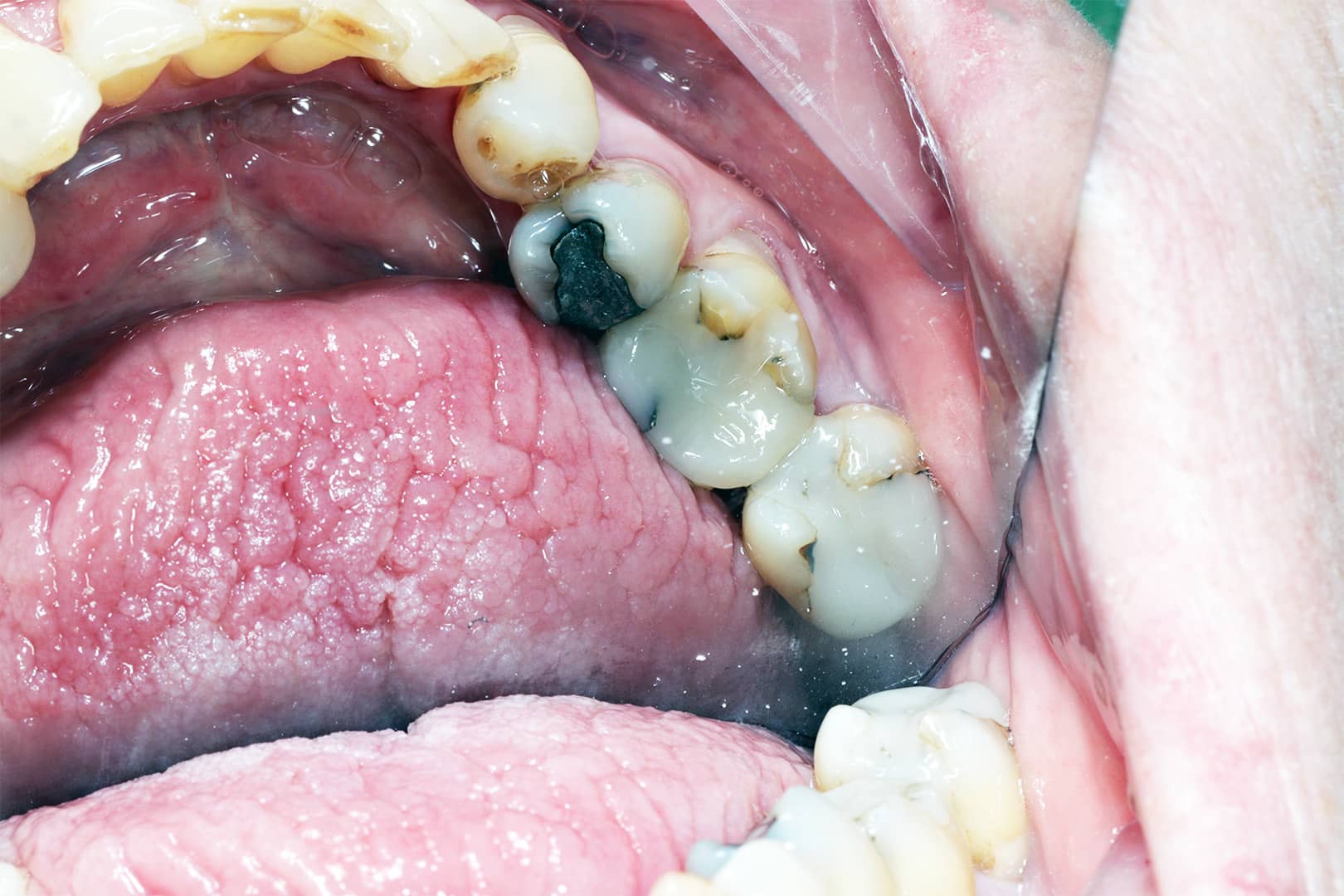
This is also why two fillings that sound similar can require different appointment times and fees. A small one-surface filling is not the same clinical task as rebuilding several surfaces of a molar.
A filling appointment should be planned around comfort, but no treatment should be advertised as universally pain free. Local anaesthetic is commonly used when decay removal or tooth preparation could be uncomfortable. Some small surface repairs may need little or no anaesthetic. The dentist will explain the expected sensations and options before starting.
Tell the team if you have dental anxiety, sensitive teeth, a strong gag reflex, difficulty staying open or a previous experience that made treatment hard. Slower pacing, a stop signal, breaks, explanation before each step, local anaesthetic, nitrous oxide where suitable and the Comfort Menu can be considered.
Beyond Dental Care allows at least one hour for a filling appointment. Several fillings, a deep cavity, a difficult-to-access tooth or a restoration involving multiple surfaces may require a longer visit. The dentist may also recommend staging treatment when several teeth need care or when the tooth's response needs to be reviewed before a permanent restoration is completed.
Appointment time includes anaesthetic, isolation, removal of decay, bonding, layered composite placement, shaping, bite adjustment and polishing. The clinical work should not be reduced to the time it takes to place resin into the cavity.
Tooth-coloured fillings at Beyond Dental Care start from $200. An extensive filling may cost up to $600. The final fee depends on the size and location of the restoration, the number of tooth surfaces involved, the amount of tooth that needs rebuilding and the clinical time required.
| Cost factor | Why it changes the fee |
|---|---|
| Number of tooth surfaces | A one-surface restoration is generally simpler than rebuilding two, three or more connected surfaces. |
| Size and depth | Larger or deeper cavities require more removal, isolation, material and time. |
| Tooth position | Back teeth can be harder to access and must tolerate heavier chewing forces. |
| Aesthetic layering | Front teeth may require additional shade, translucency and contour work. |
| Existing filling | Removing a damaged restoration and assessing the tooth underneath may increase complexity. |
| Crack or missing cusp | The tooth may need an onlay or crown rather than a direct filling. |
| Additional diagnostics | Clinically required X-rays or tests may be itemised separately. |
| Number of teeth | Several fillings require more chair time and may be planned over more than one appointment. |
Both treatments use tooth-coloured composite resin, but they solve different problems. A white filling is primarily restorative: it replaces tooth structure lost to decay, fracture or failure of an existing restoration. Composite bonding is commonly used to add or reshape material for a chip, small gap, uneven edge or cosmetic contour change.
| Question | White filling | Composite bonding |
|---|---|---|
| Primary purpose | Restore decay or damaged tooth structure | Repair or reshape selected visible areas |
| Typical trigger | Cavity, failed filling, fracture or lost restoration | Chip, small gap, short edge, localised shape or colour concern |
| Decay removal | Often required | Not usually required unless restorative treatment is also needed |
| Location | Front or back teeth | Most commonly visible front teeth |
| Pricing on current pages | From $200; extensive filling up to $600 | From $300 per tooth |
For appearance-focused resin repairs where decay is not the primary problem, see Composite Bonding Bulimba.
Beyond Dental Care uses mercury-free composite resin for current direct fillings. Composite is tooth coloured and bonds to prepared tooth structure. Amalgam is a metal alloy that has been used for many years and is visually silver or grey.
Healthdirect advises that existing amalgam fillings generally do not need to be replaced unless the dentist identifies a specific clinical reason. Unnecessary replacement may require removal of additional tooth structure and starts a new restoration cycle.
Reasons to assess an old silver filling may include fracture, recurrent decay, loss of seal, a broken cusp, pain, wear, a poor contact or a patient's informed aesthetic preference. The dentist should explain whether monitoring, repair or replacement is appropriate for that tooth.
A direct composite filling is placed and completed in the mouth during the appointment. Porcelain or ceramic inlays and onlays are indirect restorations designed outside the mouth and bonded to the tooth. A crown covers the visible portion of a heavily weakened tooth.
The choice is not limited to a filling or a crown. The dentist considers how much healthy tooth remains, whether a cusp is cracked or missing, how the bite loads the tooth, moisture control, the size of the restoration and whether a direct filling can provide adequate function and protection.
| Restoration | Common role | Main distinction |
|---|---|---|
| Direct composite filling | Small to moderate cavity or fracture | Completed directly in the mouth, usually in one appointment |
| Ceramic inlay | Selected cavity within the cusps | Laboratory- or digitally made indirect restoration |
| Ceramic onlay | Larger defect needing one or more cusps protected | Covers selected parts of the biting surface while preserving remaining tooth |
| Dental crown | Heavily weakened, root-treated or extensively fractured tooth | Full-coverage restoration around the visible tooth |
When a direct filling may not provide enough protection under chewing forces, compare the options in Dental Crowns Bulimba.
A lost, cracked or broken filling can expose the tooth to food, temperature, pressure and further fracture. It is not always a same-day dental emergency, but prompt assessment can determine whether the tooth needs a filling repair, complete replacement filling, crown or another treatment.
Contact our emergency dental team urgently when a lost filling is accompanied by:
Until the appointment, keep the area clean, avoid chewing on the tooth and avoid placing household adhesives or non-dental materials into the cavity. A pharmacy temporary filling product may be suitable for some situations when used according to its instructions, but it does not replace diagnosis or a permanent restoration.
A painful, sharp or newly lost filling may need the earliest available appointment through Emergency Dentist Bulimba.
This consented case shows a tooth-coloured dental restoration replacing decay and older filling material. The required preparation, shade match and final contour depend on the condition of the individual tooth.
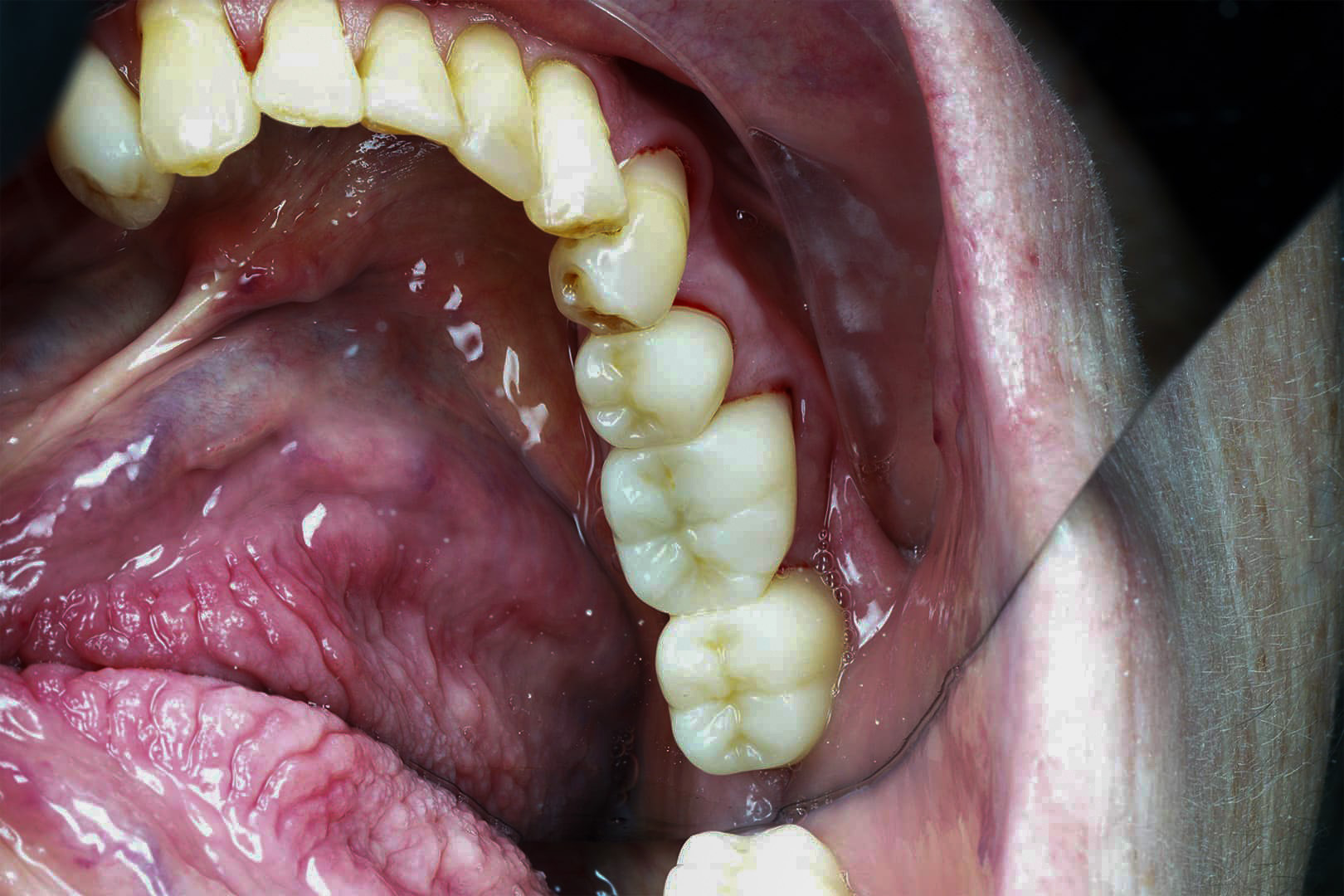
Treatment performed by Dr Jacky Shum, Dentist(AHPRA registration DEN0001659446).
After photograph taken immediately after treatment.
Individual results vary. Images show the outcome for these patients only and do not guarantee the same result.
Our restorative dentists assess decay, cracked or worn enamel and existing restorations before recommending tooth-coloured composite fillings.
Book an assessment for suspected tooth decay, a cavity, a cracked or lost filling, sensitivity around an old restoration, or a front or back tooth that may need repair. The dentist will confirm whether a bonded composite filling, filling repair, replacement restoration, inlay, onlay or crown is appropriate and provide an itemised written quote.
Beyond Dental Care provides general and preventive dental care for babies, toddlers, school-age children and teenagers across Bulimba and nearby Brisbane suburbs. Appointments are adapted to the child’s age, confidence, oral health and ability to participate. The aim is to identify concerns early, support useful home-care habits and make dental visits familiar before pain or urgent treatment becomes the child’s first experience of dentistry.
Our children's dental team provides check-ups, professional cleaning, fluoride treatment, fissure sealants, tooth-coloured fillings, dental trauma assessment, selected extractions and other general dental care within each dentist’s clinical scope. Children who need hospital treatment, general anaesthesia, fixed braces or more complex paediatric management can be referred to an appropriately qualified specialist.
Eligibility and balance checked before treatment
The dental team provides children's check-ups, cleaning, preventive care, fissure sealants, tooth-coloured fillings, dental trauma assessment, selected extractions and other general dental treatment within each dentist's scope. Where a child needs hospital treatment, general anaesthesia, fixed braces or more complex paediatric care, the dentist can arrange referral to an appropriately qualified specialist.
55-second educational explainer
See how a calm first visit may include a parent conversation, counting and examining teeth, checking gums and bite, cleaning or dental X-rays when appropriate, and practical prevention advice.
| Treatment detail | Beyond Dental Care approach |
|---|---|
| Age group | Babies, children and teenagers, including first dental visits |
| First visit timing | When the first tooth appears or by the first birthday, whichever comes first |
| Preventive care | Dental examination, cleaning where appropriate, fluoride advice or application, fissure sealants and home-care guidance |
| Restorative care | Tooth-coloured fillings and other treatment selected according to the tooth, age, cooperation and long-term plan |
| Dental anxiety | Gradual familiarisation, clear explanations, breaks, Comfort Menu options and nitrous oxide where clinically appropriate |
| Complex care | Referral to a registered specialist paediatric dentist, orthodontist or hospital provider when required |
| CDBS | Up to $1,158 over two consecutive calendar years when a new benefit period starts in 2026 and eligibility continues |
| Clinic | Beyond Dental Care · Portside Wharf · (07) 3268 2116 |
Children’s dentist and kids dentist are everyday descriptions for a registered general dentist who provides dental care for babies, children or teenagers. Paediatric dental care describes age-appropriate care for children, but a paediatric dentist is a registered dental specialist with additional specialist training.
At Beyond Dental Care, children’s dental treatment is provided by registered dentists working within their education, experience and clinical scope. Where a child needs complex behavioural support, hospital facilities, general anaesthesia or specialist paediatric management, referral to a registered specialist paediatric dentist can be arranged.

Baby teeth, also called primary teeth, support chewing, speech and normal development. They maintain space and help guide permanent tooth eruption. Although they eventually fall out, primary teeth can still develop decay, infection, pain or an abscess and may require active treatment.
A first visit does not need to involve treatment. A baby or young child may sit on a parent's lap, explore the room, meet the dentist and open their mouth only as much as they comfortably can. The goal is to gather useful information without forcing an examination that the child is not ready to complete.
The exact appointment depends on the child's age, confidence and reason for attending. A first visit may include:
For some young children, meeting the team and becoming familiar with the dental chair is enough for the first appointment. A staged approach can be more useful than attempting too much in one visit.
Baby teeth support chewing, speech and normal development. They also hold space for permanent teeth and help guide them into the mouth. A baby tooth can still develop decay, infection, pain or an abscess even though it will eventually fall out.
Whether a damaged baby tooth should be restored, monitored or removed depends on how much tooth remains, whether the pulp is affected, the child's age, the expected time before the tooth naturally falls out, the position of the permanent tooth and the child's ability to complete treatment. The least complex option is not always extraction, and the most extensive option is not always necessary.
Dental X-rays for children are selected according to the clinical concern, age, cooperation, previous images and expected diagnostic benefit. They are not a routine requirement at every child dental check-up. They may be recommended when the expected diagnostic benefit justifies the exposure. For example, X-rays can show decay between teeth, the depth of a cavity, developing permanent teeth, missing or additional teeth, root changes or the effects of dental trauma.
The appropriate interval depends on decay risk, oral hygiene, enamel quality, previous treatment, diet, orthodontic development and medical factors. Six-monthly visits are common, but some children may need a shorter or longer recall period.
The broader examination and preventive sequence is explained in Check-up & Clean Bulimba.
Dental X-rays are not taken automatically at every children's appointment. They may be recommended when the expected diagnostic benefit justifies the exposure. For example, X-rays can show decay between teeth, the depth of a cavity, developing permanent teeth, missing or additional teeth, infection around a root, dental trauma or concerns about eruption.
The dentist should explain why an image is recommended, what information it is expected to provide and whether an alternative is available. X-rays covered by CDBS remain subject to eligibility, item rules and the child's available balance.
Permanent molars and some baby teeth have deep grooves on their chewing surfaces. These grooves can retain plaque and food even when a child brushes regularly. A fissure sealant is a thin protective material placed over selected grooves to reduce the chance of decay developing in those areas.
Sealants do not replace brushing, fluoride toothpaste or dental reviews. They need to be checked because sections can wear or detach over time. Suitability depends on the tooth's eruption, moisture control, groove anatomy and whether decay is already present.
A custom-fitted sports mouthguard can help protect the teeth, lips and gums of children and teenagers participating in contact or collision sports. It is made from an impression or digital record of the child’s teeth and should be reviewed as the mouth grows, baby teeth are lost, permanent teeth erupt or orthodontic treatment changes the fit.
A small cavity may be managed with a direct filling. A tooth with extensive decay, infection, a large fracture or insufficient remaining structure may need a different restoration, pulp treatment, extraction or specialist assessment. The dentist should discuss the options and how long the baby tooth is expected to remain in the mouth.
For material choices, procedure details and aftercare, see White Fillings Bulimba.
Some badly damaged teeth do not have enough sound structure for a small filling to provide reliable protection. Depending on the tooth and diagnosis, options may include a full-coverage crown, treatment of the dental pulp, root canal treatment for a permanent tooth, extraction or referral.
Pulp treatment in a baby tooth is not identical to adult root canal therapy. The method and materials are selected to preserve the tooth where appropriate without interfering with the developing permanent tooth. We do not promise that every infected baby tooth can be saved, and the treating dentist confirms which materials and procedures are suitable for your child.
More involved care may overlap with root canal treatment or a dental crown, depending on the tooth, age and remaining structure.
A baby tooth may need removal when it is too damaged to restore, infection cannot be controlled with conservative treatment, trauma has made the tooth non-restorable, or the tooth is preventing normal eruption. Extraction can also form part of an orthodontic plan, but the decision requires a clear diagnosis; primary teeth are not removed solely because they are baby teeth.
If a baby tooth is lost earlier than expected, the dentist may assess whether a space maintainer or orthodontic review is needed. This depends on the child's age, the missing tooth, the eruption stage of the permanent tooth and the surrounding spacing.
Children can develop urgent dental pain from decay or infection, and injuries can occur during sport, school or play. Contact our dental team promptly for:
Do not reinsert a knocked-out baby tooth. For a knocked-out permanent tooth, hold it by the crown rather than the root, rinse briefly only if dirty, and seek urgent dental care. If it can be done safely, the tooth may be returned to its socket or kept moist in milk while travelling to the dentist. Serious head injury, loss of consciousness, breathing difficulty or uncontrolled bleeding requires emergency medical care.
For first-aid steps and the urgent booking pathway, see Emergency Dentist Bulimba.
A custom-fitted sports mouthguard can help protect the teeth, lips and gums during contact and collision sports. It is made from an impression or digital record of the child's teeth and should be reviewed as the mouth grows, permanent teeth erupt or orthodontic treatment changes the fit.
A mouthguard cannot prevent every dental or facial injury, but a correctly fitting appliance is easier to retain and generally provides more reliable coverage than a loose over-the-counter guard.
Children's dental visits include more than cavity detection. The dentist can monitor the sequence of tooth eruption, missing or additional teeth, crowding, crossbite, deep bite, open bite, retained baby teeth and habits that may influence development.
Some children may be suitable for clear aligner treatment when they are old enough to follow the wear schedule and the case can be managed by the treating dentist. Beyond Dental Care does not provide fixed metal braces. Children who need conventional braces, growth modification or specialist orthodontic management are referred to a registered orthodontist.
Where clear aligners may be appropriate for an older child or teenager, the assessment process is explained in Clear Aligners & Invisalign® Bulimba.
Dental anxiety in children can relate to an unfamiliar environment, previous treatment, sensory sensitivity, fear of pain or difficulty knowing what will happen next. A nervous child may benefit from more time, fewer steps or several short familiarisation visits before treatment. The dentist can explain instruments in age-appropriate language, use tell-show-do techniques, agree on a stop signal and take breaks when needed.
For children who can complete treatment but need additional help to relax, nitrous oxide and oxygen, often called happy gas, may be considered after a clinical assessment. The child remains awake and responsive. Suitability depends on age, medical history, breathing through the nose, treatment length and the child's ability to accept the nasal hood.
If treatment cannot be completed safely in the dental chair, the dentist may refer the child to a registered specialist paediatric dentist or hospital provider for care under sedation or general anaesthesia. General anaesthesia is not provided as a routine service.
Children with sensory, communication, developmental, behavioural or medical needs may benefit from a planned introduction to the clinic. Useful adjustments can include a quieter appointment time, a shorter first visit, familiarisation before treatment, fewer people in the room, a visual sequence, preferred communication methods and information from parents or carers about triggers and calming strategies.
The dentist will assess whether the required treatment can be delivered safely in the general dental setting. Referral may be recommended when the child needs hospital facilities, general anaesthesia, complex behavioural support or specialist paediatric management.
Preventive dental care for children combines supervised brushing, fluoride toothpaste, sensible dietary habits, professional reviews and treatment such as fluoride or fissure sealants where appropriate. These measures reduce risk but cannot guarantee that a child will remain free of tooth decay.
CDBS is not available to every child automatically. Eligibility is determined by Services Australia, and the available benefit is not a separate annual amount that resets every year. It operates within a two-consecutive-calendar-year benefit period.
A child must meet all of the following conditions for the relevant calendar year:
Families do not need to submit a separate CDBS application. Services Australia normally advises eligible families. Eligibility and balance can also be checked through a linked Medicare account in myGov or by contacting Medicare.
The indexed CDBS cap is $1,158 when a child's new two-year benefit period begins in 2026. That period covers the 2026 and 2027 calendar years, provided the child remains eligible in the second year.
The higher cap does not retrospectively replace an existing benefit period. If a child's two-year period began in 2025, the applicable cap remains $1,132 for the 2025–2026 period, even if treatment continues during 2026.
Subject to item rules, clinical need, eligibility and the available balance, CDBS can cover basic dental services including:
CDBS does not cover orthodontic treatment, cosmetic dental treatment or dental services provided in hospital. A service being clinically recommended does not automatically mean it is covered under the schedule.
| CDBS point | What parents need to know |
|---|---|
| Benefit period | Two consecutive calendar years, starting in the calendar year of the first eligible service |
| 2026-start cap | Up to $1,158 across 2026 and 2027, subject to continued eligibility |
| 2025-start cap | Up to $1,132 across 2025 and 2026 |
| Using the balance | The full balance may be used in the first year, leaving no amount for the second year |
| Unused funds | Unused funds do not carry beyond the two-year period |
| Second-year eligibility | The child must remain eligible to use the remaining balance in year two |
| Item restrictions | Some services have item or timing restrictions even when a balance remains |
| Private health | The same dental service cannot be claimed through both CDBS and a private health insurer |
When booking, tell the team that you intend to use CDBS. Bring the child's Medicare card or ensure the details are available. The practice can check eligibility and the remaining balance before treatment where the required systems are available.
Before treatment, the parent or guardian should receive information about the proposed services, fees and expected CDBS benefit, then sign the required consent form. Whether a visit has no out-of-pocket cost depends on the service, the child's remaining balance, item restrictions and the clinic's current billing arrangements.
For current eligibility rules, covered services and benefit limits, check the official Services Australia Child Dental Benefits Schedule information.
Beyond Dental Care accepts private health funds and can process eligible claims through HICAPS. The rebate and out-of-pocket amount depend on the family's policy, waiting periods, annual limits, item numbers and remaining extras benefits.
A family cannot claim both CDBS and private health insurance for the same dental service. Different services in the same treatment plan may be handled differently, but the billing method should be confirmed before treatment.
Daily prevention reduces the chance that a child's first significant dental experience will involve pain or extensive treatment. Practical measures include:
Arrange an appointment when you notice:
Facial swelling affecting breathing or swallowing, serious facial trauma, loss of consciousness or uncontrolled bleeding requires urgent medical care rather than waiting for a routine dental appointment.
Our children's dentists provide gentle, age-appropriate examinations, cleans and preventive care for Bulimba families.
No. Beyond Dental Care is a general dental practice that treats children as part of family dentistry. Children are seen by general dentists working within each dentist's clinical scope, which covers most of what a child needs through their growing years.
Where a referral is appropriate, it is arranged to a registered specialist paediatric dentist, orthodontist or hospital provider. Being told a referral is needed is not a delay tactic — it means the treatment is better done by someone whose training is built around it.
When the first tooth appears, or by the first birthday, whichever comes first. This is earlier than many parents expect. The visit is deliberately short and low-key, with the examination adapted to the child's age and cooperation.
After the first visit, follow-ups are usually scheduled every six to twelve months depending on what the dentist finds.
Very little that a child would object to. A first appointment is mostly conversation and looking, and it is deliberately paced so nothing is rushed.
Nothing invasive is done at a first visit unless there is an urgent problem. The aim is that the child leaves willing to come back.
Many children are reviewed around every six months, though the interval is set by individual risk. Some children are seen more often for a period, others can safely stretch to twelve months.
Children’s recall intervals should be based on decay risk, development, oral hygiene and previous disease. Primary teeth have thinner enamel and can deteriorate quickly once decay progresses.
Many do, through two separate schemes that are often confused with each other. One is a Queensland public service, the other is a federal Medicare benefit that can be used at a private practice.
Orthodontic and cosmetic treatment is excluded from both schemes. Eligibility rules change from time to time, so confirm current entitlements with Medicare or Queensland Health before assuming cover.
The CDBS is a Medicare benefit that pays for basic dental services for eligible children, capped over a two-year benefit period. It can be used at a private practice, so a child does not have to attend a public clinic to access it.
Eligibility, remaining balance and item restrictions are confirmed before treatment starts, so you know what is covered and what is not before anything is booked.
Yes, subject to eligibility, item rules and the remaining balance. Check-ups and tooth-coloured fillings are among the services the schedule is designed to cover.
The expected benefit is confirmed before treatment so any gap is known in advance.
No. The $1,158 cap applies when a child's new two-year benefit period begins in 2026. A period that started in 2025 stays on the earlier cap even if treatment continues into 2026.
Because the applicable cap depends on when the first eligible service was claimed, the balance is checked before treatment.
The balance is held by Medicare, not by the dental practice, and you can check it yourself at any time.
Balances are commonly reduced by services claimed at another practice, so checking before a treatment plan is agreed avoids an unexpected gap.
No. Orthodontic treatment is excluded from the Child Dental Benefits Schedule, regardless of how much of the cap remains unused.
The exclusion is set by the schedule itself and is not a practice decision, so it applies wherever the child is treated.
Children who do not qualify are treated in exactly the same way; the difference is only in how treatment is paid for.
An itemised estimate is provided before treatment starts, so the cost is known in advance whether or not a benefit applies.
The 7/4 rule is a rough memory aid for tracking when baby teeth arrive. It suggests a first tooth at around seven months, then about four more teeth every four months until all twenty are through.
Treat it as a rough guide rather than a schedule. It is useful for noticing a child who is significantly behind, not for judging one who is a month or two late.
Most first teeth appear between six and twelve months. Eruption is generally considered delayed if there is no tooth by around twelve to eighteen months, and an assessment is sensible by eighteen months.
Late teething on its own is usually harmless. The reason for checking is to confirm the teeth are there rather than to hurry them along.
A four-year-old should have a full set of twenty baby teeth, evenly seated in the gums, with a smooth milky-white surface and small gaps between the front teeth.
The gaps surprise many parents, but they are a good sign — the jaw is making room for the larger adult teeth to come.
Most children lose their first tooth around five or six, but four is within normal variation — particularly for a child who got their baby teeth early. What matters is why the tooth came out.
A baby tooth lost well ahead of schedule can allow neighbouring teeth to drift into the space, so the dentist may assess whether a space maintainer or orthodontic review is needed. That depends on the child's age, which tooth was lost and how the adult teeth are developing.
By age ten, most children have lost somewhere around twelve to fourteen of their twenty baby teeth, and are working through the canines and back molars.
Order matters more than timing. A child who is losing teeth in an unusual sequence is worth reviewing even if the total count looks right.
It is common — decay affects a substantial share of children by age four — but common is not the same as acceptable. Baby teeth have thinner enamel than adult teeth, so decay moves through them faster.
Caught at the chalky white-spot stage, decay can sometimes be arrested with fluoride and better cleaning rather than a filling. Once a hole has formed, it will not heal on its own.
Early decay in toddlers usually shows first as dull, chalky white bands close to the gum line, most often on the upper front teeth. Left alone, those marks darken and the surface breaks down.
White spots are the stage worth acting on. At that point the enamel has lost minerals but has not yet collapsed, and the change can sometimes be halted.
Frequency does more damage than quantity. Sugar and acid feed the bacteria that produce enamel-dissolving acid, and constant grazing never lets saliva neutralise the mouth between exposures.
A single sweet at the end of a meal does far less harm than the same sweet eaten slowly over an afternoon. Confining sugar to mealtimes is usually more effective than removing it entirely.
The 2-2-2 rule is a memory aid: brush twice a day, for two minutes each time, and have a dental check twice a year. It is a simple minimum reminder, not a personalised recall plan.
Two minutes is far longer than most children brush unprompted. A timer or a two-minute song is usually more effective than asking them to count.
Usually yes. The idea that baby teeth do not matter because they fall out overlooks how long some of them stay: the back baby molars are not replaced until around ten to twelve years of age.
The decision weighs how much tooth is left, how close the tooth is to being shed and how the child is managing treatment. A filling is not automatic, and neither is leaving it.
In two steps, and often more gently than parents expect. Very small, shallow cavities in baby teeth can sometimes be treated without numbing at all.
The numb feeling is often stranger for a child than the treatment itself. Explaining that the lip will feel big and sleepy for a while helps more than avoiding the subject.
A filling on a properly numbed tooth should not be painful. Children usually report odd sensations rather than pain, and most single fillings take somewhere between twenty and forty-five minutes.
Time varies with the size of the cavity and which tooth it is — back molars take longer than front teeth — and with how settled the child is on the day.
Where a child needs additional help to relax, nitrous oxide and oxygen — often called happy gas — may be considered after a clinical assessment. The child remains awake and responsive throughout.
Suitability depends on the child, the treatment planned and their medical history and is assessed individually.
General anaesthesia is not provided at the practice. Children who need it are referred to an appropriately qualified specialist or hospital provider.
A referral is a scope decision, not a reflection on the child. Treatment under general anaesthesia belongs with a team equipped and trained for it.
Yes. Where decay or damage reaches the nerve of a baby tooth, treating the pulp and covering the tooth can keep it in place until it is due to be shed naturally.
The dentist should explain the options and how long the restoration is expected to last, since a baby tooth only needs to survive until it is replaced.
Retaining a restorable primary tooth can help preserve space, function and normal development until it is naturally shed. Extraction is considered when the tooth cannot be maintained or when there is another clear clinical reason for removal.
Where a tooth is removed, the dentist assesses whether a space maintainer is needed based on the child's age, which tooth was lost and how the adult teeth are developing.
The teeth on either side can begin to lean into the gap. How much that matters depends on which tooth was lost and how long it will be before the adult tooth arrives.
Early loss of a front baby tooth is often of little consequence. Early loss of a back molar is the situation most likely to need active management.
Act quickly, and treat a baby tooth differently from an adult tooth. This distinction matters more than anything else in the first few minutes.
Call (07) 3268 2116 rather than waiting for the next available routine appointment. Where the injury involves loss of consciousness, a suspected fracture or uncontrolled bleeding, attend a hospital emergency department first.
Pain relief suitable for the child's age and weight, following the directions on the packaging or advice from your pharmacist. Pain relief manages the symptom; it does not treat the cause, and a tooth that is aching needs to be seen.
Swelling of the face or gum, fever, or difficulty swallowing needs same-day attention rather than a routine booking, and hospital assessment if breathing or swallowing is affected.
For any contact or collision sport, yes. A custom mouthguard is made from a mould of the child's own teeth, which is why it fits and stays put in a way a boil-and-bite guard generally does not.
Custom sports mouthguards are individually fitted to the child's teeth and bite, and the fit is reviewed as the teeth change.
Book a baby’s first dental visit, child dental check-up, preventive appointment, tooth-decay assessment or dental trauma review. Our children's dental team provides age-appropriate general dental care, with CDBS billing available for eligible services and fees confirmed before treatment.
Bleeding gums, persistent bad breath, gum recession or teeth that feel loose or have started to shift may indicate gingival inflammation or periodontal disease. Gum disease can progress beneath the gum line with little pain and affect the bone and tissues supporting the teeth. Beyond Dental Care provides periodontal assessment, gum disease treatment and non-surgical deep cleaning for suitable patients in the Bulimba suburb and surrounding Brisbane suburbs.
A deep dental cleaning, also known as scaling and root planing or non-surgical periodontal therapy, is different from a routine Check-up & Clean. It may be recommended when plaque and hardened calculus have accumulated beneath the gum line or within periodontal pockets. Treatment removes these deposits, cleans affected root surfaces and creates better conditions for the gum tissues to heal and stabilise.
Health funds claimed on the spot
A deep clean, also called scaling and root planing or non-surgical periodontal treatment, is different from a routine Check-up & Clean. It is prescribed when plaque and hardened calculus have accumulated beneath the gum line or within periodontal pockets. Treatment removes these deposits, cleans the root surfaces and creates better conditions for the gums to heal and stabilise.
Deep-cleaning fees begin at $232.50. Depending on how much of the mouth requires treatment, the total may range from $232.50 to $930. Your dentist confirms the extent, number of visits and itemised cost after a periodontal assessment.
1-minute 10-second educational explainer
See how periodontal measurements guide scaling and root planing beneath the gum line, including deposit removal, root-surface debridement and ongoing maintenance.
| Treatment detail | Beyond Dental Care approach |
|---|---|
| Cost | From $232.50 |
| Total treatment | $232.50 to $930 depending on the extent of the mouth requiring care |
| Common clinical name | Scaling and root planing, periodontal debridement, non-surgical periodontal treatment or deep dental cleaning |
| Treatment duration | Mild disease may require one or two appointments of about 60 minutes. More extensive disease may require up to four appointments. |
| Comfort options | Local anaesthetic, nitrous oxide for suitable patients, or a combination based on clinical need and patient preference |
| Main purpose | Remove plaque, calculus and bacterial deposits from below the gum line and clean root surfaces to support healing and disease control |
| Follow-up | Reassessment and an individual maintenance interval based on bleeding, pocket depths, bone levels, risk factors and response |
| Complex cases | Referral to a registered specialist periodontist may be recommended when disease is advanced or requires surgical or specialist management |
Periodontal treatment is gum disease treatment for the gums, periodontal ligament and bone that support the teeth. Periodontics is the area of dentistry concerned with these supporting tissues. General dentists can diagnose and manage many periodontal conditions, while a periodontist is a registered specialist who manages more complex disease.
Treatment can range from improved home care and a professional scale for gingivitis to scaling and root planing for periodontitis. Advanced disease may require additional treatment or specialist referral. The diagnosis determines the treatment pathway; bleeding alone does not establish periodontitis.
The main goals are to control inflammation, remove deposits that cannot be reached with a toothbrush, reduce sites where bacteria collect, protect the supporting tissues and establish a maintenance plan that limits further progression.
Gingivitis is inflammation limited to the gums and does not involve loss of the attachment or bone supporting the teeth. Periodontitis affects the deeper supporting tissues and can lead to periodontal pockets, gum recession, bone loss, tooth movement or tooth loss.
| Feature | Gingivitis | Periodontitis |
|---|---|---|
| Main tissues affected | Inflammation is limited mainly to the gum tissue. | Inflammation affects the deeper supporting tissues and may be associated with bone loss. |
| Common signs | Redness, swelling and bleeding during brushing or flossing. | Bleeding, deeper pockets, recession, bad breath, tooth movement or looseness. Symptoms may still be mild. |
| Reversibility | Inflammation can usually resolve when plaque is controlled and professional cleaning is completed. | Lost supporting bone does not simply grow back after cleaning. Treatment aims to stop progression and maintain the remaining support. |
| Typical treatment direction | Oral-hygiene coaching, removal of plaque and calculus, and an appropriate professional cleaning schedule. | Periodontal assessment, scaling and root planing, risk-factor management, reassessment and ongoing supportive periodontal care. |
| Need for referral | Usually managed in general dental care. | Complex, advanced or non-responsive cases may require referral to a registered specialist periodontist. |
Gingivitis does not inevitably progress in every person. Progression is influenced by plaque levels, smoking, diabetes, genetics, immune response, medications, oral hygiene and other individual factors. Early assessment matters because periodontitis can develop with little pain.
Gum disease can be quiet. Some people notice obvious changes, while others have periodontal pockets or bone loss identified only during a dental examination. Possible signs include:
Bleeding gums are common, but they are not a sign that cleaning should stop. They usually indicate inflammation and should be assessed, particularly when bleeding is persistent or accompanied by recession, bad breath or loose teeth.
Rapidly increasing swelling, fever, difficulty swallowing or severe pain needs urgent assessment through Emergency Dentist Bulimba.
Plaque is the main trigger for gum inflammation, but susceptibility and progression vary. A periodontal assessment should consider the mouth, medical history, medicines and lifestyle rather than treating every patient with the same recall interval.
Bleeding gums are common, but persistent bleeding should not be dismissed or treated by avoiding the area. Bleeding, bad breath, gum recession, loose teeth, pus or changes in the bite require assessment to determine whether the cause is gingivitis, periodontitis, a localised gum infection or another condition.
Gum disease diagnosis begins with a periodontal assessment rather than the automatic prescription of a deep clean. The dentist reviews symptoms, medical and dental history, plaque and calculus levels, gum recession, bleeding, tooth mobility and relevant risk factors.
Periodontal pocket depth is only one part of diagnosis. Bleeding, recession, attachment loss, radiographic bone changes, risk factors and disease pattern all influence the treatment plan.
A routine Check-up & Clean may detect early gum changes, but diagnosed periodontitis requires a separate treatment and maintenance plan.
| Question | Routine Check-up & Clean | Deep Cleaning / Periodontal Treatment |
|---|---|---|
| Who is it for? | Patients with healthy gums, mild gingivitis or routine preventive needs. | Patients diagnosed with periodontal disease or deposits extending into periodontal pockets. |
| Where is cleaning focused? | Visible tooth surfaces and accessible areas around the gum line. | Deeper below the gum line and along affected root surfaces. |
| Is root planing included? | Not usually. | Yes, where clinically indicated as part of scaling and root planing. |
| Is local anaesthetic common? | Often unnecessary for a routine clean. | Frequently considered because deeper areas are treated. |
| How many visits? | Usually one comprehensive appointment at Beyond Dental Care. | One to four visits may be required depending on extent and tolerance. |
| What happens next? | Recall interval based on individual preventive needs. | Reassessment followed by supportive periodontal care at an individual interval. |
Routine professional cleaning removes accessible plaque, tartar and surface stain as part of preventive dental care. Scaling and root planing (deep cleaning) treats diagnosed periodontal disease by removing deposits and cleaning affected root surfaces beneath the gum line. A routine clean cannot replace periodontal therapy where deeper disease is present, but bleeding gums alone do not automatically mean that multi-visit scaling and root planing is required.
The exact sequence depends on the number of areas affected, the depth and accessibility of deposits, sensitivity and the patient's ability to tolerate a longer appointment. A typical deep-cleaning plan includes:
The goal is not to scrape away healthy tooth structure. Treatment removes deposits and contaminated surface material that maintain inflammation. Some areas are straightforward to access, while deep pockets, root grooves, furcations and crowded teeth can make treatment more complex.
Scaling and root planing reaches areas below the gum line, so local anaesthetic is commonly used to numb the gums and tooth roots. Patients may feel pressure, vibration and water movement, but sharp pain should be reported so the dentist can pause and adjust the anaesthetic or technique.
Nitrous oxide may be available for suitable patients who feel anxious. Treatment can also be divided into shorter appointments when completing the entire mouth in one visit would be uncomfortable or clinically impractical.
After treatment, temporary tenderness, minor bleeding and sensitivity to temperature can occur. These effects usually reduce as the tissues settle. The dentist will provide instructions based on the areas treated, anaesthetic used and the patient's medical history.
A deep clean for mild or localised gum disease may take one or two appointments of around 60 minutes. More extensive periodontal treatment may be divided across as many as four appointments so each area can be cleaned carefully and comfort can be maintained.
The number of visits depends on how much of the mouth is affected, deposit levels, pocket depth, sensitivity, root anatomy and whether the dentist needs to reassess one area before proceeding. Appointment count is not a direct measure of how severe the disease is.
Supportive periodontal therapy begins after active gum disease treatment and reassessment. The dentist reviews plaque control, bleeding, tissue response, pocket measurements, tooth mobility and areas that remain difficult to clean before setting an individual periodontal maintenance schedule.
Follow the instructions provided at the appointment. Contact the clinic if pain worsens instead of improving, bleeding does not settle, swelling increases, fever develops or the bite feels unexpectedly different.
The result of deep cleaning cannot be judged only by how smooth the teeth feel. At review, the dentist considers plaque control, bleeding, tissue response, pocket measurements, mobility and any remaining areas that are difficult to access. If the gums respond well, the next stage is ongoing periodontal maintenance (supportive periodontal care). If deep or bleeding pockets remain, the dentist may recommend additional non-surgical treatment, further imaging or referral to a registered specialist periodontist.
The standard six-month recall is not suitable for every person with a history of periodontitis. Some patients may be reviewed and maintained approximately every three to four months, while others can safely attend at a different interval. The schedule should be based on current inflammation, pocket depths, previous bone loss, plaque control, smoking, diabetes and treatment response.
Periodontal maintenance is scheduled according to disease risk and should not be confused with a routine Check-up & Clean.
Professional treatment removes deposits that home tools cannot reach, but it cannot replace daily plaque control. The most useful routine is the one a patient can perform consistently and correctly.
The Australian Dental Association recommends cleaning between teeth once a day and attending regular professional check-ups and cleaning. Individual periodontal patients may need more specific tools and a shorter professional-maintenance interval.
Periodontitis has recognised associations with conditions including diabetes and cardiovascular disease, and periodontal inflammation is relevant during pregnancy. These associations do not mean gum disease directly causes every linked condition, or that deep cleaning replaces medical treatment.
The practical approach is coordinated care. Tell the dentist about diabetes, pregnancy, cardiovascular conditions, immune disorders and relevant medicines. Patients should continue medical care with their GP or specialist while periodontal disease is assessed and managed by the dental team.
Deep-cleaning fees start from $232.50. Depending on the percentage of the mouth requiring treatment, the total may range from $232.50 to $930. The dentist will confirm the areas involved, number of appointments and itemised fees before treatment begins.
| Cost factor | Why it changes the treatment plan or fee |
|---|---|
| Extent of the mouth affected | Localised treatment requires less appointment time than treatment across multiple areas. |
| Deposit levels and pocket access | Heavy subgingival calculus and difficult root anatomy can require more detailed instrumentation. |
| Number and length of appointments | Treatment may be completed in one or two visits or divided across up to four appointments. |
| Anaesthetic and comfort needs | The treatment sequence may be adjusted for sensitivity, anxiety and tolerance. |
| Additional diagnostics | Clinically required X-rays or other diagnostic procedures may be itemised separately. |
| Further care | Maintenance, additional treatment or specialist referral is separate from the initial deep-cleaning course. |
Deep cleaning can be unexpected, particularly when gum disease has progressed without pain. Beyond Dental Care offers payment options that may help eligible patients spread treatment costs. Third-party approval, fees and terms apply.
Inflammation affecting the soft tissues around an implant may be described as peri-implant mucositis. When inflammation is associated with progressive loss of supporting bone, peri-implantitis may be present. Bleeding, discharge, increasing pocket depth, discomfort or changes around an implant require assessment rather than routine cleaning alone.
Payment arrangements should not change the clinical diagnosis or lead to unnecessary treatment. Ask for an itemised plan showing the proposed areas, appointments, likely health-fund rebate and any separate review or maintenance fees.
When periodontal treatment is spread across several visits, the available dental payment plans can be compared with the full itemised cost.
Many cases of gingivitis and mild to moderate periodontitis can be assessed and treated in general dental practice. Referral to a registered specialist periodontist may be recommended when:
Periodontist is a protected specialist title. Our dental team includes registered dentists providing gum assessment and non-surgical periodontal care, with specialist referral where clinically appropriate.
Active gum disease should be identified and stabilised before implant treatment is planned. Existing bone loss, smoking, plaque control and maintenance history influence implant risk and long-term care.
After implant placement, professional reviews remain important because inflammation can affect the tissues around implants as well as natural teeth.
Stable gum health is part of suitability and long-term maintenance for dental implant treatment.
Our dentists assess bleeding, inflammation, pocketing and plaque risk before recommending a staged gum-care plan.
A deep clean is different from a routine dental clean because it treats diagnosed periodontal disease below the gum line rather than providing preventive cleaning alone. Scaling and root planing reaches periodontal pockets and affected root surfaces that may not be accessible during a standard clean.
Bleeding gums alone do not automatically mean that a deep clean is required. The dentist first determines whether the problem is gingivitis, periodontitis or another condition.
Periodontal treatment describes care for the gums and tissues supporting the teeth, while a periodontist is a registered dental specialist. Many cases of gingivitis and mild to moderate periodontitis can be assessed and managed by a general dentist.
The distinction matters because receiving periodontal treatment does not mean the treating dentist is claiming to be a periodontist. Referral is arranged where the disease or procedure falls outside general dental management.
Scaling and root planing is recommended after a periodontal assessment shows that deeper gum disease requires treatment. Bleeding gums are one clue, but the decision is based on the full pattern of findings rather than on a single symptom.
A routine clean may be enough for healthy gums or gingivitis. Diagnosed periodontitis usually needs its own treatment and maintenance plan.
A routine clean can remove accessible deposits around the gum line, but established calculus deeper inside periodontal pockets may require scaling and root planing. The important distinction is where the calculus is located and whether the supporting tissues have been affected, not only how much is present.
The dentist determines the treatment depth after examining the gums. More intensive cleaning is not beneficial when periodontal treatment is not clinically indicated.
Deep cleaning can control and stabilise periodontitis, but it does not erase damage that has already occurred or guarantee that the disease will never become active again. Scaling and root planing removes deposits and disrupts bacterial biofilm so inflamed tissues have better conditions to heal.
Periodontitis is therefore managed rather than treated once and forgotten. Reassessment determines whether the disease is stable or whether further periodontal treatment or specialist review is needed.
Deep cleaning does not regrow established gum recession. What often changes is inflammation: swollen tissue can become firmer and sit more closely around the teeth once deposits are removed and the gums begin to settle.
The dentist reassesses the tissues after treatment and can explain whether the appearance reflects healthy reduction in swelling, existing recession or an area that needs further management.
Teeth can look longer after deep cleaning because swollen gum tissue has reduced and existing recession has become easier to see. Removing thick calculus can also reveal tooth surfaces and spaces that were previously covered by deposits.
The important measures are bleeding, pocket depths, plaque control, mobility and overall tissue response. If recession creates persistent sensitivity or an aesthetic concern, the dentist can discuss whether additional management is appropriate.
The number of appointments depends on how much of the mouth requires treatment and how complex the affected areas are. Mild or localised disease may require one or two appointments of about 60 minutes, while more extensive treatment may be divided across up to four visits.
The final sequence is confirmed after periodontal assessment. Needing several visits does not by itself indicate how severe the disease is.
Deep-cleaning treatment starts from $232.50 and may total $232.50 to $930 depending on how much of the mouth requires treatment. For gum care in Bulimba, the dentist confirms the affected areas, number of appointments and itemised fees after periodontal assessment.
An itemised treatment plan is provided before treatment begins so the initial deep-cleaning course can be distinguished from later maintenance or specialist care.
Gum disease can become active again after successful treatment because plaque and calculus can accumulate again and individual risk factors remain. This is why periodontitis usually requires ongoing monitoring rather than a single course of deep cleaning with no further review.
A recurrence does not necessarily mean the original treatment failed. Periodontitis is a condition that can fluctuate, so detecting renewed inflammation early makes it easier to decide what additional care is needed.
Smoking can make gum disease less obvious because visible bleeding may be reduced even while periodontal breakdown is occurring. A lack of bleeding therefore does not necessarily mean the gums are healthy in someone who currently smokes or has a significant smoking history.
The dentist combines this information with pocket measurements, bone levels, recession, plaque and tooth mobility rather than relying on bleeding alone. Smoking cessation support can also be discussed where appropriate.
A periodontist referral may be recommended when periodontal disease is advanced, difficult to access, progressing rapidly or not responding sufficiently to appropriate non-surgical treatment. Beyond Dental Care's general dentists provide periodontal assessment and non-surgical gum care within their clinical scope.
Referral does not mean that routine dental care stops. General dental reviews and preventive care can continue while the specialist manages the aspects requiring advanced periodontal expertise.
Deep cleaning should be manageable with appropriate anaesthesia and pacing. Because scaling and root planing reaches below the gum line and along sensitive root surfaces, local anaesthetic is commonly used, and nitrous oxide may be considered for suitable anxious patients.
Sharp pain during treatment should be reported immediately so the dentist can pause and adjust the anaesthetic or technique. Comfort planning is individual and can include dividing treatment into shorter appointments.
Periodontal pockets can become shallower after deep cleaning when inflammation reduces and the gum tissue heals more closely around a clean root surface. The amount of improvement varies and cannot be predicted from the starting pocket measurement alone.
The dentist remeasures the gums after active treatment rather than assuming every pocket has responded. Persistent deep or bleeding sites may need additional non-surgical care, further imaging or specialist periodontal assessment.
The main disadvantages of deep cleaning are temporary discomfort, sensitivity and the possibility that gum recession or spaces between teeth become more noticeable as inflammation settles. Treatment may also require several appointments and does not restore bone or gum tissue already lost to periodontitis.
These limitations are weighed against the risk of leaving active periodontitis untreated. The dentist should explain expected benefits, alternatives and limitations before treatment so the decision is based on the individual periodontal findings.
After deep cleaning, avoid anything that unnecessarily irritates healing gum tissue or interferes with plaque control. The exact instructions depend on the areas treated, the anaesthetic used and your medical history, so the advice given at the appointment takes priority.
Some tenderness and sensitivity can occur after treatment. Contact the clinic if symptoms worsen rather than gradually settling, or if swelling, fever or another unexpected change develops.
The alternative depends on the diagnosis. A person with gingivitis may improve with better plaque control and an appropriate professional clean, but diagnosed periodontitis with deposits inside periodontal pockets cannot usually be managed by a routine clean or home care alone.
There is no single substitute that is appropriate for every patient. The safest comparison is made after the dentist has confirmed whether the condition is gingivitis, periodontitis or another gum problem.
Mild soreness or tenderness can persist for a few days after scaling and root planing, particularly where the gums were already inflamed or deeper areas were treated. Sensitivity may also be noticeable around root surfaces that were previously covered by deposits or swollen tissue.
Recovery varies with the amount of treatment, inflammation, sensitivity and individual healing. Pain that is severe or worsening should not be assumed to be part of normal recovery and should be assessed.
Feeling generally unwell is not an expected goal or routine effect of deep cleaning. Local tenderness, mild bleeding and tooth sensitivity can occur, but fever, increasing swelling or worsening pain deserves prompt assessment rather than being dismissed as normal healing.
Contact the clinic promptly for worsening dental symptoms. Difficulty breathing or swallowing, rapidly increasing facial or neck swelling, serious facial trauma or uncontrolled bleeding requires urgent hospital assessment.
A history of periodontitis usually means ongoing periodontal monitoring remains important, although the frequency and type of maintenance can change over time. The dentist sets the interval according to current disease activity and risk rather than assigning every patient the same permanent schedule.
If periodontal health remains stable, the interval may be adjusted. If bleeding or deeper pockets return, the dentist may recommend closer maintenance, additional treatment or specialist review.
Gingivitis can usually resolve when plaque and calculus are controlled because the inflammation is limited mainly to the gum tissue and has not caused the supporting-tissue loss seen with periodontitis. Early assessment is useful because the two conditions require different treatment pathways.
Once periodontitis has developed, treatment aims to control the disease and preserve the support that remains rather than describing the condition as completely reversed.
Gum tissue can tighten more closely around cleaned tooth roots as inflammation reduces, and periodontal pockets may become shallower. This healing response is different from growing back gum tissue or bone that has already been lost.
The dentist measures the response at reassessment instead of relying on appearance alone. Areas that remain deep or continue to bleed may require further non-surgical treatment or referral to a registered specialist periodontist.
Deep cleaning does not cause tooth loss. If periodontitis has already reduced bone support, existing tooth mobility may become more noticeable as swelling and heavy deposits are removed.
If a tooth feels substantially looser after treatment, the dentist should reassess it. Mobility reflects the condition of the supporting tissues and needs to be interpreted in the context of the periodontal diagnosis.
Some people with a history of periodontitis benefit from periodontal maintenance approximately every three to four months because their risk and previously affected sites require closer professional monitoring. This is not a fixed interval for every patient.
The maintenance schedule is based on response and risk, not on the calendar alone. Some patients may need a different interval once periodontal health has been reassessed.
Brush twice daily and clean between the teeth every day unless the dentist gives different site-specific instructions. With periodontal disease, technique and access to the gum margins matter more than repeatedly scrubbing the teeth.
Bleeding during cleaning is usually a reason to have the gums assessed, not a reason to stop cleaning altogether. The dentist can demonstrate tools suited to the pocket pattern and spaces present.
Many teeth affected by periodontal disease can be maintained when enough supporting tissue remains and the disease responds to treatment and ongoing maintenance. Whether a particular tooth can be saved depends on its individual prognosis rather than simply on the diagnosis of periodontitis.
The dentist reassesses individual teeth after treatment. Where the prognosis remains uncertain or advanced management may improve the options, referral to a periodontist can be considered.
Periodontitis is important because it affects the bone and other tissues that hold teeth in place, and it can progress with surprisingly little pain. Untreated disease can lead to deeper pockets, recession, tooth movement, mobility and eventual loss of periodontal support.
Serious does not mean untreatable. The aim is to identify the disease, control active inflammation and preserve as much healthy periodontal support as possible.
There is no reliable safe period for leaving diagnosed periodontitis untreated. Progression varies between people and between different areas of the same mouth, and the disease can cause further supporting-tissue loss without producing severe pain.
Treatment timing is confirmed after examination. Rapidly increasing swelling, fever, severe pain or difficulty swallowing needs urgent assessment rather than a routine periodontal appointment.
Persistent bad breath can be associated with gum disease because plaque, calculus and inflamed periodontal pockets can retain bacterial deposits that are difficult to remove with routine brushing. Bad breath alone, however, does not prove that periodontitis is present.
If bad breath repeatedly returns despite normal brushing and interdental cleaning, a dental examination can determine whether gum disease, another dental condition or a non-dental cause needs attention.
Periodontitis can make teeth loose or allow them to shift when supporting bone and periodontal attachment have been lost. New gaps, changes in tooth position or a different bite can therefore be important signs of more advanced periodontal involvement.
Mobility does not automatically mean the tooth has to be lost. Its prognosis depends on the remaining support, disease control and how the tooth responds after periodontal treatment.
Diabetes is an important periodontal risk factor, particularly when blood glucose is not well controlled. It does not prevent periodontal treatment, but it is relevant when the dentist assesses disease severity, healing, maintenance needs and the likelihood of recurrent inflammation.
Dental treatment does not replace medical diabetes care. Periodontal management and medical management should continue alongside each other, with the dentist recommending medical review where information relevant to safe dental care needs clarification.
Pregnancy-related hormonal changes can increase gum inflammation, so some people notice more bleeding, redness or swelling during pregnancy. These changes do not automatically mean that periodontitis is present, but persistent symptoms still deserve dental assessment.
Tell the dentist that you are pregnant and provide relevant medical information. Appropriate dental assessment and plaque control remain important during pregnancy, while treatment is planned according to the diagnosis and individual clinical circumstances.
Some private health extras policies may provide a rebate for eligible periodontal items, but the amount depends on the individual fund, policy, waiting periods, annual limits and remaining benefits. Coverage is therefore not assumed from the treatment name alone.
For patients travelling from Bulimba for periodontal treatment, the treatment plan should distinguish the initial deep-cleaning course from separate diagnostic, review, maintenance or specialist services so the relevant benefits can be checked accurately.
Beyond Dental Care offers payment options that may help eligible patients spread the cost of periodontal treatment. Payment arrangements are separate from the clinical decision about what treatment is needed, and third-party approval, fees and terms may apply.
Payment plans and SuperCare may be available where eligibility requirements are met. Suitability, treatment extent and fees are confirmed after periodontal assessment so financing does not determine the diagnosis or lead to treatment that is not clinically required.
Book an assessment for bleeding gums, persistent bad breath, gum recession, loose or shifting teeth, a suspected gum infection or previous periodontal bone loss. The dentist will confirm whether you need preventive cleaning, scaling and root planing, supportive periodontal maintenance or specialist referral and provide a staged written plan.
Root canal treatment, also called root canal therapy or endodontic treatment, removes inflamed, infected or non-vital pulp tissue from the root canal system, then cleans, shapes and seals the canals. The dental pulp is often described as the “tooth nerve”, although it also contains blood vessels and connective tissue. The aim is to preserve the natural tooth when it can be restored with a reasonable prognosis.
Payment plans and SuperCare where eligible
Root canal therapy generally costs from $700 to $1,500 depending on the tooth, number of canals, infection, anatomy and number of appointments. A temporary filling, core build-up, final filling or dental crown may also be required and is quoted separately. For a fuller breakdown, see our guide to root canal cost in Brisbane.
58-second educational explainer
See how inflamed or infected tissue is removed from inside a tooth before the canals are cleaned, shaped, filled and sealed, followed by a filling or crown.
| Treatment detail | Beyond Dental Care approach |
|---|---|
| Cost | $700 to $1,500 |
| Typical duration | One to three sessions, commonly around 60 minutes each |
| Main purpose | Remove infected or inflamed pulp, clean and seal the canal system, and retain the tooth where possible |
| Diagnosis | Clinical examination, dental X-rays and additional tests where clinically required |
| Comfort options | Local anaesthetic, nitrous oxide where suitable, slower pacing and the Comfort Menu |
| Final restoration | A tooth-coloured filling, core restoration or crown may be recommended after treatment |
| Complex cases | Referral to a registered specialist endodontist may be recommended when the case is outside the treating dentist's scope |
| Treatment pathways commonly compared with root canal care | Emergency Dentist, Dental Crowns, White Fillings, Tooth Extraction, Dental Bridges and Dental Implants |
Endodontics is the area of dentistry concerned with the dental pulp, root canals and tissues surrounding the tooth roots. Root canal treatment, root canal therapy, RCT and endodontic treatment describe the same broad procedure.
A painful or infected tooth is sometimes described as having an “infected nerve”, “dead nerve” or “dead tooth”. Clinically, the dentist determines whether the pulp is healthy, reversibly irritated, irreversibly inflamed, infected or non-vital before recommending treatment.
Endodontist is a protected specialist title. Beyond Dental Care’s general dentists provide root canal treatment within their training, experience and clinical scope and refer complex cases to a registered specialist endodontist where appropriate.
Inside each tooth is a pulp chamber containing nerves, blood vessels and connective tissue. Narrow canals extend through the roots. When the pulp develops irreversible inflammation, infection or necrosis, a routine filling cannot remove the affected tissue from inside the canal system.
Root canal treatment removes the affected pulp, cleans and shapes the internal canal system, disinfects the space and seals it to reduce the risk of reinfection. The opening in the tooth is then restored with a filling, core restoration or crown so the tooth can return to function.
The treatment does not remove the tooth root. It aims to keep the natural tooth in the jaw and avoid extraction when the remaining tooth structure, root and supporting tissues are suitable.
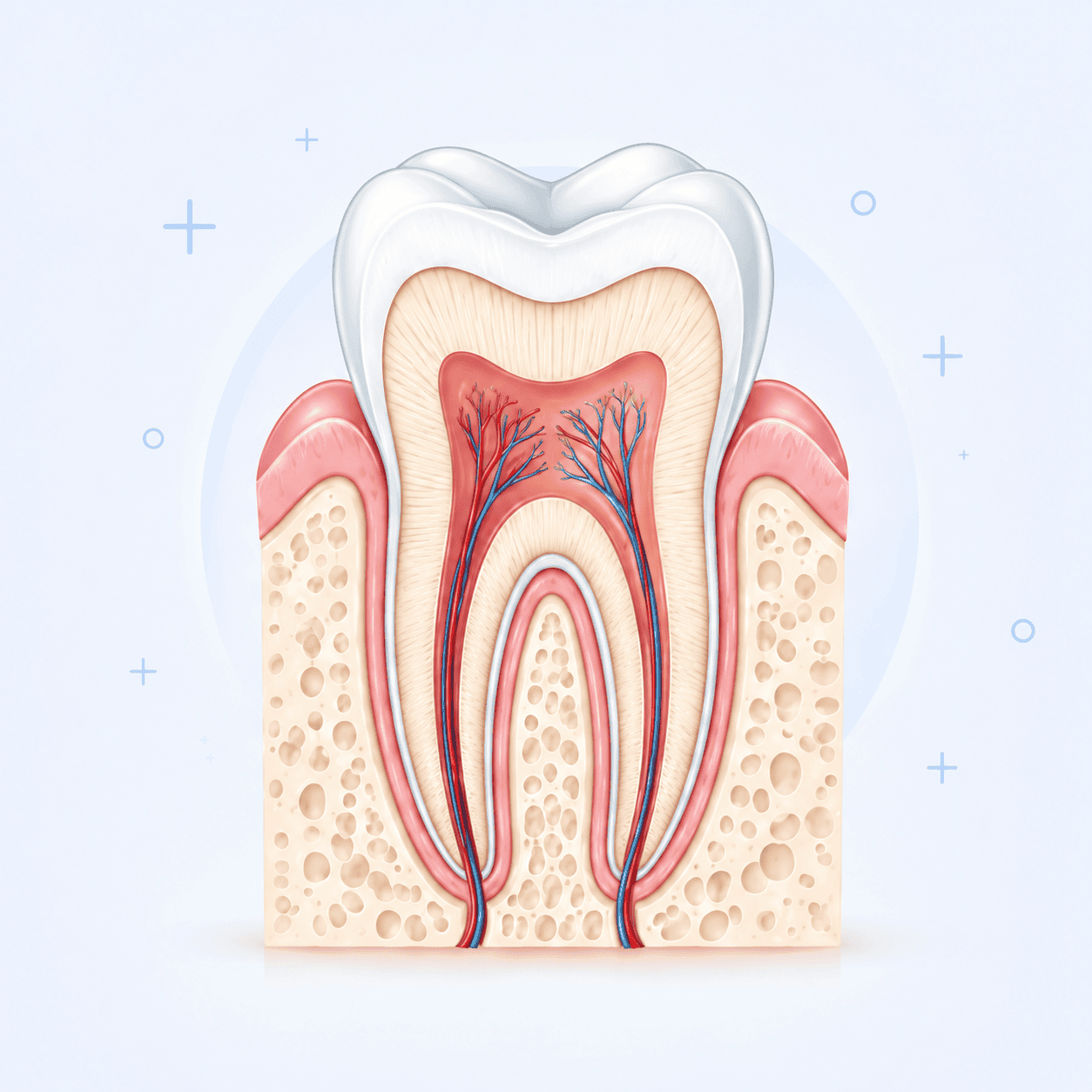
Root canal treatment may be required when deep decay, a crack, trauma, repeated dental work or a failed restoration causes irreversible pulpitis, pulp necrosis or infection around the root. The external tooth may sometimes appear intact even when the pulp has been damaged.
Antibiotics may sometimes be prescribed when infection is spreading or there are systemic signs, but antibiotics alone do not remove infected tissue from inside the root canal system. The source of infection still needs dental assessment and treatment.
Symptoms vary according to the condition of the pulp and surrounding tissues. Some teeth produce severe pain, while others are identified during examination or on a dental X-ray after the pulp has become non-vital.
Not every toothache requires root canal therapy. Cracks, gum disease, sinus pressure, bite problems, sensitivity, a high filling and referred pain can produce similar symptoms. Diagnosis is required before treatment is recommended.
Severe toothache, swelling, a dental abscess, a broken tooth or pain that prevents eating or sleeping should be assessed promptly. Emergency treatment may begin with diagnostic tests, pressure relief, drainage where appropriate, cleaning of the pulp chamber or canals, medication within the tooth and a temporary seal. Completing the full root canal and final restoration may require later appointments.
Severe pain, swelling or an acute dental infection may need the earliest available appointment through Emergency Dentist Bulimba.
Root canal diagnosis combines the symptom history with examination, pulp testing, pressure or bite tests and dental imaging. No single symptom or X-ray finding should be used by itself to determine whether irreversible treatment is required.
A diagnosis should be made before irreversible treatment begins. In some cases, monitoring, a replacement filling, a crown, crack protection or another treatment may be more appropriate than root canal therapy.
Depending on the depth of damage and remaining tooth structure, treatment may also involve a white filling or a dental crown.
The exact sequence depends on the tooth, infection and number of visits. A typical procedure includes:
Root canal treatment may be completed in one visit or staged over several appointments. Additional visits may be needed for active infection, drainage, several canals, difficult or calcified anatomy, previous root filling material, removal of an existing restoration or uncertainty about the diagnosis.
A temporary filling between visits protects the access opening but is not the final restoration. Follow the dentist's instructions and return promptly if the temporary filling breaks, the tooth feels different or symptoms worsen.
Beyond Dental Care advises that treatment may require one to three sessions, commonly around 60 minutes each. A front tooth may have one canal, while a premolar or molar can have more complex anatomy. The number of canals, infection level, previous treatment and difficulty locating or cleaning the canals all affect appointment time.
Root canal treatment and the final restoration are separate stages. A crown may be recommended afterward depending on the tooth and how much structure remains. A crown can sometimes be completed using in-clinic same-day CEREC technology, but the dentist must first determine that the root canal treatment is complete and the tooth is ready for its final restoration.
The tooth and surrounding area are numbed with local anaesthetic before treatment. The procedure is intended to remove the source of pain, but it should not be described as universally painless. Inflamed teeth can sometimes be more difficult to numb, and pressure, vibration or temporary tenderness may still be felt.
Tell the dentist if you are anxious, have had difficulty becoming numb, have a strong gag reflex or need more explanation and breaks. The appointment may include slower pacing, a stop signal, local anaesthetic adjustments, nitrous oxide where suitable and the Comfort Menu.
After treatment, mild tenderness around the tooth can occur while the surrounding tissues settle. Severe pain, increasing swelling, fever, a rapidly changing bite or symptoms that worsen after the first few days should be reported to the clinic.
Root canal therapy generally costs from $700 to $1,500. The final amount depends on whether the tooth is an incisor, canine, premolar or molar, the number and shape of the canals, infection, previous treatment, case difficulty and the number of appointments. Diagnostic records, temporary restorations, core build-up and the final filling or crown are identified separately in the written plan.
| Cost factor | Why it changes the fee |
|---|---|
| Tooth type | Front teeth commonly have simpler canal anatomy than many premolars and molars. |
| Number of canals | More canals require additional cleaning, shaping, disinfection and filling. |
| Infection or abscess | Active infection, drainage or medication between visits may increase treatment stages. |
| Previous root canal treatment | Retreatment can require removal of existing material and investigation of missed or reinfected canals. |
| Canal anatomy | Curved, narrow, calcified or difficult-to-locate canals can increase complexity. |
| Restoration removal | An existing filling or crown may need to be removed or accessed before treatment. |
| Imaging and tests | Clinically required X-rays, tests or additional imaging may be itemised. |
| Final restoration | A filling, core build-up, post or crown may be required after the root canal and is priced separately. |
| Specialist referral | A registered specialist endodontist sets independent fees if referral is required. |
Many root-canal-treated teeth need additional protection because the tooth may already have lost substantial structure through decay, fracture, previous fillings and the access opening required for treatment. Back teeth also carry greater chewing forces. A dental crown can cover and reinforce a weakened tooth, but it is not automatically required for every root canal.
A core build-up replaces missing internal tooth structure and creates a stable foundation for the final restoration where required. It is separate from the root canal filling placed inside the roots and separate from the crown that covers the visible tooth.
A front tooth with strong remaining structure may sometimes be restored with a bonded filling. A molar, premolar, cracked tooth or heavily restored tooth is more likely to need a crown or another indirect restoration. The decision depends on remaining tooth structure, crack risk, bite forces, tooth position and the amount of restorative material already present.
Where suitable, ceramic crowns may be designed and milled in-clinic using CEREC technology for same-day placement. Other crowns may be made through a dental laboratory. The dentist will confirm which approach is suitable after the root canal phase.
The restoration used after treatment is explained in more detail in Dental Crowns Bulimba.
| Question | Dental filling | Root canal treatment |
|---|---|---|
| What is treated? | Decay or damage affecting the outer tooth structure | Inflamed, infected or non-vital tissue inside the tooth |
| Is the pulp removed? | No | Yes, the affected pulp is removed and the canals are sealed |
| Typical indication | Small to moderate cavity or direct restoration | Deep decay, pulp infection, trauma or irreversible inflammation |
| Final restoration | Composite filling may complete treatment | A filling, core or crown is placed after the canal system is treated |
| Current Beyond Dental Care fee | From $200; extensive fillings up to $600 | $700 to $1,500, with final restoration separate |
A filling cannot disinfect infected root canals. Conversely, a root canal is not needed merely because a tooth has a small cavity. Examination and testing determine how deeply the problem extends.
When decay is limited to the outer tooth and the pulp remains healthy, a white filling may be sufficient instead.
Root canal treatment retains the natural tooth and root, while extraction removes the tooth completely. The decision depends on restorability, cracks, bone and gum support, infection, prognosis, treatment burden and the patient’s wider dental plan.
| Consideration | Root canal treatment | Tooth extraction |
|---|---|---|
| Main goal | Treat the internal infection and retain the natural tooth | Remove the tooth and source of infection or damage |
| When considered | The tooth has enough sound structure and support to restore | The tooth is non-restorable, severely fractured or has a poor prognosis |
| Further treatment | A filling or crown may be required | A gap may be left or replaced with a bridge or implant |
| Treatment time | Usually staged over one to three visits plus restoration | Extraction may be completed sooner, but replacement adds treatment time |
| Long-term planning | Ongoing care of the restored natural tooth | Healing, space management and possible tooth replacement |
If the tooth cannot be retained, compare tooth extraction and the later replacement options of a dental bridge or dental implant.
Pain can temporarily settle when the pulp dies, but this does not mean the infection has resolved. Bacteria may continue through the root canal system and affect the bone and tissues around the root. Delay can lead to recurrent pain, an abscess, swelling, bone loss, tooth fracture or the need for extraction.
The urgency depends on diagnosis and symptoms. A tooth with spreading swelling, fever, difficulty swallowing, severe pain or facial changes needs prompt assessment. A symptom-free tooth with an X-ray finding may still require planned treatment, but the dentist can explain the timeframe and monitoring requirements.
Ongoing Check-up & Clean appointments help monitor the treated tooth, final restoration and surrounding gum.
There is no guaranteed lifespan. A treated tooth may remain functional for many years when the canal system has been adequately treated, the tooth is restored promptly, the surrounding tissues heal and oral hygiene and bite forces are managed. Longevity is influenced by the amount of tooth remaining, cracks, crown or filling quality, gum health, new decay, grinding and regular dental review.
The tooth can still develop a cavity, fracture, gum disease or reinfection. Root canal treatment removes the pulp but does not make the tooth maintenance-free.
Root canal treatment is a routine dental procedure, but no outcome can be guaranteed. Risks and limitations may include:
The dentist should explain the diagnosis, treatment alternatives, expected stages, restoration requirements, material risks and what would happen if treatment is not completed.
A previously treated tooth can develop new pain, infection or an X-ray change months or years later. Possible causes include new decay, leakage beneath a filling or crown, a crack, untreated canal anatomy, delayed final restoration or a new problem affecting the tooth. The phrase “failed root canal” is commonly used, but the cause and available treatment options must be diagnosed before assuming that the tooth requires extraction.
Endodontic retreatment involves reopening the tooth, removing previous root filling material, cleaning the canals again and resealing them. It is more complex than first-time treatment and may be referred to a specialist endodontist depending on anatomy, previous treatment and expected prognosis.
The visible result in this consented case includes root canal treatment and a final ceramic crown. Root canal therapy treats the inside of the tooth; the crown restores and protects the visible tooth structure where full coverage is required.


Treatment performed by Dr Mitesh Vasant, Dentist(AHPRA registration DEN0001791968).
After photograph taken approximately 3 weeks after treatment.
Individual results vary. Images show the outcome for these patients only and do not guarantee the same result.
Dr PA Zaw and Dr Muhammad Qasim assess the tooth, imaging and symptoms before recommending root canal (endodontic) treatment.
Book an assessment for persistent toothache, lingering temperature sensitivity, pain when biting, a darkened tooth, swelling, a gum pimple, a deep cavity or symptoms affecting a previously root-canal-treated tooth. Dr PA Zaw will assess the tooth, pulp, roots and restorability before explaining whether a filling, crown, root canal treatment, retreatment, extraction or specialist referral is appropriate.
Dental implant treatment can replace one missing tooth with an implant-supported crown, several adjacent teeth with an implant-supported bridge, improve the stability of a removable implant overdenture or support a fixed full-arch restoration. A single implant and custom crown starts from $5,000.
A complete implant restoration usually includes the implant fixture placed in the jaw, an abutment and the visible crown, bridge or denture. The free implant consultation discusses suitability, treatment stages, likely costs and payment options. Dental X-rays, CBCT imaging, scans and other diagnostic or preparatory treatment are charged separately.
Payment plans and SuperCare where eligible
53-second educational explainer
See the main stages of a single-tooth implant pathway, from assessment and implant placement to healing, abutment connection and the final custom crown.
The appropriate tooth-replacement pathway depends on how many teeth are missing, whether the gap is isolated or extends across an arch, the condition of remaining teeth, available bone, gum health, bite, cleaning access and whether the final restoration should be fixed or removable.
| Your situation | Possible option | Starting from | Typical planning |
|---|---|---|---|
| One missing tooth | Single implant with custom crown | From $5,000 | ~3–6 months |
| Three or four missing in a row | Implant-supported bridge | From $8,000 | ~4–6 months |
| Loose or uncomfortable denture | Implant overdenture | From $6,500 | ~3–4 months |
| Full upper or lower arch | All-on-4™ full-arch restoration | From $20,000 / arch | ~4–6 months |
| Full arch, six implants where planned | All-on-6™ full-arch restoration | From $30,000 / arch | ~4–6 months |
| Insufficient bone in an implant area | Bone grafting where indicated | From $600 | May add ~3–4 months |
Timelines and fees are estimates for standard pathways. Healing, extractions, grafting, anatomy, medical factors and the final restoration can change the schedule and cost.
Dental implant cost depends on the complete treatment rather than the implant fixture alone. An itemised estimate should identify the implant fixture, abutment, crown, bridge or denture, diagnostic imaging, extractions, temporary teeth, grafting, sedation where applicable and planned review stages. Treating infection, decay or gum disease before implant placement can also affect the total.
Payment guide
Compare estimated repayments for common implant treatment amounts. Repayments include interest at about 7.5% p.a. Figures are illustrative only and are not a treatment quote or finance approval.
Illustrative repayments only, calculated on the full treatment amount at about 7.5% p.a. reducing balance over the selected term. Finance is subject to application, credit assessment, lending criteria, fees, interest and the provider's terms. Ask reception for a written treatment estimate.
Bulimba patients considering a single implant and crown, an implant-supported bridge, an overdenture, All-on-4™ or All-on-6™ treatment can explore a TLC dental payment plan after receiving an itemised treatment quote. TLC is an external credit provider, so approval, the available amount, interest rate, fees, repayment term and total repaid depend on its assessment and current terms.
Payment plans are provided by Total Lifestyle Credit Pty Ltd under its own lending criteria and terms. Beyond Dental Care does not provide credit advice, approve applications or guarantee a particular rate, term or repayment amount.
The dental implant is the fixture placed into the jawbone; it is not the entire replacement tooth. After healing, an abutment connects the fixture to the visible implant-supported restoration. Depending on the number of missing teeth, the restoration may be a crown, bridge, removable overdenture or fixed full-arch bridge.
During osseointegration, bone heals around the implant fixture and provides support for the future restoration. The dentist assesses healing and implant stability before deciding when the implant can be loaded with temporary or final teeth.
A single implant-supported crown replaces one missing tooth without using the neighbouring natural teeth as bridge supports. The implant fixture is placed in the missing-tooth site and, after suitable healing, connected to an abutment and customised crown. The estimate identifies separate fees for extraction, grafting, diagnostic imaging, temporary restoration or sedation where applicable.
An implant-supported bridge replaces several adjacent missing teeth with a connected fixed restoration. The number and position of implants are planned according to the gap, available bone, bite and design of the final bridge. An implant is not necessarily placed for every missing tooth.
An implant-retained overdenture is removable and attaches to implants through clips or other attachment components. It may improve stability where a conventional denture lifts, rubs or moves during speech and chewing. The denture still needs to be removed for cleaning, and the attachment components may require maintenance or replacement over time.
All-on-4™ treatment uses several implants to support a full-arch restoration for an upper or lower jaw where most or all teeth are missing, failing or cannot reasonably be retained. It does not involve placing one implant for every missing tooth. Suitability depends on clinical examination, 3D imaging, bone, gum health, bite, medical factors and the design of the proposed restoration.
| All-on-4™ | All-on-6™ | |
|---|---|---|
| Implant fixtures | Four | Six |
| Restoration | Full-arch bridge | Full-arch bridge |
| Starting price | From $20,000 / arch | From $30,000 / arch |
| Selection | Based on clinical and 3D assessment — more implants are not automatically better for every patient | |
| Maintenance | Professional reviews and daily cleaning required | |
Dental implants require sufficient bone in a suitable position. Tooth loss, infection, periodontal disease and time without a tooth can reduce bone height or width. CBCT imaging may be recommended to assess the ridge, nearby nerves and the maxillary sinus before treatment.
Bone grafting starts from $600 and may add approximately three to four months to the pathway. Not every implant requires grafting. The dentist will explain whether the existing bone is suitable, whether grafting is recommended or whether another implant position or tooth-replacement option is more appropriate.
In the upper back jaw, limited bone height and the position of the sinus may affect implant planning. A sinus lift, also called sinus augmentation, may be considered or referred where additional bone is required beneath the sinus. It is a separate procedure and is not automatically part of implant treatment.
Suitability depends on the proposed implant site, available bone, gum and periodontal health, remaining teeth, bite, medical history, medications and the ability to maintain the restoration. Older age alone does not determine suitability.
Active gum disease, uncontrolled infection, smoking, poorly controlled diabetes, heavy clenching or grinding, inadequate cleaning access and selected medicines or medical conditions can affect planning, healing or long-term risk. These factors do not produce the same recommendation for every patient and must be assessed individually.
Implants are not maintenance-free. The patient must be able to clean around the implant crown, bridge or overdenture and attend professional reviews to monitor the gum tissues, bone, bite and implant components.
Discuss the missing teeth, goals, health history and possible options.
X-rays, CBCT imaging or scans where indicated.
Confirm implant position, restoration, stages, fees, alternatives and timeline.
Manage decay, gum disease, extractions or grafting where required.
The implant is placed under local anaesthetic, with comfort or sedation options where suitable.
The implant and tissues heal (osseointegration) before final loading.
A scan or impression is taken, then the crown, bridge or denture is fitted and the bite checked.
Monitor gums, bone, bite and implant components over time.
Placement is performed with local anaesthetic so the area is numb; sedation may be available for suitable patients. Some swelling, bruising and discomfort can follow and varies with the treatment. Tell the clinic about dental anxiety or concerns about injections so the appointment can be planned appropriately.
Payment plans may help spread the cost, subject to finance approval and provider terms, and treatment can often be paid in stages across planning, placement, healing and restoration. Private health fund benefits vary by policy, waiting periods, annual limits and item numbers; we can provide proposed item numbers so you can ask your fund what may be covered, and HICAPS is available where applicable.
A straightforward single-tooth implant commonly takes several months from planning to final crown placement. Timing may be longer when a tooth must be removed, infection needs to settle, grafting is required or osseointegration requires additional time. Each stage is confirmed clinically rather than assigned a guaranteed completion date.
| Treatment pathway | Planning estimate |
|---|---|
| Single implant with crown | ~3–6 months |
| Implant bridge | ~4–6 months |
| All-on-4™ or All-on-6™ full arch | ~4–6 months |
| Implant overdenture | ~3–4 months |
| Bone grafting | May add ~3–4 months |
Placing an implant immediately after extraction, attaching a temporary tooth and fitting the final restoration are separate clinical decisions. Some patients may be suitable for immediate placement or earlier temporary loading, while others require a staged healing period. Even when temporary teeth are fitted early, biological integration continues according to the loading protocol, and the implant is reviewed during healing and after the definitive restoration is fitted.
Early recovery relates to the surgical site, while long-term implant care relates to the gums, supporting bone, bite and prosthetic components. The implant fixture cannot develop tooth decay, but the surrounding tissues can become inflamed and crowns, bridges, dentures, screws or attachment components can still require maintenance.
The current implant assessment is offered at no consultation fee (reference value $390 when billed separately) and includes:
The offer does not automatically include X-rays, CBCT imaging or other diagnostic and treatment services. It is limited to one assessment per patient, is subject to clinician availability, is not transferable or redeemable for cash, and cannot be combined with another offer. Online bookings require a $50 deposit, fully credited to treatment when you attend; the clinic's cancellation conditions apply. Suitability, fees and timing are confirmed after assessment.
Already have an implant quote elsewhere? A second opinion helps you compare more than the headline fee. Bring the treatment plan, imaging and quote where available. Useful points to compare include:
Our implant dentists assess bone, gum health and bite before planning single implants, implant bridges, overdentures or All-on-4 treatment.
Book a consultation for one missing tooth, several adjacent missing teeth, an unstable denture or a complete upper or lower arch. The dentist will assess the remaining teeth, gums, bone, bite and treatment goals before comparing an implant-supported crown, implant bridge, implant overdenture, All-on-4™ or another tooth-replacement option and providing a written staged quote.
A dental crown, sometimes called a tooth cap, is a custom-made restoration that covers the visible part of a damaged or weakened tooth. It may be recommended for a cracked tooth, a heavily filled tooth, severe wear or a root-canal-treated tooth when a filling or onlay would not provide enough protection.
Material selection depends on the tooth, remaining structure, bite, appearance goals and the forces the crown needs to withstand.
Suitable ceramic crowns can be scanned, designed and milled in-clinic with CEREC. Laboratory-made crowns remain available when another material or staged process is more appropriate.
52-second educational explainer
See how a suitable weakened tooth may be rebuilt through preparation, digital scanning, computer-aided design, in-clinic milling, fitting and final bite checks.
A crown should not be the automatic treatment for every damaged tooth. The dentist first assesses the amount of healthy tooth remaining, the depth and position of any crack, existing fillings, the root, gum and bone support, and the way the tooth meets the opposing bite.
These treatments differ in how much of the tooth they cover and why they are used. A filling repairs a localised defect, while an inlay or onlay restores a larger area without covering the entire visible tooth. A veneer mainly changes the front surface. A crown provides more extensive coverage when the remaining tooth needs broader structural protection.
| Option | Common role | How much of the tooth it covers |
|---|---|---|
| Composite filling | Repairs a cavity, chip or localised defect where enough healthy tooth remains. | Only the damaged area. |
| Inlay or onlay | Rebuilds a larger damaged area while preserving more natural tooth than a full crown. | Part of the chewing surface and one or more cusps. |
| Dental crown | Protects and restores a tooth with extensive structural loss, cracks, heavy wear or root canal treatment. | The visible tooth above the gum line. |
| Dental veneer | Changes the front surface of a tooth mainly for colour, shape or proportion. | Primarily the front surface. |
Where a bonded onlay, overlay or filling can provide predictable protection, the dentist may discuss it as a more conservative alternative. Where the tooth is heavily compromised, a full crown may provide more reliable coverage.
For front-tooth appearance changes or smaller restorations, compare dental veneers and white fillings.
A CEREC crown is a digitally designed ceramic restoration produced with computer-aided design and in-clinic milling. For suitable teeth, preparation, digital scanning, crown design, fabrication and final fitting can be completed during one appointment, commonly lasting approximately two to three hours.

| Feature | Same-Day CEREC Crown | Traditional Laboratory Crown |
|---|---|---|
| Appointments | Usually one appointment. | Usually two appointments. |
| Treatment time | Approximately 2–3 hours in one visit. | About 90 minutes for preparation, then around 60 minutes for fitting approximately two weeks later. |
| Impression | Digital intraoral scan. | Digital scan or conventional impression, depending on the case and laboratory. |
| Temporary crown | Usually not required when completed the same day. | Usually fitted while the final crown is being made. |
| Fabrication | Designed and milled in the clinic. | Fabricated by a dental laboratory. |
| Material choice | Commonly suitable for selected ceramic restorations. | Allows a broader range of laboratory materials and layered designs. |
| Clinical result | Designed to restore the tooth in a single visit where suitable. | Used when laboratory fabrication or a staged approach is preferred. |
There is no single crown material that is best for every tooth. Front teeth require careful shade, translucency and shape control. Back teeth may need to tolerate heavier chewing or grinding forces. Existing restorations, available tooth structure, gum position and personal preferences also influence the choice.
Porcelain and ceramic crowns are tooth-coloured restorations designed to reproduce the shape, colour and light-reflecting properties of natural teeth. They are commonly selected for visible teeth and can also be used in many back-tooth situations when the material and design suit the bite.
Designed to reproduce natural shape, colour and light reflection.
All-ceramic crowns can be made without a metal substructure.
Composite crowns and indirect composite restorations use tooth-coloured resin-based material. They may be considered when a repairable, conservative or differently priced option suits the tooth and treatment plan. Composite behaves differently from porcelain and zirconia, so its suitability depends on the tooth location, bite force, remaining tooth structure and expected service life.
The dentist will explain whether a composite crown, an onlay, a direct composite restoration or another material is more appropriate. Composite crown pricing is confirmed after examination because the design and amount of reconstruction vary.

Zirconia is a high-strength dental ceramic used for crowns and bridges. It may be selected for back teeth, heavy bite forces, implant crowns or situations where strength is a leading consideration. Modern translucent zirconia can also provide a tooth-coloured result, although the final material choice depends on the balance between appearance and strength required for the specific tooth.

A porcelain-fused-to-metal crown has a metal substructure covered with tooth-coloured porcelain. It combines a long-established metal framework with a visible porcelain surface. These crowns are priced at $1,800 at Beyond Dental Care, including treatment appointments and a follow-up review.

Gold and high-gold-alloy crowns may be considered for back teeth exposed to significant bite pressure. Gold can be made relatively thin and has a long history in restorative dentistry. The colour is visibly metallic, and the final price varies with the weight of the restoration and current metal prices.

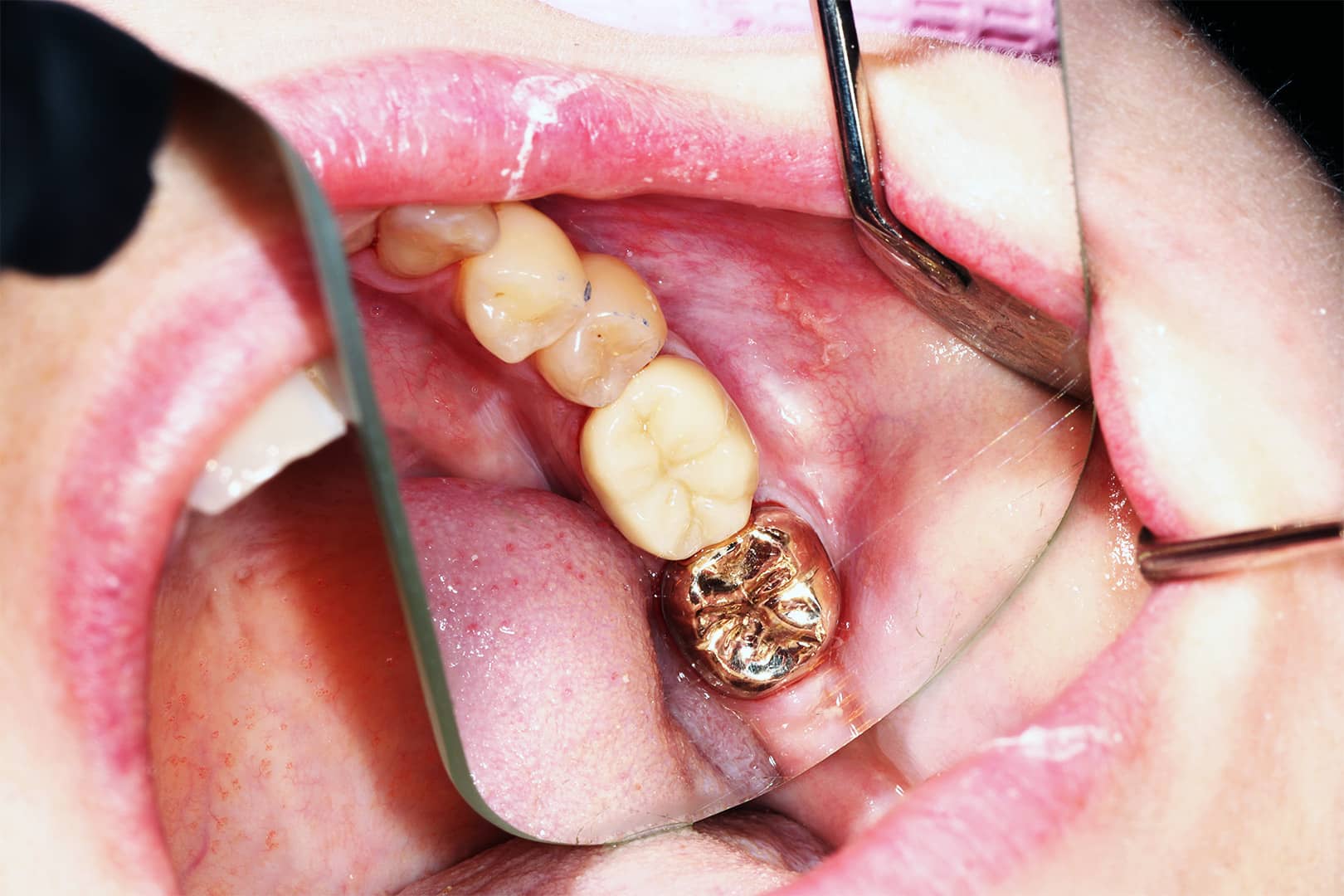
| Material | Appearance | Typical considerations | Price guidance |
|---|---|---|---|
| Porcelain / ceramic | Tooth-coloured and custom matched. | Visible teeth, same-day CEREC in suitable cases, broad restorative use. | $1,800 |
| Composite | Tooth-coloured resin-based material. | Selected cases where repairability, conservation and bite allow. | Confirmed after examination |
| Zirconia | Tooth-coloured; translucency varies by type. | Higher-strength requirements, back teeth and some implant restorations. | Confirmed in treatment plan |
| Porcelain fused to metal | Tooth-coloured porcelain over metal. | Established laboratory option with metal support. | $1,800 |
| Gold | Gold or metallic appearance. | Heavy bite forces, back teeth and patients who prefer gold. | Varies by weight and market rate |
Material choice is made after the dentist assesses the tooth and bite. A stronger material is not automatically better if it requires a design that does not suit the remaining tooth, opposing teeth or cosmetic area.
Porcelain, ceramic and porcelain-fused-to-metal crowns at Beyond Dental Care are priced at $1,800 per crown. The price includes the appointments required to prepare and fit the crown and a follow-up review.
Gold crowns may cost more because the fee changes with the amount of metal used and current market rates. Composite and zirconia options are quoted after assessment because the preparation, material and fabrication pathway vary.
The dentist will explain the proposed treatment and costs before the crown appointment. Private health fund benefits vary according to the fund, policy, annual limits and waiting periods.
Cost plannerChoose what is happening with the tooth, how many teeth need assessment and the crown pathway you want to explore. The planner separates the crown stage from treatment that may be needed before, alongside or instead of a crown.
A missing or non-restorable tooth may be replaced with a dental implant and crown or, depending on the surrounding teeth, a dental bridge.
A crown covers the visible tooth more extensively. A veneer or composite bonding may preserve more natural tooth structure when the concern is mainly colour, shape or proportion and the tooth does not need full coverage.
Indicative treatment estimate only. Final fees depend on whether the tooth can be restored, the number of teeth, crown material, root canal requirements, foundation work, gum health, bite forces, existing restorations and any additional diagnostic or preparatory treatment. A dentist must assess whether a crown, filling, onlay, veneer, bridge, implant or another treatment is appropriate.
Bulimba patients considering a CEREC ceramic crown, a zirconia crown, a porcelain-fused-to-metal (PFM) crown or a full gold crown can explore a TLC dental payment plan after receiving an itemised treatment quote. TLC is an external credit provider, so approval, the available amount, interest rate, fees, repayment term and total repaid depend on its assessment and current terms.
Payment plans are provided by Total Lifestyle Credit Pty Ltd under its own lending criteria and terms. Beyond Dental Care does not provide credit advice, approve applications or guarantee a particular rate, term or repayment amount.
| Included | Details |
|---|---|
| Crown preparation appointment | Preparation of the tooth and digital scanning or impressions. |
| Crown fabrication | CEREC in-clinic milling or laboratory fabrication, depending on the treatment plan. |
| Final fitting | Fit, contacts, colour, shape and bite assessment before cementation or bonding. |
| Temporary crown where required | Used for traditional laboratory cases when the final crown is not fitted the same day. |
| Follow-up review | Review of comfort, bite and surrounding tissues after treatment. |
Any treatment needed before the crown, including root canal therapy, extraction, gum treatment or extensive foundation work, is discussed and quoted separately.
Before preparing the tooth, the dentist confirms whether it is restorable and whether a crown provides an appropriate balance between protection and preservation of healthy structure.
The exact sequence depends on whether the crown is completed with CEREC on the same day or fabricated by a laboratory. The eight clinical steps are easier to understand as four treatment phases.
The dentist confirms the diagnosis, remaining tooth structure, material choice and whether additional treatment is needed first.
Decay, weak material and failing restorations are removed, and the tooth is shaped for the planned crown.
The prepared tooth, neighbouring teeth and bite are recorded for fit, contacts and chewing function.
A suitable ceramic crown may be milled in-clinic; other crowns are produced by a dental laboratory.
A temporary may protect the prepared tooth while a laboratory restoration is completed; it is usually unnecessary for same-day CEREC.
The dentist checks the margin, contacts, shade, shape and relationship with the opposing tooth before final placement.
The restoration is secured and excess bonding or cement material is removed.
The bite, comfort, gum response and cleaning around the completed crown are reviewed according to the treatment plan.
| Treatment pathway | Typical appointment structure |
|---|---|
| Same-day CEREC crown | One appointment of approximately 2–3 hours. |
| Traditional laboratory crown | Approximately 90 minutes for preparation, followed by a fitting appointment of around 60 minutes about two weeks later. |
| Additional treatment required | The timeframe may be longer when root canal treatment, gum treatment, extraction healing or another preparatory stage is needed. |
Times are planning estimates rather than guarantees. The condition of the tooth, material, laboratory process and required adjustments can change the appointment schedule.
A root canal treats infection or inflammation inside a tooth, but it does not replace lost tooth structure. Teeth that have had root canal treatment may already contain large fillings, cracks or extensive decay and can be more vulnerable to fracture.
Root canal treatment seals the canal system but does not rebuild tooth structure lost through decay, fracture or previous fillings. A composite core build-up may first replace missing internal structure and create a foundation for the final crown. The core, root canal filling and crown are separate parts of the completed restoration.
A crown may be recommended to protect the remaining tooth and restore the chewing surface. The dentist assesses how much structure remains, where the tooth sits in the mouth and how much force it receives before deciding whether full coverage is required.
The reasons a tooth may need endodontic care first are explained in Root Canal Treatment Bulimba.
A crown can hold together and protect parts of a tooth affected by a crack, broken cusp or extensive structural loss. The outcome depends on how far the crack extends. A crack limited to the visible tooth may be restorable, while a crack extending deeply into the root may make the tooth unsuitable for a crown.
A painful or newly broken tooth may need urgent assessment.
Urgent careCrowns for front teeth require detailed control of shade, translucency, length, surface texture and the way the restoration meets the gum. Porcelain, ceramic and selected zirconia materials may be considered according to the tooth and the surrounding smile.
Before a front crown is made, the dentist may discuss whitening if you would like the surrounding natural teeth to be lighter. Crown materials do not whiten later, so the final crown shade should be selected after the whitening result has stabilised.
For a front-tooth colour plan, consider whitening before shade selection and compare whether dental veneers provide a more conservative option.
Back teeth absorb stronger chewing forces and may also be affected by clenching or grinding. Material selection and crown design are therefore based on strength, available space, the opposing tooth and the way the bite moves.
Ceramic, zirconia, porcelain-fused-to-metal and gold crowns may all be considered for back teeth. The dentist will explain why a particular material is recommended rather than treating every molar in the same way.
A crown must do more than fit over the tooth. Its contact points, chewing surface and relationship with the opposing tooth affect comfort and longevity. A crown that is too high may feel painful when biting. A crown that does not manage existing grinding forces may be at greater risk of fracture or loosening.
How the crown meets the opposing tooth.
How the bite moves from side to side and forward.
Whether neighbouring contacts allow floss to pass correctly.
Signs of clenching, grinding or uneven tooth wear.
Whether a protective night guard should be considered.
Dental crowns, veneers, fillings and bonding do not change colour with whitening. If a visible crown is being planned and you also want lighter natural teeth, whitening is usually completed first. The crown shade can then be matched to the colour you intend to maintain.
Whitening after a crown has been fitted may lighten the surrounding natural teeth while leaving the crown unchanged, creating a visible mismatch.
When whitening is planned, complete teeth whitening before the final crown shade is selected.
Where a crown is recommended for the right reason and fitted to the tooth and bite, its role is broader than simply “covering” the tooth.
Protect weakened tooth structure from further fracture.
Restore a broken, worn or heavily filled tooth and improve the shape and colour of a severely damaged tooth.
Rebuild a functional chewing surface. Sensitivity may improve when it is caused by exposed or structurally compromised tooth tissue that is appropriately treated with a crown; a crown is not a general treatment for tooth sensitivity.
Provide the final restoration for some root-canal-treated teeth, restore a dental implant or support a bridge.
Provide a long-term restorative option with appropriate maintenance.
A crown is an irreversible treatment because tooth structure must be prepared to create space for the restoration. The dentist should explain the expected benefits, alternatives and material-specific considerations before treatment.
When more support is needed
If decay, an old filling or a fracture has left too little sound tooth to support a crown, the dentist may first rebuild the missing structure with bonded composite. This creates a stable core that can then be shaped to support the planned restoration.
Immediately after treatment
Avoid chewing until the local anaesthetic has completely worn off so you do not accidentally bite your lip, cheek or tongue.
Mild sensitivity to pressure or temperature, or tenderness around the gum, can occur for a short time after placement.
Let us know if the crown moves, chips, feels too high when you bite, or discomfort persists or becomes worse.
These consented cases include ceramic, porcelain and gold crown treatment. Some cases also involved core restorations, fillings or veneers, so the visible result should be read in the context of the complete treatment provided.
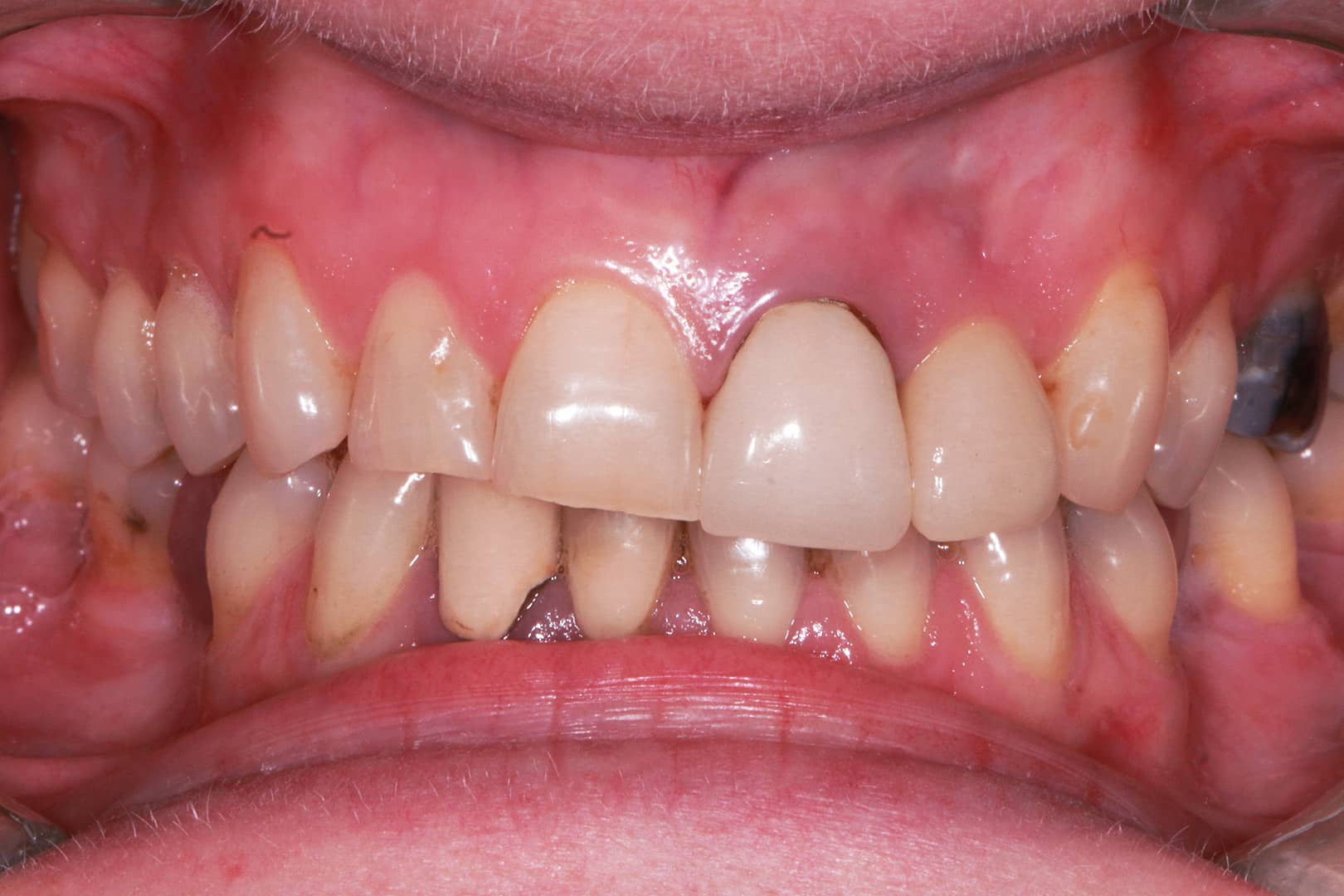
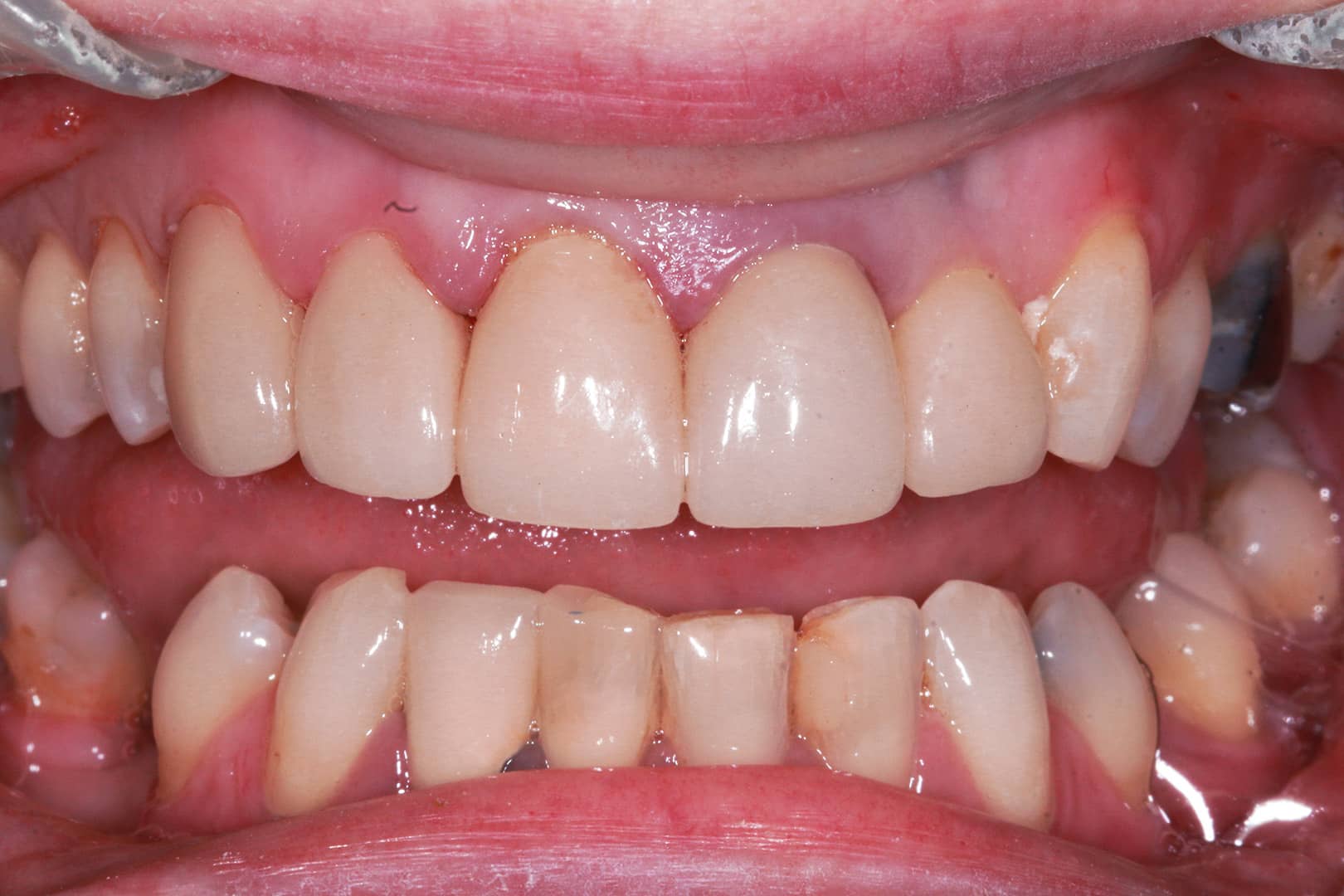
Treatment performed by Dr Mitesh Vasant, Dentist(AHPRA registration DEN0001791968).
After photograph taken approximately 3 weeks after treatment.
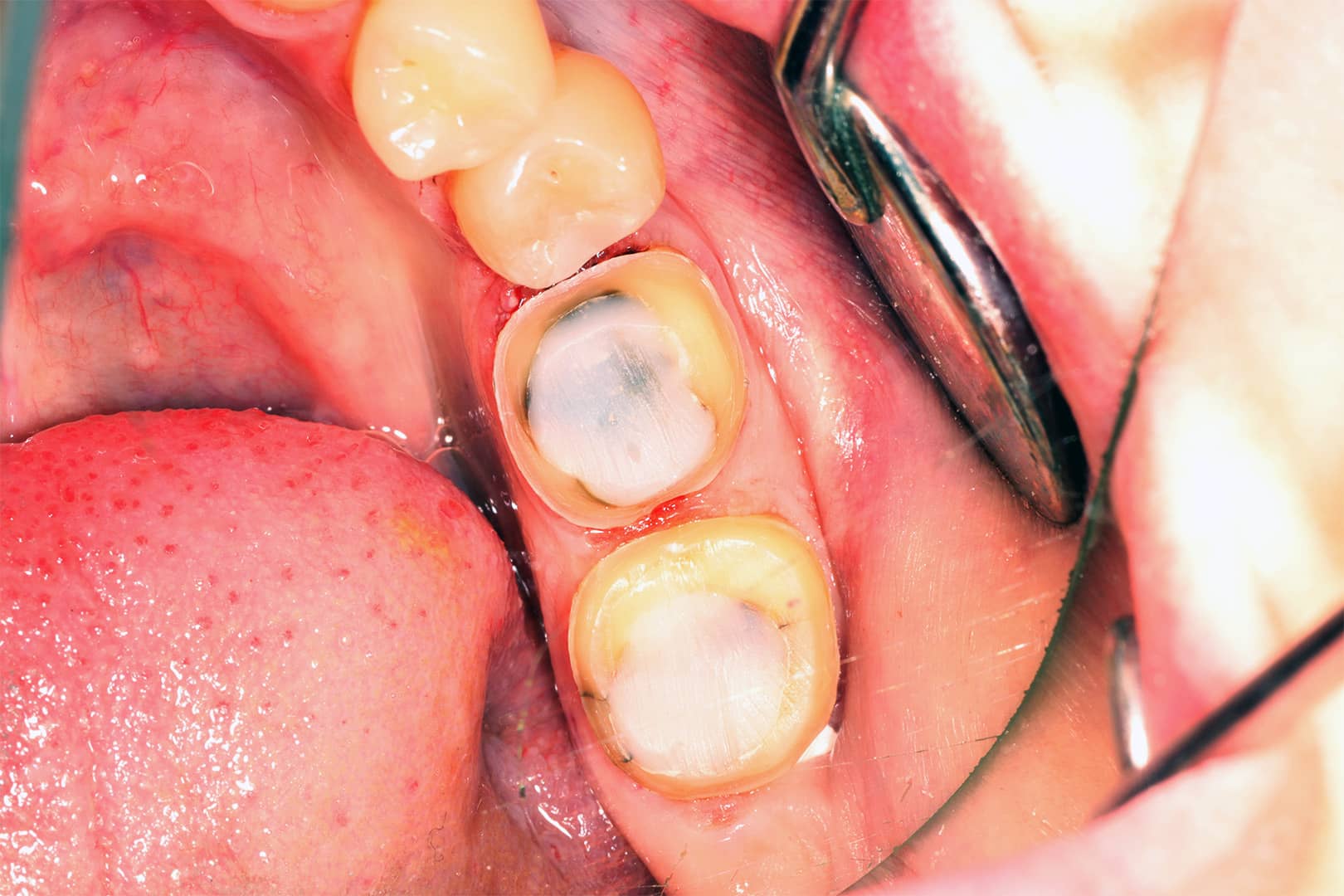
Treatment performed by Dr Jacky Shum, Dentist(AHPRA registration DEN0001659446).
After photograph taken approximately 2 weeks after treatment.
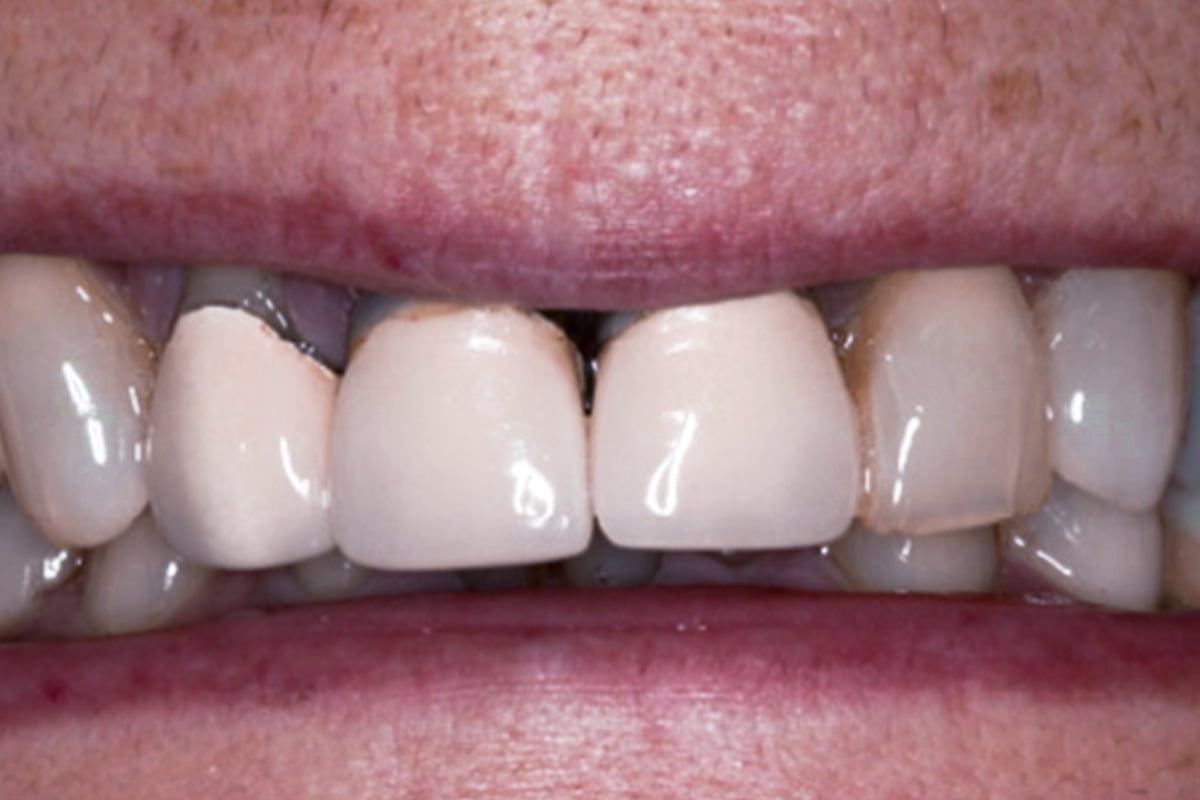
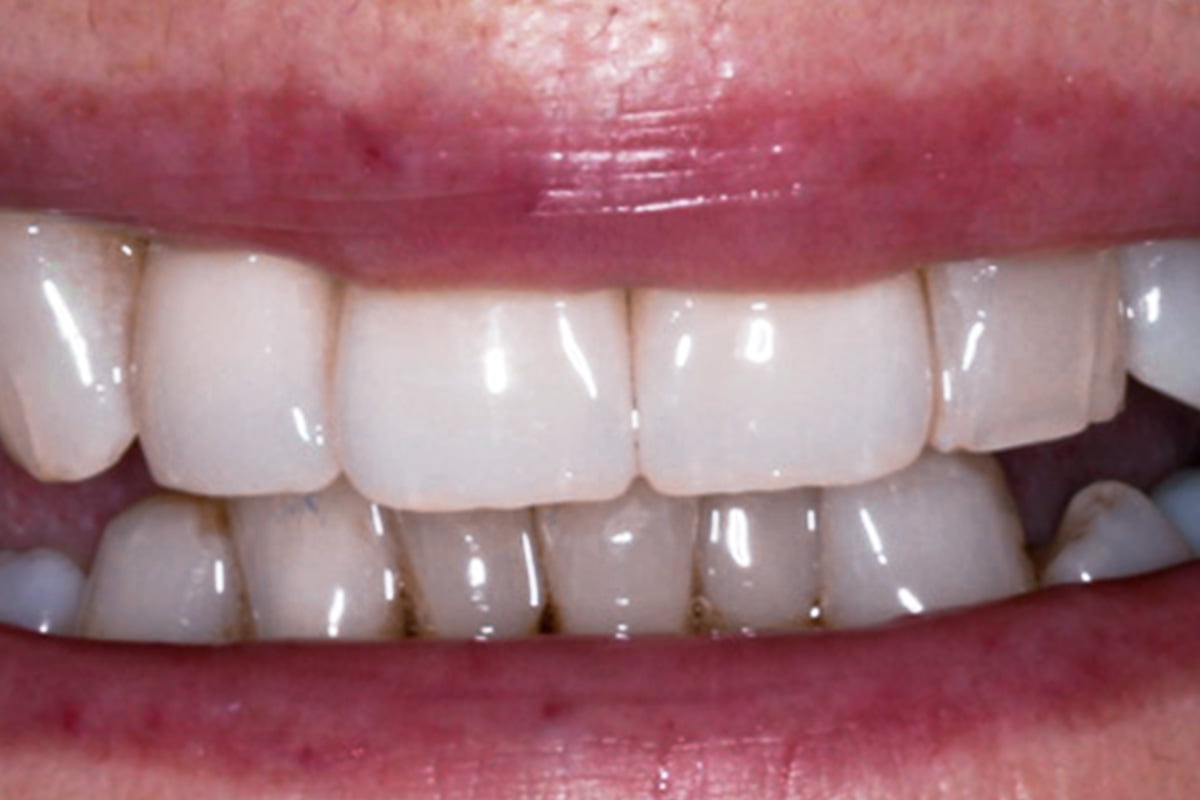
Treatment performed by Dr PA Zaw, Dentist(AHPRA registration DEN0001979187).
After photograph taken approximately 2 weeks after treatment.


Treatment performed by Dr Mitesh Vasant, Dentist(AHPRA registration DEN0001791968).
After photograph taken approximately 2 weeks after treatment.
Individual results vary. Images show the outcome for these patients only and do not guarantee the same result.
Our restorative dentists assess cracked, root-treated or heavily filled teeth before recommending CEREC or laboratory-made crowns.
Book an assessment for a cracked or broken tooth, a large failing filling, a root-canal-treated tooth, a loose or lost crown, severe tooth wear or a tooth that may need greater protection. The dentist will compare a filling, inlay, onlay, crown or other appropriate treatment and provide an itemised written quote.
A dental bridge is a fixed tooth replacement used to restore one missing tooth or several adjacent teeth. It may also be described clinically as a fixed partial denture. A traditional bridge is supported by crowned natural teeth, a Maryland or resin-bonded bridge uses bonded retainers, and an implant-supported bridge is anchored to dental implants.
Unlike a removable partial denture, a fixed bridge is not taken out by the patient for cleaning or sleeping. Daily cleaning is still required beneath the replacement tooth and around every supporting tooth or implant.
Payment plans and SuperCare where eligible
Beyond Dental Care plans the bridge around more than the visible gap. The dentist assesses the health of the supporting teeth, gum and bone condition, bite pressure, cleaning access, appearance, the number of missing teeth and whether an implant-based option would preserve more natural tooth structure.
Dental bridge payment plans may begin from $27 per week, subject to the treatment plan, third-party provider approval and applicable terms. The final cost depends on the number of bridge units, supporting teeth or implants, material, laboratory requirements and any preliminary treatment.
52-second educational explainer
See how a conventional bridge connects a custom replacement tooth to crowns on neighbouring support teeth, from preparation and digital records to temporary care, fitting and cementation.
| Treatment detail | Beyond Dental Care approach |
|---|---|
| Purpose | Replace one tooth or a short row of missing teeth, restore chewing and speech, and limit unwanted movement of surrounding teeth. |
| Support | Natural teeth, dental implants or a design selected after clinical assessment. |
| Typical treatment length | Commonly two appointments. Appointment time varies with bridge size and complexity and may be around two hours. |
| Materials | Porcelain, ceramic, zirconia, porcelain-fused-to-metal or other materials selected for tooth position, bite and appearance. |
| Indicative repayment guidance | From $27 per week |
| Pre-treatment needs | Decay management, gum care, root canal treatment, tooth extraction, healing, implant placement or replacement of failing restorations where required. |
| Maintenance | Daily brushing plus cleaning underneath the pontic with floss threaders, super floss, interdental brushes or another method demonstrated by the dentist. |
| Alternatives | Dental implant with crown, implant-supported bridge or another suitable tooth-replacement plan. |

A dental bridge is a fixed dental prosthesis containing one or more artificial replacement teeth. The replacement tooth is called a pontic. The natural teeth or dental implants supporting the bridge are called abutments.
A common three-unit bridge replaces one missing tooth with a pontic positioned between two supporting crown units. Other designs may use one supporting tooth, bonded wings or dental implants, depending on the location of the gap and the forces involved.
It can be either. The bridge itself is a restorative tooth-replacement treatment. Its support determines whether the plan is mainly crown-based or implant-based.
| Restoration | How it is supported | Main clinical link |
|---|---|---|
| Traditional dental bridge | Crowns are placed over natural teeth on both sides of the gap, with a pontic between them. | Closely linked to dental crowns. |
| Cantilever bridge | A pontic is supported from one side by a crowned natural tooth. | A crown-based option used only where bite forces and support make it suitable. |
| Maryland or resin-bonded bridge | A framework or wing is bonded to the back of one or more neighbouring teeth. | A conservative restorative option, commonly considered for selected front-tooth gaps. |
| Implant-supported bridge | Dental implants support the bridge without relying on natural teeth as crown abutments. | Closely linked to dental implants and implant prosthetics. |
A tooth-supported bridge relies on crowns, while an implant-supported bridge forms part of implant treatment.
A bridge may be considered when one tooth or several neighbouring teeth are missing and a fixed replacement is suitable. The dentist must determine whether the proposed natural-tooth or implant abutments can support the bridge and whether the restoration can be cleaned predictably.
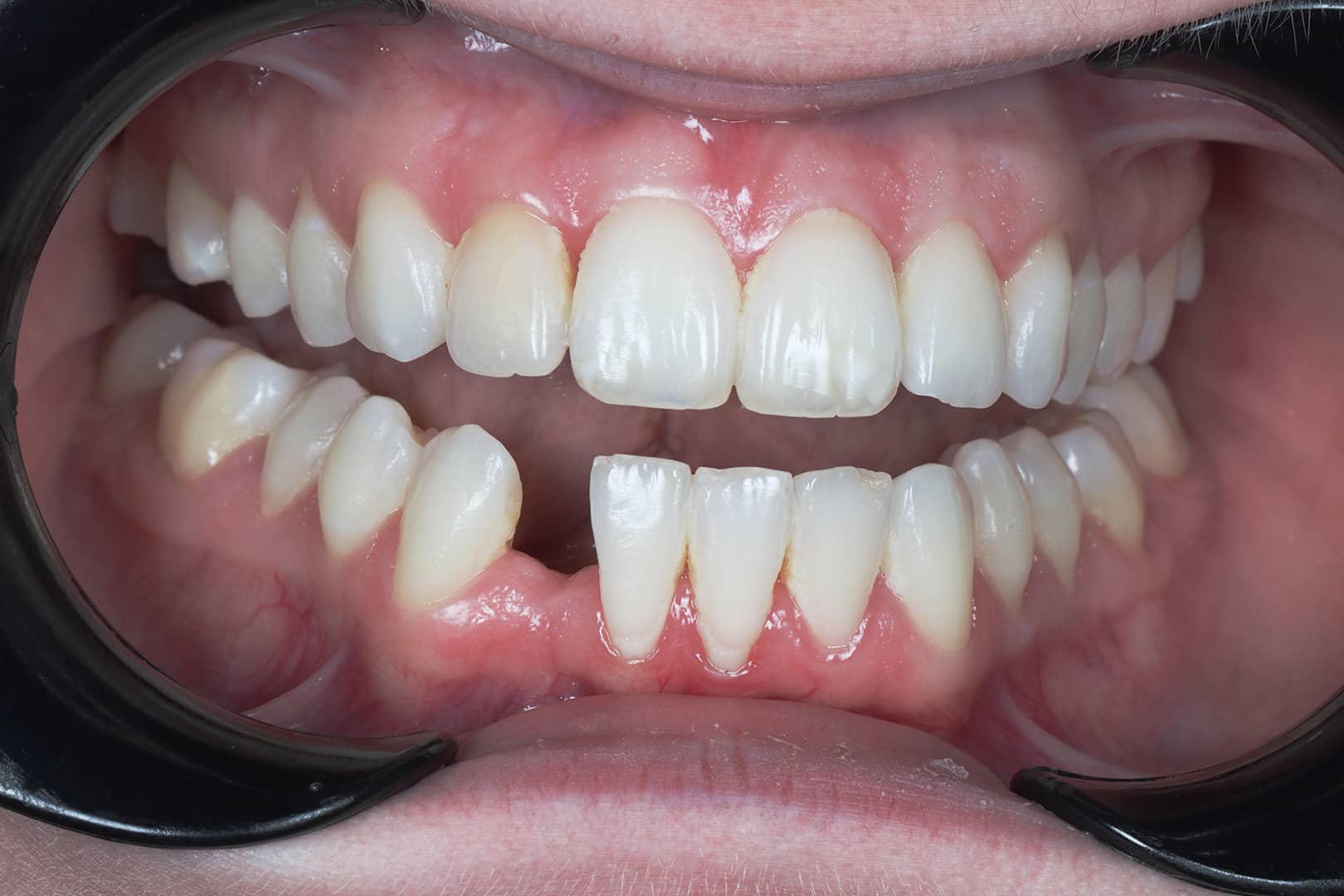
A bridge should not be chosen only because there is a visible gap. The dentist also assesses the prognosis of the supporting teeth, gum health, bone levels, root canal history, bite forces, grinding, appearance and the expected ability to maintain the bridge.
The effect of a missing tooth varies according to its position, the bite and the surrounding teeth. Some gaps remain stable, while others contribute to movement, food trapping or changes in chewing. Possible consequences include:
Not every space requires the same treatment or the same timing. Your dentist can explain whether replacement is recommended and compare a bridge with implant-based options.
Several bridge designs exist, but not every design is suitable for every tooth position. The final choice depends on the number and location of missing teeth, the condition of neighbouring teeth, bite pressure, appearance, cleaning access and whether implants are available.
| Bridge type | Typical design | Important considerations |
|---|---|---|
| Traditional bridge | Crowned abutment teeth on both sides support one or more pontics. | Strong and commonly used, but requires irreversible preparation of the supporting teeth. |
| Cantilever bridge | One crowned abutment supports a pontic from one side. | Places greater leverage on one supporting tooth and is selected cautiously. |
| Maryland bridge | A bonded wing or framework retains the pontic from the back of neighbouring teeth. | Preserves more enamel but can debond and is generally unsuitable for heavy back-tooth forces. |
| Implant-supported bridge | Two or more implants support multiple replacement teeth. | Avoids crowning healthy neighbouring teeth but requires implant surgery, healing and sufficient bone. |
A traditional three-unit bridge commonly uses two crown abutments to support one replacement tooth between them. Longer bridges may contain additional pontics or supporting units, but the number and position of abutments must be planned according to the span, remaining teeth and bite.
When both neighbouring teeth are healthy and unrestored, preparing them for crowns removes enamel permanently. A dental implant may avoid preparing those neighbouring teeth for crowns, but it involves surgery, additional healing time and different costs. The choice depends on the condition of the whole mouth, the missing-tooth site, preferences and treatment priorities.
A Maryland bridge, also called a resin-bonded or adhesive bridge, uses one or more retainers bonded to the back of neighbouring teeth. It may provide a conservative fixed replacement for a selected missing front tooth because less tooth preparation is usually required than for a conventional crown-supported bridge.
Its suitability depends heavily on bite contact, enamel available for bonding, tooth alignment and the size of the replacement tooth. A resin-bonded bridge may loosen or debond, especially where it carries heavy forces. The dentist will explain whether rebonding, redesign or another option is more predictable.
An implant-supported bridge replaces several adjacent teeth using dental implants as the foundations. The bridge may reduce the need to place one implant for every missing tooth, depending on the gap, bone, implant position and bite.
This option avoids preparing natural teeth as bridge abutments. However, it requires implant assessment, surgical placement, integration with the jawbone and a later restorative phase. Bone grafting or other preliminary care may be necessary in some cases.
The surgical and restorative stages are explained in Dental Implants Bulimba.
A predictable bridge starts with the supporting structures. The assessment may include:
Decay and active gum disease should be controlled before a definitive bridge is fitted. Supporting teeth with uncertain prognosis can compromise the entire restoration.
Before a bridge is fitted, active gum disease may require periodontal care, the supporting teeth need a full dental assessment, and an infected abutment may need root canal treatment.

Most tooth-supported bridges are completed over two appointments, although the sequence can vary with the bridge design, material and preliminary treatment.
A temporary bridge is not as strong as the final restoration. Avoid very hard or sticky foods, clean carefully around it and contact the clinic if it loosens, fractures or affects the bite.
An implant-supported bridge follows a different sequence because the implants are placed and allowed to integrate before the definitive bridge is fitted. The implant and restorative stages are coordinated within the overall implant plan.
Beyond Dental Care advises that bridge treatment is generally completed in two appointments. Appointment lengths vary according to the number of units and the work required, and may be around two hours. Laboratory turnaround, healing after extraction, gum treatment or implant integration can extend the overall timeline.
A temporary bridge may be used between appointments for a conventional tooth-supported bridge. Implant-supported bridges take longer because healing and osseointegration occur before the definitive restoration is fitted.
The bridge material is selected for tooth position, bridge length, available space, bite pressure, appearance and laboratory design. Common options include:
| Material or design | Potential advantages | Points to consider |
|---|---|---|
| Porcelain or all-ceramic | Tooth-coloured appearance and optical qualities suited to visible areas. | Material thickness, bridge span and bite must support the design. |
| Zirconia | High strength with tooth-coloured options for many front and back restorations. | Translucency and surface finishing vary by zirconia type and laboratory design. |
| Porcelain-fused-to-metal | Combines a metal framework with a porcelain outer surface. | Metal may influence opacity or become visible at a receding gum margin. |
| Metal or gold alloy | Can provide strength in limited space and may preserve more tooth structure in selected areas. | Colour is visibly metallic and cost can vary with alloy and market price. |
| Implant-supported framework | Designed to distribute load across implants and replace several teeth. | Requires implant planning, surgery, healing and maintenance around implant components. |
The best material is not determined by appearance alone. A natural-looking bridge that is too weak for the bite, or a strong bridge that cannot be cleaned, is not a successful design.
Front-tooth bridges require careful attention to colour, translucency, gum contours, tooth proportions and speech. Depending on the bite and adjacent teeth, the dentist may consider a traditional ceramic bridge, a resin-bonded Maryland bridge or an implant-supported crown or bridge.
Teeth whitening should be completed before the final bridge shade is selected when whitening is part of the smile plan. Bridge materials do not lighten with bleaching in the same way as natural enamel.
When whitening is part of a front-tooth plan, complete teeth whitening before the final bridge shade is selected.
Both options can replace a missing tooth, but they use different foundations. A bridge relies on neighbouring teeth unless it is implant-supported. A single dental implant replaces the missing root and supports its own crown.
| Consideration | Tooth-supported bridge | Dental implant with crown |
|---|---|---|
| Neighbouring teeth | Usually prepared for crowns and become part of one connected restoration. | Normally remain separate and do not need preparation for the implant crown. |
| Surgery | No implant surgery for a conventional bridge. | Requires implant surgery and adequate bone and healing. |
| Treatment time | Often completed over two restorative appointments after the area is ready. | Usually includes surgical healing before the final crown. |
| Cleaning | Requires daily cleaning under the pontic and around abutment margins. | Requires cleaning around the implant crown and gum interface. |
| Failure pattern | A problem with one abutment may affect the entire bridge. | The implant crown and adjacent natural teeth remain separate, although implant complications can occur. |
| Best fit | May suit patients whose adjacent teeth already require crowns or who prefer a non-implant option. | May suit patients who want an independent tooth replacement and meet surgical requirements. |
Neither option is universally better. The dentist should compare biological cost, surgery, timeframe, maintenance, expected function, appearance and total treatment cost for the individual case.
For the surgical pathway, healing stages and implant-specific costs, compare Dental Implants Bulimba.
A dental crown covers and restores one existing tooth or implant. A bridge includes at least one replacement tooth and uses one or more crowns, bonded retainers or implants for support. In a traditional three-unit bridge, two crowns support one pontic.
A patient may hear the words crown and bridge during the same treatment because the supporting components are crowns. The dentist should still explain which teeth are being prepared, which part replaces the missing tooth and how the connected restoration will be cleaned.
The supporting crown components and single-tooth restorations are explained in Dental Crowns Bulimba.
A standard toothbrush cannot clean the complete surface beneath a bridge pontic. Daily cleaning beneath the replacement tooth and around the abutment margins helps control plaque, gum inflammation, bad breath and decay affecting the supporting teeth.
The correct tool depends on bridge design and available space. Cleaning should be demonstrated after fitting rather than left as a generic instruction to floss. Regular Check-up & Clean appointments also allow professional review of the bridge, abutment teeth and gums.
A dental bridge is a long-term restoration but is not permanent. Its lifespan depends on the supporting teeth or implants, bridge span, bite, material, cleaning access, decay risk, gum health, smoking, grinding and professional maintenance.
An ageing bridge may sometimes be monitored, recemented or repaired. Replacement may be required when the bridge no longer fits, repeatedly loosens, fractures, develops unacceptable wear or when decay, gum disease or structural failure affects a supporting tooth.
Informed consent
Understanding the possible risks of a dental bridge helps you compare a conventional tooth-supported bridge with an implant-supported bridge. The relevance of each risk depends on the bridge design, supporting teeth or implants, bite forces, gum health and cleaning access.
Assessment may require removal of the bridge to examine the supporting teeth. A bridge that has loosened does not always need complete replacement, but it should not be repeatedly recemented without investigating why retention was lost.
A loose or lost bridge should be assessed promptly. Do not use household glue or force the restoration back into place. Follow the urgent booking guidance in Emergency Dentist Bulimba.
Dental bridge payment guidance starts from $27 per week. This is an indicative repayment example rather than a fixed treatment price. The total cost depends on:
The number of replacement teeth and total bridge units.
Whether the bridge is supported by natural teeth or dental implants.
The material, framework and laboratory design.
The condition of the proposed abutment teeth.
Need for fillings, root canal treatment, crowns, gum care or extraction before bridge treatment.
Imaging, implant surgery, bone grafting or temporary restorations where required.
Whether an existing bridge must be removed or replaced.
Your dentist will provide an itemised treatment plan after assessment. Ask whether the quote includes abutment preparation, the pontic and supporting units, temporary bridge, laboratory fabrication, fitting, review, removal of an existing bridge and any treatment required for the supporting teeth.
Private health fund rebates vary by policy, annual limits, waiting periods and the item numbers used for the specific bridge. Beyond Dental Care accepts private health funds and can provide the treatment information needed for you to check your expected benefit.
Payment plans may help spread the cost of a dental bridge. These arrangements are provided by third parties and are subject to their eligibility criteria, fees and terms. A payment plan should not replace discussion of the clinical alternatives or total treatment cost.
For a multi-unit or implant-supported bridge, compare the available dental payment plans with the full treatment sequence and total cost.
This consented case shows the visible result after fixed dental bridge treatment. Bridge design, supporting teeth or implants, material, bite and cleaning access are assessed individually before treatment.
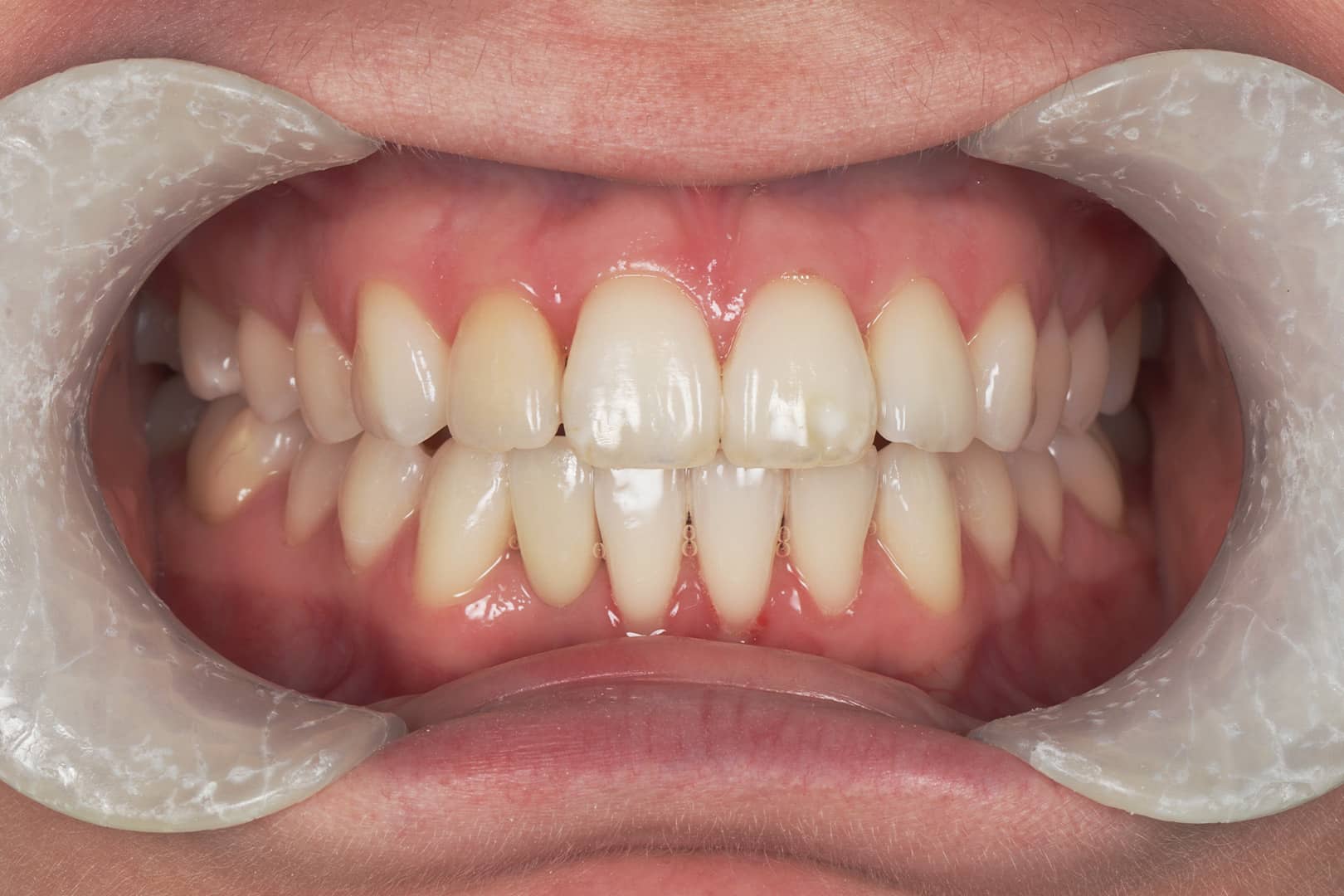
Treatment performed by Dr Jacky Shum, Dentist(AHPRA registration DEN0001659446).
After photograph taken approximately 2 weeks after treatment.
Individual results vary. Images show the outcome for these patients only and do not guarantee the same result.
Our restorative dentists assess the neighbouring teeth, bite and cleaning access before recommending a bridge or an implant alternative.
A dental bridge can be related to either crowns or implants because the bridge describes the fixed replacement teeth, while the supporting structure depends on the design. A traditional bridge uses crowned natural teeth, while an implant-supported bridge is anchored to dental implants.
The dentist assesses the gap, neighbouring teeth, gums, bone, bite and cleaning access before deciding which type of support is appropriate.
A dental bridge can replace a single missing tooth. One common design is a three-unit traditional bridge, where a replacement tooth sits between two crowns placed over suitable teeth on either side of the gap.
If both neighbouring teeth are healthy and unrestored, the dentist should specifically discuss the irreversible preparation required for a traditional bridge and compare it with alternatives.
A dental bridge can replace one tooth or several adjacent missing teeth, but there is no single safe maximum that applies to every mouth. As the span becomes longer, the supporting teeth or implants, bite forces and design become increasingly important.
The dentist plans the number of replacement teeth together with the foundations rather than deciding suitability from the size of the visible gap alone.
Dental bridge payment guidance starts from $27 per week, but this is an indicative repayment example rather than a fixed treatment price. For Bulimba patients, the total fee is confirmed after the bridge design and any preparatory treatment have been assessed.
The dentist provides an itemised written treatment plan so the bridge itself, preliminary treatment and any later maintenance can be distinguished before treatment begins.
A conventional tooth-supported bridge is generally completed over two appointments once the mouth is ready for treatment. Appointment length depends on the number of units and the work required and may be around two hours.
The dentist confirms the expected sequence after assessment rather than promising the same completion date for every bridge.
Bridge preparation is performed with local anaesthetic where natural teeth need to be shaped, so the area is numbed during treatment. Pressure, vibration and movement may still be noticeable, but sharp pain should be reported so the dentist can pause and adjust the treatment.
A prepared supporting tooth can sometimes develop deeper pulpal inflammation or infection and require further treatment. Persistent, worsening or sharp pain should therefore be assessed rather than assumed to be a normal part of adjustment.
Many dental bridges function for approximately 5 to 15 years, and some last longer, but a bridge is not considered permanent for life. Longevity depends as much on the supporting teeth, gums and daily maintenance as it does on the bridge material itself.
An ageing bridge does not always need replacement. Depending on the problem, the dentist may recommend monitoring, repair, recementation or replacement after examining the bridge and its foundations.
Food can pass beneath a dental bridge because a cleanable space is required underneath the replacement tooth. That space should allow plaque and food debris to be removed rather than forming an inaccessible pocket beneath the bridge.
The dentist should demonstrate how to clean the particular bridge after fitting. Persistent food trapping may relate to the bridge shape, gum changes or another problem that needs assessment.
The artificial replacement tooth in a bridge cannot develop tooth decay, but natural teeth supporting a conventional bridge can. Decay can form around crown margins or beneath a bridge retainer if plaque is allowed to remain around the supporting teeth.
Daily brushing and cleaning underneath the pontic are therefore essential even though the bridge itself is artificial. Regular examinations also allow the dentist to assess margins, gums and supporting teeth that cannot be fully evaluated by appearance alone.
A bridge is not necessarily cheaper than an implant once the complete treatment plan is compared. Conventional bridge payment guidance starts from $27 per week, while a single implant with a custom crown starts from $5,000 and an implant-supported bridge starts from $8,000.
The comparison should also consider permanent alteration of neighbouring teeth, surgery, treatment time, maintenance and what happens if one component later fails. A headline fee alone does not establish which option is better value.
The main limitation of a conventional dental bridge is that suitable neighbouring teeth usually have to be permanently prepared for crowns, and the replacement becomes one connected restoration. Problems affecting one supporting tooth can therefore compromise more than one bridge unit.
These disadvantages do not mean bridges are inappropriate. They need to be weighed against the advantages and alternatives for the specific gap and supporting teeth.
A dental bridge may not be predictable when the proposed support is weak, active disease is uncontrolled, the span places excessive demands on the foundations or the finished restoration cannot be cleaned properly. Suitability is therefore established before any teeth are prepared.
The dentist may recommend treating decay or gum disease first, changing the bridge design, considering an implant-supported option or using another tooth-replacement pathway.
A dental bridge can be planned after an extraction, but the timing depends on healing, gum shape, the condition of the neighbouring teeth and the type of bridge being considered. The final restoration should be designed for the tissues that will support and surround it.
There is no single waiting period that suits every extraction site. The dentist confirms when the area is ready after examining the healing tissues and the proposed bridge design.
If teeth whitening is part of the overall smile plan, it should generally be completed before the final shade of a front dental bridge is selected. Bridge materials do not lighten with bleaching in the same way as natural tooth enamel.
Whitening is not routinely required before a bridge. It only changes the sequence when the patient already intends to lighten the natural teeth as part of the same treatment plan.
Dental bridge assessment and restorative treatment are provided by the general dentists at Beyond Dental Care, with implant planning, coordination or referral arranged where the selected treatment requires it. Bridge suitability is assessed individually rather than assumed from the presence of a missing tooth.
A patient may ultimately be advised that a traditional bridge, Maryland bridge, implant-supported bridge, implant crown or another replacement option is more appropriate. Implant or specialist involvement is coordinated when required by the clinical plan.
An implant-supported bridge for multiple adjacent missing teeth starts from $8,000 in the implant treatment pathway. The published planning example is for three or four missing teeth in a row, with the final number and position of implants determined clinically.
The implant pathway lists approximately four to six months as a planning estimate for an implant bridge, but healing and preliminary treatment can change both timing and cost. A personalised written estimate is provided after assessment.
Private health extras may contribute towards eligible dental bridge items, but the amount depends on the individual policy rather than the bridge treatment alone. Annual limits, waiting periods, item numbers and remaining benefits all affect the eventual rebate.
Beyond Dental Care cannot determine the benefit set by a private health fund. Checking the proposed items before treatment is the most reliable way to understand the likely out-of-pocket amount.
Payment options may be available for dental bridge treatment, and SuperCare may be explored where the relevant eligibility requirements apply. The advertised $27 per week figure is repayment guidance, not a guaranteed repayment or a fixed price for every bridge.
Payment arrangements should be compared only after the bridge type, supporting teeth or implants and total treatment cost have been confirmed.
Neither option is universally better. A dental bridge is fixed in place, while a partial denture is removable, so the appropriate choice depends on the pattern of missing teeth, remaining tooth support, cleaning requirements and the type of replacement the patient prefers.
The decision should be made after examining the remaining teeth and gums rather than assuming that a fixed restoration is automatically preferable to a removable one.
A permanent dental bridge is designed to restore chewing as part of replacing missing teeth, although comfort and function depend on the bridge position, bite and supporting structures. A newly fitted bridge should not feel excessively high or interfere with normal jaw closure.
A temporary bridge requires greater care because it is not as strong as the definitive restoration. Very hard or sticky foods should be avoided while the temporary bridge is in place.
A fixed bridge is intended to restore a missing area without being removed by the patient, so it generally functions more like fixed dental work than a removable appliance. It will not be anatomically identical to having the original natural tooth and root.
A bridge that feels high, loose, painful or increasingly difficult to clean should be reviewed. The aim is predictable function and maintainability rather than trying to make the patient ignore an obvious problem.
A missing tooth does not always cause the same problem or require immediate replacement, but some gaps can lead to changes in the surrounding teeth and bite. The importance of replacement depends on where the tooth was, the remaining contacts and the way the mouth functions.
The dentist can explain whether monitoring the gap is reasonable or whether a bridge, implant-based restoration or another replacement option is advisable.
A conventional dental bridge permanently changes the natural teeth used as crown supports because enamel must be removed to create space for the bridge retainers. That preparation is intentional, but it means those teeth take on additional restorative and functional responsibilities.
An implant-supported replacement can avoid preparing healthy neighbouring teeth, but it introduces a different set of requirements including surgery, bone assessment, healing and implant maintenance.
A bridge that comes loose may sometimes be recemented, but it should first be examined to determine why it lost retention. Reattaching a bridge without checking the supporting teeth, cement, fit and bite can leave an underlying problem untreated.
A loose bridge does not always require replacement. Depending on the findings, the dentist may discuss recementation, repair, redesign or a new restoration. Call (07) 3268 2116 if the bridge has dislodged or the supporting teeth are painful.
A bridge should be assessed when its fit, bite, appearance or supporting tissues change. Some problems can be repaired or monitored, while others require removal of the bridge so the dentist can examine the teeth underneath.
Replacement is more likely when the bridge no longer fits, repeatedly loosens, fractures significantly or when decay, periodontal disease or structural failure affects a supporting tooth.
There is no single bridge material that is best for every tooth. The dentist selects the material according to the location of the bridge, span, available space, bite forces, appearance and the design that can be maintained properly.
A strong material does not make an unsuitable bridge design durable. Material, support and bite need to be planned together.
Food restrictions depend on whether the bridge is temporary or definitive and on the individual bite. A temporary bridge needs particular care because it is not as strong or securely retained as the final restoration.
The main goal is not a permanent list of forbidden foods. It is protecting the bridge from excessive forces while maintaining the supporting teeth, gums and cleaning access.
The area beneath a dental bridge should be cleaned every day because an ordinary toothbrush cannot reach the complete surface underneath the pontic. Daily cleaning also protects the crown margins and gum tissue around the supporting teeth.
The correct tool depends on the bridge design and available space. The dentist should demonstrate the technique after fitting rather than simply advising generic flossing, and professional maintenance is scheduled according to individual risk.
A conventional tooth-supported bridge does not require a bone graft simply because a tooth is missing. Bone grafting becomes relevant when dental implants are being considered as the support and the proposed implant site does not have sufficient suitable bone.
Not every implant-supported bridge requires grafting. Imaging and clinical assessment determine whether the existing bone can support the planned implants or whether another approach is more suitable.
A supporting natural tooth can develop pain even though it is covered by part of a bridge. The bridge itself has no dental nerve, but the natural abutment teeth remain living structures unless they have previously had root canal treatment.
The dentist may need dental X-rays or removal of the bridge to examine the supporting tooth properly. Difficulty breathing or swallowing, rapidly increasing swelling or uncontrolled bleeding requires urgent hospital care.
Book an assessment for one missing tooth, several adjacent missing teeth, a loose or damaged existing bridge, or a gap affecting appearance, speech or chewing. The dentist will assess the neighbouring teeth, gums, bone, bite and cleaning access before comparing a traditional bridge, Maryland bridge, implant-supported bridge, implant crown or another tooth-replacement option.
Payment and funding pathways
Beyond Dental Care provides an itemised written treatment quote before you choose how to pay. Depending on the treatment, purchase amount, your circumstances and provider eligibility, options may include TLC, Afterpay, PayPal Pay in 4, assistance through SuperCare to apply for compassionate release of superannuation, private health fund claiming, or paying the clinic directly. Provider limits, approval and terms apply where relevant. These payment pathways are separate from the dentist’s clinical recommendation and do not change which treatment is appropriate.
External dental finance
TLC is an external credit provider. After your dentist confirms the treatment plan and fee, you may apply to spread eligible dental costs over an approved repayment term. Approval, available credit, interest, fees, repayment amount and the total repaid are determined by TLC under its current lending criteria—not by Beyond Dental Care.
Eligibility-based application support
SuperCare is not a loan or repayment plan. It is an external service that may assist with an application to the Australian Taxation Office for compassionate release of superannuation. The ATO applies strict legal criteria and evidence requirements to medical-treatment applications, including dental treatment. Treatment undertaken solely for cosmetic reasons would not normally qualify, and approval is not guaranteed.
Quotes, claiming and direct payment
Where your policy includes dental benefits, eligible services can generally be claimed through HICAPS at the clinic. Your rebate depends on your insurer, level of cover, waiting periods, annual limits and item numbers. The team can provide treatment item numbers and a written quote so you can ask your health fund for an estimate before proceeding.
Payment planning may be discussed whenever treatment involves a larger total fee or several appointments. Explore the relevant clinical and pricing information before comparing funding options:
Private health-fund rebates vary by fund, policy, waiting periods, annual limits and the dental item numbers claimed. TLC is an external credit provider. SuperCare assists with applications; approval for compassionate release of super is not guaranteed. Beyond Dental Care does not provide financial advice.
2026 eligibility and claiming information
Bulimba patients visiting Beyond Dental Care can use private health fund claiming through HICAPS, check Child Dental Benefits Schedule eligibility and ask about DVA dental arrangements for eligible veterans. These programs have different eligibility, claiming and approval rules. Reception can help with clinic item numbers and appointment preparation, while the relevant insurer or government agency remains responsible for confirming benefits and coverage.
Private insurance
What to know in 2026
Beyond Dental Care accepts private health funds and can process supported claims through HICAPS, so you can see the available rebate and pay the remaining gap at the clinic. Your benefit depends on your insurer, policy, waiting periods, annual limits and the item numbers used.
For planned care, ask for an itemised quote before treatment and contact your fund for an estimate. Benefit periods do not all reset on the same date, so your insurer remains the source for your current balance and policy rules.
Our dental insurance reset guide explains common Australian reset cycles. For broader funding information, see our dental payment plans guide.
Medicare dental benefit
What to know in 2026
The Child Dental Benefits Schedule may cover up to $1,158 over two consecutive calendar years for eligible children when a new benefit period begins in 2026. Covered basic services can include examinations, X-rays, cleaning, fissure sealing, fillings, root canal treatment and extractions, subject to the scheme rules and remaining balance.
Orthodontic treatment, cosmetic dentistry and hospital dental services are not covered. Reception can check the information available at booking, but Services Australia determines eligibility and the current benefit balance.
Check the current Child Dental Benefits Schedule eligibility, covered services and benefit information with Services Australia.
Veteran dental arrangements
What to know in 2026
DVA may fund clinically required dental care for eligible Veteran Card – All Conditions (Gold Card) holders. Veteran Card – Specific Conditions (White Card) coverage is generally limited to treatment connected with an accepted service-related condition. Some services, quantities or higher-cost restorative items can require prior approval or be subject to current DVA limits.
Contact reception before booking so the team can confirm whether the clinic can accept your Veteran Card for the proposed appointment and identify any documents or approvals required. DVA makes the final decision about eligibility and funded treatment.
Meet our dental team
Our dentists provide family, restorative, cosmetic and surgical dental care for patients travelling from Bulimba. Explore each clinician's qualifications and clinical interests, or ask reception which dentist is best suited to your treatment needs.
 Accepting new patients
 General, family, restorative and cosmetic dentistry, including fillings, crowns, bridges, root canal treatment, teeth whitening and composite bonding.
English and Kurdish
View Dr Sivan Amin's profile Accepting new patients
 Implant, surgical and restorative dentistry, including dental implants, wisdom teeth and surgical extractions, CEREC same-day crowns, bridges, porcelain and composite veneers, and root canal treatment.
English, Urdu, Hindi and Pashto
View Dr Muhammad Qasim's profile Accepting new patients
 Family, preventive, restorative and clear aligner care, including CEREC same-day crowns, veneers and digital smile planning.
English and Kurdish
View Dr Sitav Amin's profile Accepting new patients
 General dentistry with a clinical focus on endodontics, root canal therapy, dental implants, surgical extractions, wisdom teeth, crowns and bridges.
English and Burmese
View Dr PA Zaw's profileAll clinicians work to our Dental Ethics Policy and patient care standards and our Diversity and Inclusion Policy.
Dental comfort and anxiety support
Dental anxiety or dental fear can be connected to a previous difficult experience, fear of needles or pain, dental sounds, bright lights, a sensitive gag reflex, being reclined, or uncertainty about what will happen during treatment. The clinic is on the ground floor with step-free wheelchair access and no lift required. Patients travelling from Bulimba can tell us what makes dental visits difficult and choose practical comfort options, communication preferences and pause signals before the appointment begins.
The complimentary planner takes about one minute. It does not lock you into any choices or replace a conversation with the dental team. Show the resulting plan when you arrive, add it to your booking notes or change anything on the day.
50-second educational explainer
See how practical comfort options and communication preferences can be selected before treatment, including lip balm, moisturising gloves and a ceiling-mounted television.
Different patients need different support
Dental anxiety does not feel the same for everyone. You may be worried about discomfort, injections or numbness; sensitive to sounds, lights, smells or touch; affected by a strong gag reflex; uncomfortable lying back or keeping your mouth open; or concerned that you will not be able to pause once treatment begins. Tell the team what applies to you — including anything that happened during previous dental care.
Tell the team if injections, numbness, discomfort or previous difficulty becoming numb are a concern.
Dental sounds, suction, bright lights, smells, touch or temperature can make an appointment harder.
A strong gag reflex can affect examinations, dental X-rays, impressions and treatment positioning.
You can share as much or as little as feels useful about earlier care that made future visits difficult.
Neck, back or jaw discomfort and difficulty keeping the mouth open can be discussed before treatment.
Some patients need clear explanations, regular check-ins or reassurance that treatment can pause.
Seven questions · approximately one minute
Choose the concerns, communication preferences and practical options that may help. Every question is optional, and the plan can be changed when you arrive.
Pick any that apply.
Optional. Choose any that would help, or decide when you arrive.
Optional request
Here is your shortlist. The message below is ready to show to the front office team, dental assistant or dentist before treatment.
You did not select any specific options, which is completely fine. You can still discuss what would make the appointment easier when you arrive.
A calmer appointment starts with communication and control
Practical comfort starts with communication and a sense of control. Depending on the treatment and what is clinically possible, your appointment may include an explanation before each step, fewer procedural details, an agreed hand signal, short pauses, sensory or distraction options, physical support, topical anaesthetic before injections or additional time to confirm that the area is numb.
Tell us before the appointment if you have a strong gag reflex, find it difficult to lie back or keep your mouth open, have previously struggled to become numb, or have had an experience that made dental treatment difficult.
Choose detailed explanations before each step or ask the team to keep procedural information brief.
Agree on a stop signal, request regular check-ins and take short breaks when clinically appropriate.
Discuss sound, light, touch, temperature and distraction preferences before treatment begins.
Request blankets, a pillow or a more upright position where the planned procedure allows it.
The planner recommends practical supports based on common dental-anxiety triggers. The gallery includes additional comfort items that may also be requested before treatment or selected when you arrive. Availability and suitability can vary according to the appointment and treatment planned.

A warm drink to help you settle before treatment or during a suitable appointment break.

Gentle, even weight to help you feel more grounded, snug and secure.

A soft layer for warmth and comfort while you are sitting in the dental chair.

Watch relaxing videos, Netflix or a favourite show while treatment is underway.

Extra support to reduce pressure on your neck or lower back during longer visits.

Apply before treatment to help prevent dryness and maintain lasting moisture.

A simple way to keep your hands busy and give your mind a calmer point of focus.

A soft hand-care extra that can make your visit feel a little more comforting.

An optional under-eye comfort item. Tell the team about known skin sensitivities or allergies before use.
Share comfort preferences before treatment
Book online or call reception and tell the team if you feel nervous about dental treatment, worry about injections, have a sensitive gag reflex, need physical support or would like particular communication and comfort options. Sharing this before the appointment gives the team more opportunity to plan appropriately. Every second Tuesday, dental appointments are available until 7:30 pm. Call reception to confirm the late-opening Tuesday before booking.
Clear information makes it easier to compare options and decide what is right for you.
There is no judgement here if it has been years. A pause signal you agree in advance, a comfort menu at no cost, and you will know what is planned and what it costs before anything begins.
Explore more